






Hi all. I’m in Germany this week along with the members of our University Vice-Presidents Network having a blast networking with German institutions and hearing from some of the sharpest commentators on the German higher education scene, including Frank Ziegele, author of one of my favourite books of 2025, Authentic Universities (podcast interview here) and Jan-Martin Wiarda, my sort-of German equivalent in the sense of being a prominent education blogger, (albeit much more journalistically-inclined than I am). It’s been a big success so far – we hope more of you can join us for next year’s trip abroad.
Anyways, for understandable reasons a lot of the trip revolves around increasing possibilities for research co-operation, and so I have been playing with ways of understanding how to explain the differences in the ways that Canada and Germany fund advanced research. This is kind of important because the differences in funding are very significant and to some degree explain the differences one observes at an institutional structure and behaviour, too. What follows is my best stab at trying to explain these differences.
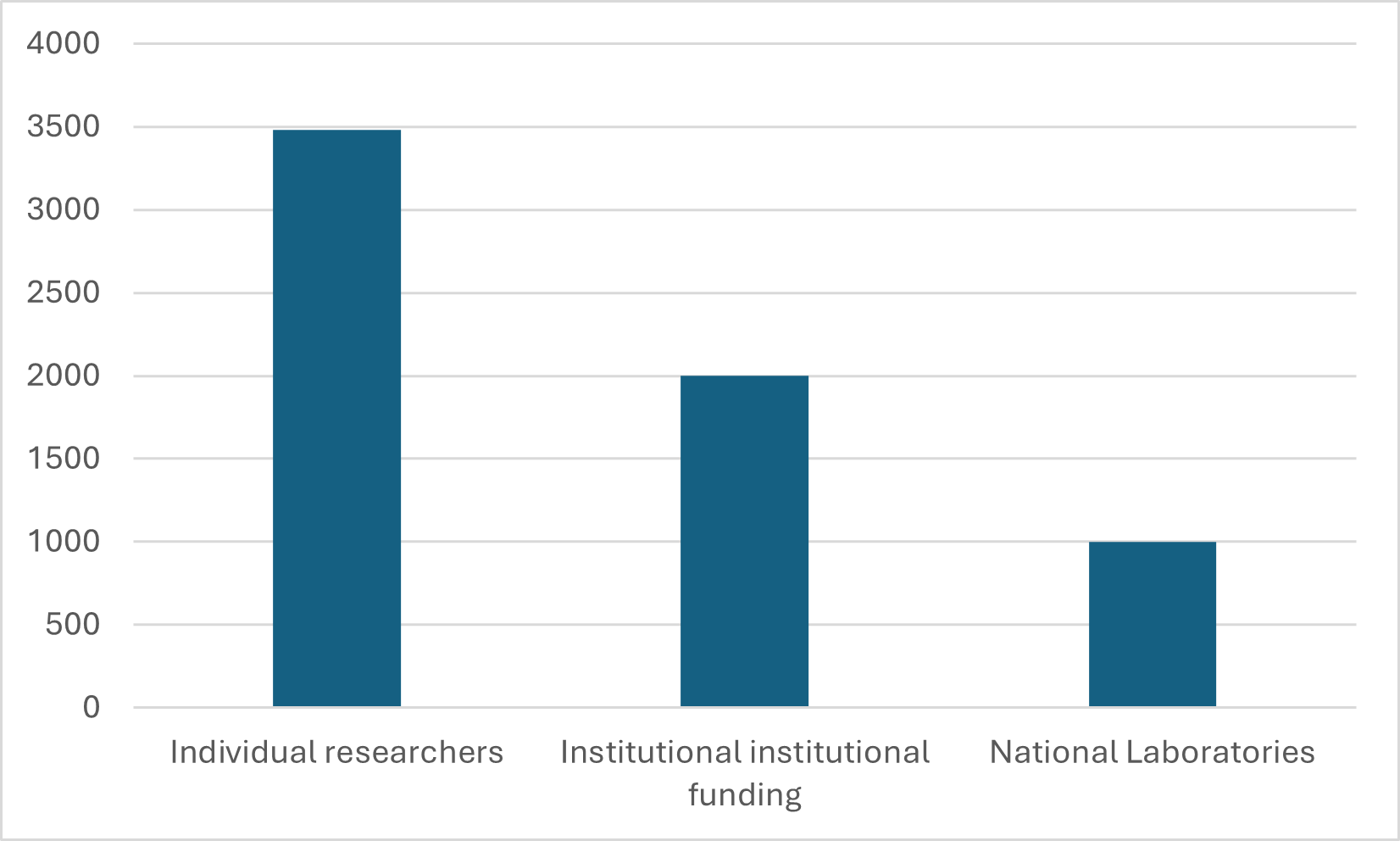
Let’s start with Canada, where more than half of all research funding goes to individual researchers at post-secondary institutions, usually on the basis of calls for proposals. The biggest source of such funds in Canada is obviously the Tri-Councils, at about $2.7 billion per year, but it also includes a variety of other sources including provincial research programs (mainly the Fonds de recherche du Quebec) at about $300M/year, the New Frontiers in Research Fund at $150M/year, the various Strategic Science Fund organizations (Genome Canada, CIFAR, etc.) collectively about the same amount and MITACS a shade less. Altogether that makes for something in the region of $3.5 billion.
On top of that, we spend about another $2 billion funding research at the institutional level. The Canada Foundation for Innovation and the Research Support Fund each account for about a quarter of that (call it roughly $450 million apiece). Various provincial research schemes (mainly Ontario and Alberta, which for the most part tend not to fund individual researcher) add another $400 million/year. The Canada Research Chairs are a bit north of $300 million/year and the Canada First Research Excellence Fund at about $200M/year. Finally, various Major Science Initiatives (Canadian Lightsource, SNOLAB, etc.) located at Canadian institutions receive another $150M or so.
And then there is the National Research Council. I know we tend to think of it a bit separately precisely because it doesn’t act as a granting agency (although it does fund the TRIUMF advanced physics lab at UBC), but when making international comparisons it’s important to keep them in the frame as well. Excluding the Industrial Research Assistance Program, that’s about another $1 billion per year.
So, in total the Canadian research number is around $6.5 billion divided thus:
Figure 1: Annual Public Spending on Canadian Research Funding by Type, in Thousands of Canadian Dollars
(Note that about $2 billion in various types of contract funding that goes from federal government ministries to institutions is excluded because a) it’s not entirely clear from aggregate data how much of that is actually for research, and b) if so, whether it is effectively funding to individual researchers or to institutions. A similar exclusion will be made for Germany to keep comparisons level.)
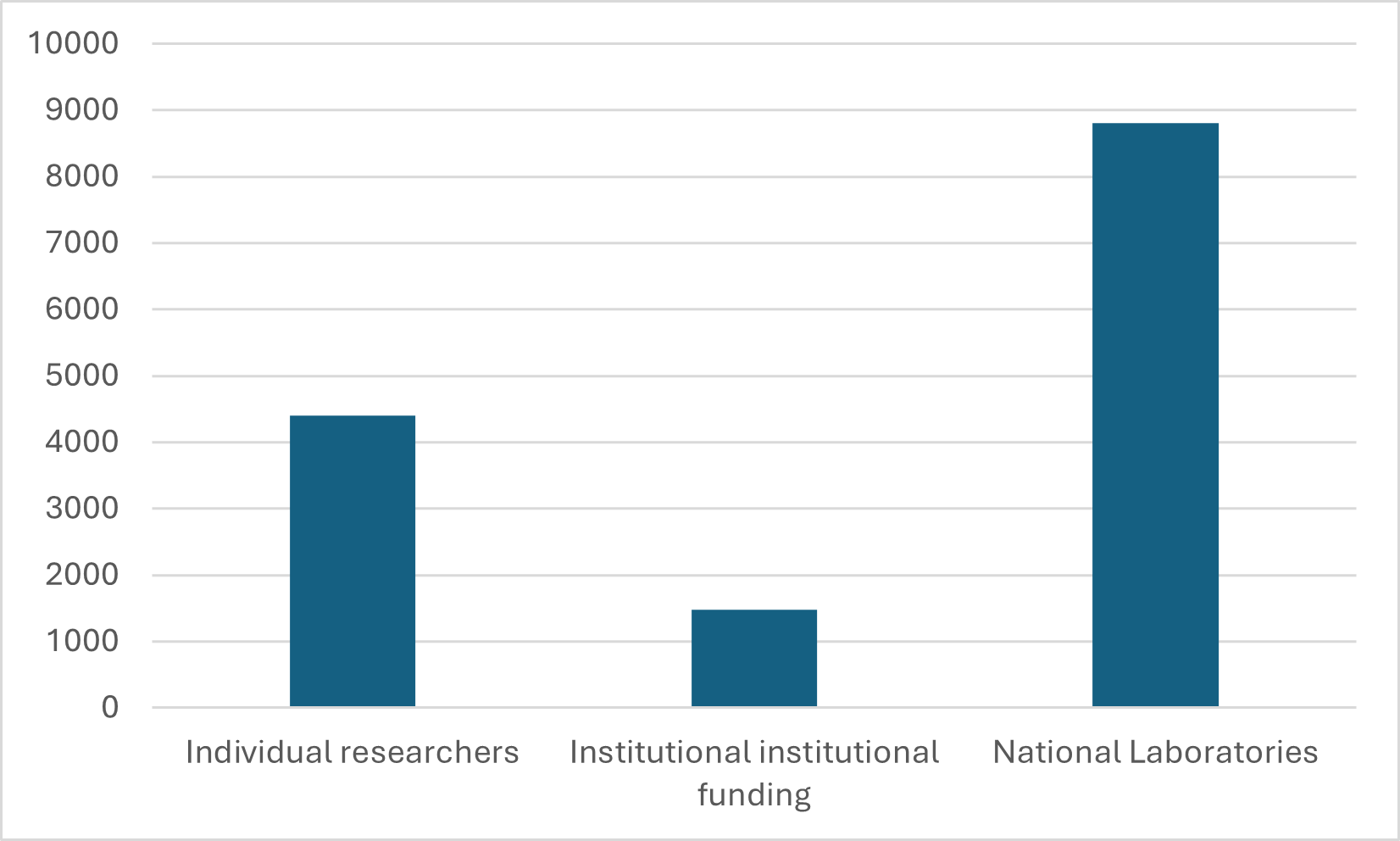
Let’s move on to Germany. With respect to money for individual researchers, the largest source of funds at €2.2 billion is Deutsche Forschungsgemeinschaft (DFG), or German Research Foundation (contrary to what many in Canadian academia would have you believe, serious countries are quite capable of operating with a single research funding organization). Horizon Europe brings in another €1.7 billion per year. Other sources of such funding include the Deutsche Akademische Austauschdienst (DAAD) for student and researcher mobility (€440M) and the Humboldt Foundation which spends about €160M/year to get international researchers to conduct research at German universities. Call it about €4.4 billion total.
Institutional funding is more limited. The largest is the country’s Excellence Scheme, which provides a restricted group of universities with €675 million per year. Institutions also receive a little over €500 million going out through the German equivalent of the Research Support Fund, as well as somewhere between €200M and €250M from Länder-funded research schemes and also €50M from the “Innovative Universities” project which funds what are known as “Third Mission” projects (technology transfer with a regional development focus).
But the big difference between Canada and Germany lies in the way the latter funds four so-called “Pakt” organization (so named because their funding is governed by the federal-Länder “Pakt für Forschung und Innovation”). These are the Helmholtz-Gemeinschaft (€4.1 Billion for large scale research centres), the Max-Planck Gesellschaft (€2.2 billion for fundamental science), the Fraunhofer Gesellschaft (€1 billion applied research with industry) for and the Leibniz-Gemeinschaft (€1.4 billion for institutes outside the university system). Under the Pakt, Max-Planck and Leibniz are funded 50-50 by the two levels of government, while the other two are funded 90-10 by the federal government. Total public expenditures on these four organizations is therefore about €8.8 billion.
(Note: the Pakt also covers the DFG, but it is a funder of research rather than a performer of research, so I have covered it separately.)
Figure 2, below, shows how all of this fits together.
Figure 2: Annual Public Spending on German Research Funding by Type, in Thousands of Euros
So now let’s get to comparison. In order to do this, we need to normalize for both currency and population. So first, I converted German figures in euros to Canadian dollars at a rate of €1 = $1.45, which is the rate where most estimates of purchasing power parity (PPP) converge. To account for population, I divide each country’s totals by total population in order to get a per capita figure. I show all this in Figure 3.
Figure 3: Per Capita Annual Public Spending on Research by Type, Canda vs. Germany
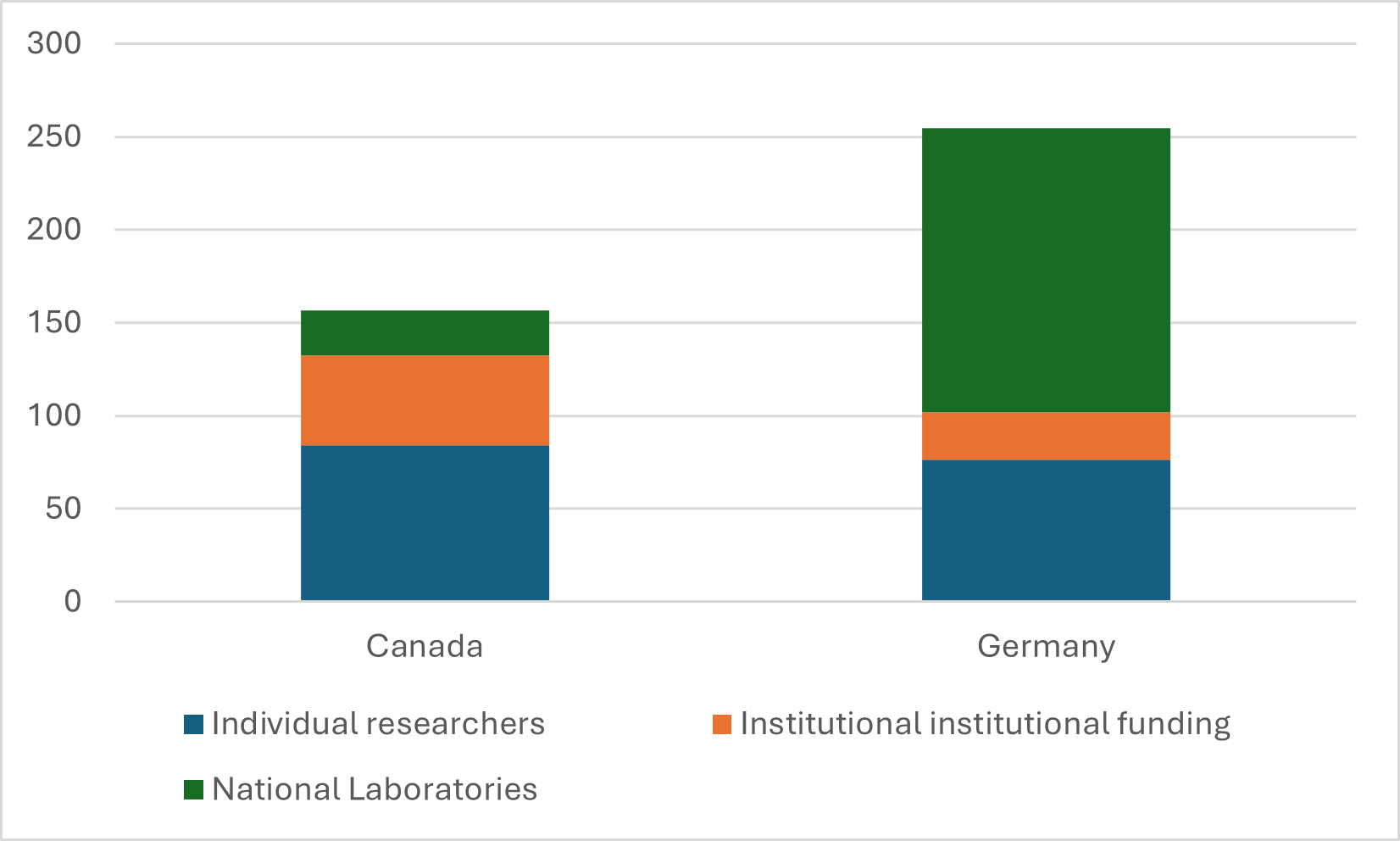
What the figure shows is that total public research spending is significantly higher in Germany than in Canada ($255 per capita to $157), but also that total public research expenditure in universities – both to individual researchers and to institutions – is significantly higher in Canada than in Germany ($132 per capita to $102). To put this another way: Germany probably has a stronger research culture overall, but it’s Canada where the universities are stronger.


2 Responses
Thanks for this, Alex. It’s a really interesting comparison. I find it fascinating to think about how funding research through non-university organizations might shape the research landscape differently. It makes me wonder whether it could create more opportunities for researchers outside universities, encourage more long-term, mission-driven or applied research agendas, and potentially influence how research connects with industry through dedicated applied research institutes. It also makes me curious about whether these structural differences show up in innovation or industry outcomes over time.
There’s also just a world of difference between the Max-Planck Gesellschaft in Germany or CNRS network in France, on the one hand, and the NRC. The MPG and CNRS are absolutely load-bearing not only for research but high-level doctoral and postdoctoral training, and their units have deep links to collocal universities. The NRC, by contrast, might as well not exist for most rank-and-file faculty researchers in Canada.