




Last Wednesday, Newfoundland and Labrador became the tenth province to deliver its budget, and that means it’s time for my annual review of provincial budgets. Spoiler: while it’s the usual mixed bag across most provinces, Ontario is the epicentre of this year’s stories. And not in a bad way.
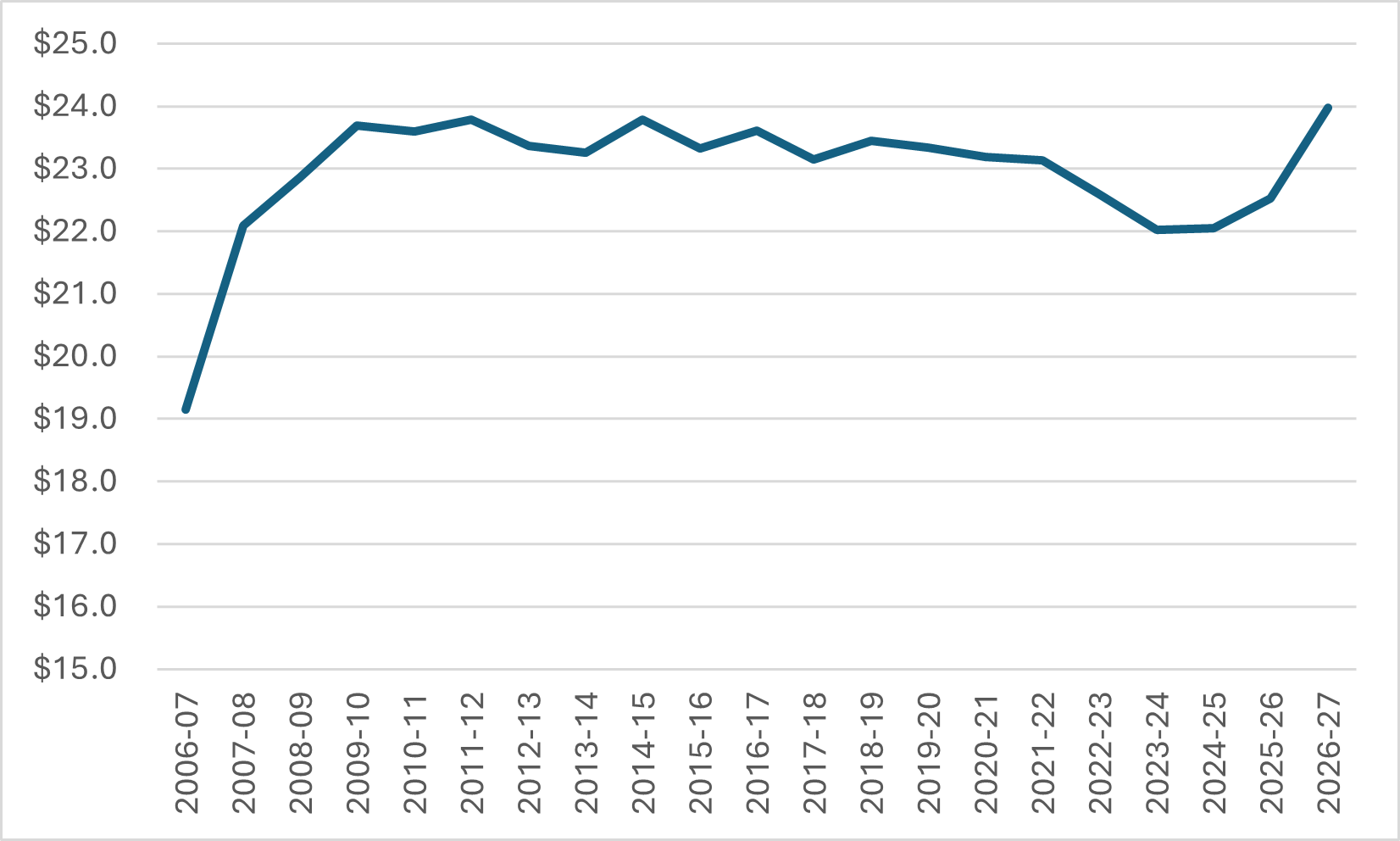
Let’s start with overall budgeted provincial transfers to institutions, shown below in Figure 1. Growth this year after inflation is a stunning 6.5% – a rise not seen in 20 years. This is the second year in a row that total spending is up in real terms, marking the first time this has happened in over 15 years. In fact, budgeted provincial transfers to institutions in 2026-27 will be at their highest point ever, at exactly $24 billion (the usual caveat here is that budgets and expenditures don’t always match exactly, though they are usually reasonably close). All in all – good news!
Figure 1: Total Budget Provincial Transfers to PSE Institutions, Canada, 2006-07 to 2026-27
Of course, Canada is made up of ten different provinces and it’s pretty rare that all provinces are heading in the same direction and the same time, as we see when we look at the 1-year changes in expenditures at a provincial level. British Columbia saw a decline in real dollars. Most provinces saw a small increase, but a few provinces saw big increases. In Saskatchewan, growth was six percent. In Alberta, the growth was seven percent albeit disproportionately on the capital side rather than on operating expenditures. But in Ontario…in Ontario the increase was nineteen percent. Turns out that big increase in funding announced a couple of months ago wasn’t backloaded, and so the big gains are basically immediate (this was not at all made clear in the government’s communications, which insisted on explaining everything in terms of money to be spent over four years). And that big jump in one province is enough to pull the whole country up by 6.5%.
Figure 2: 1- year and 5-year changes in Budgeted Provincial Transfers to Institutions by Province, 2026-27
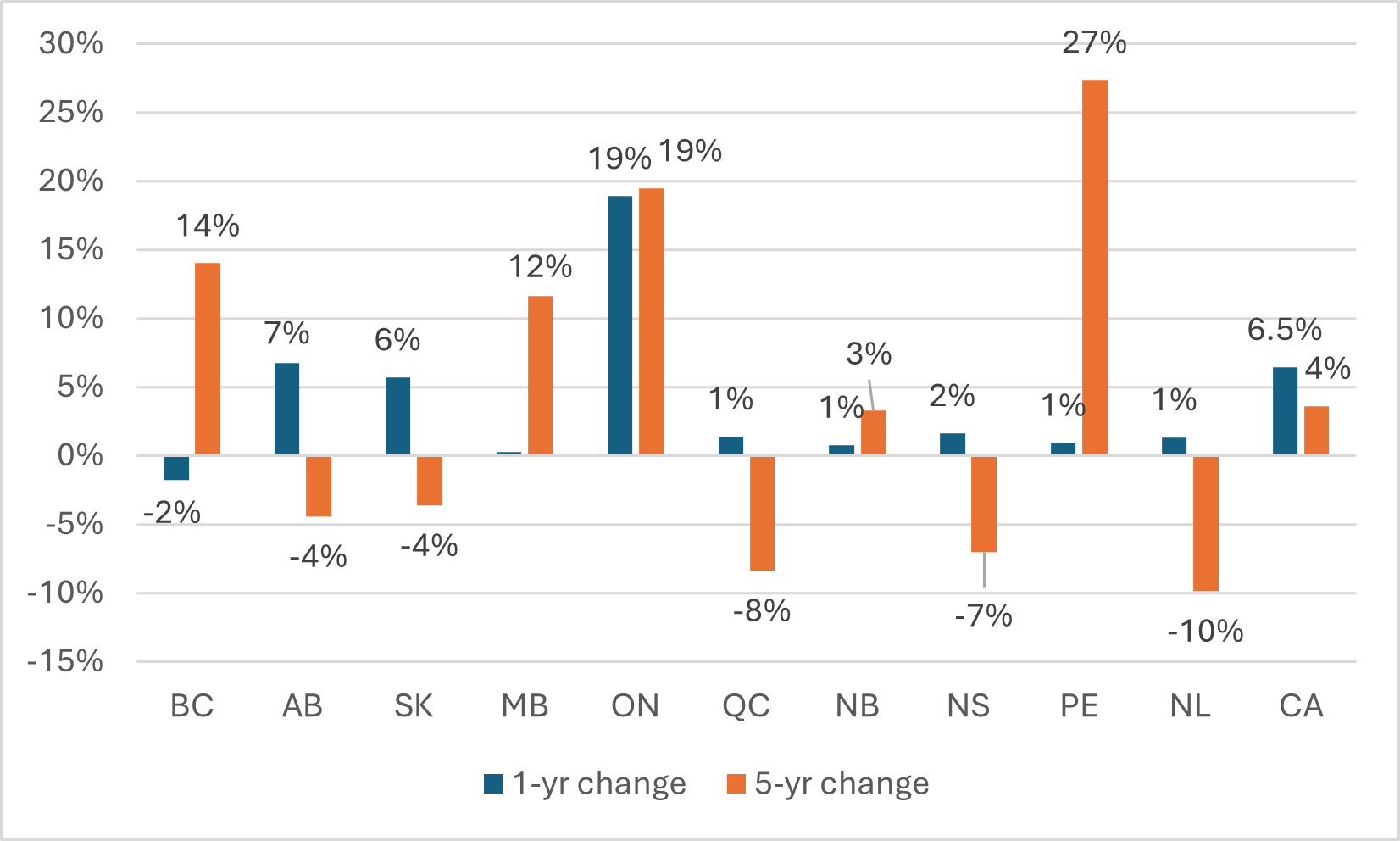
(If you’re wondering what that huge 5-year increase in Prince Edward Island is about, think: “new medical school”.)
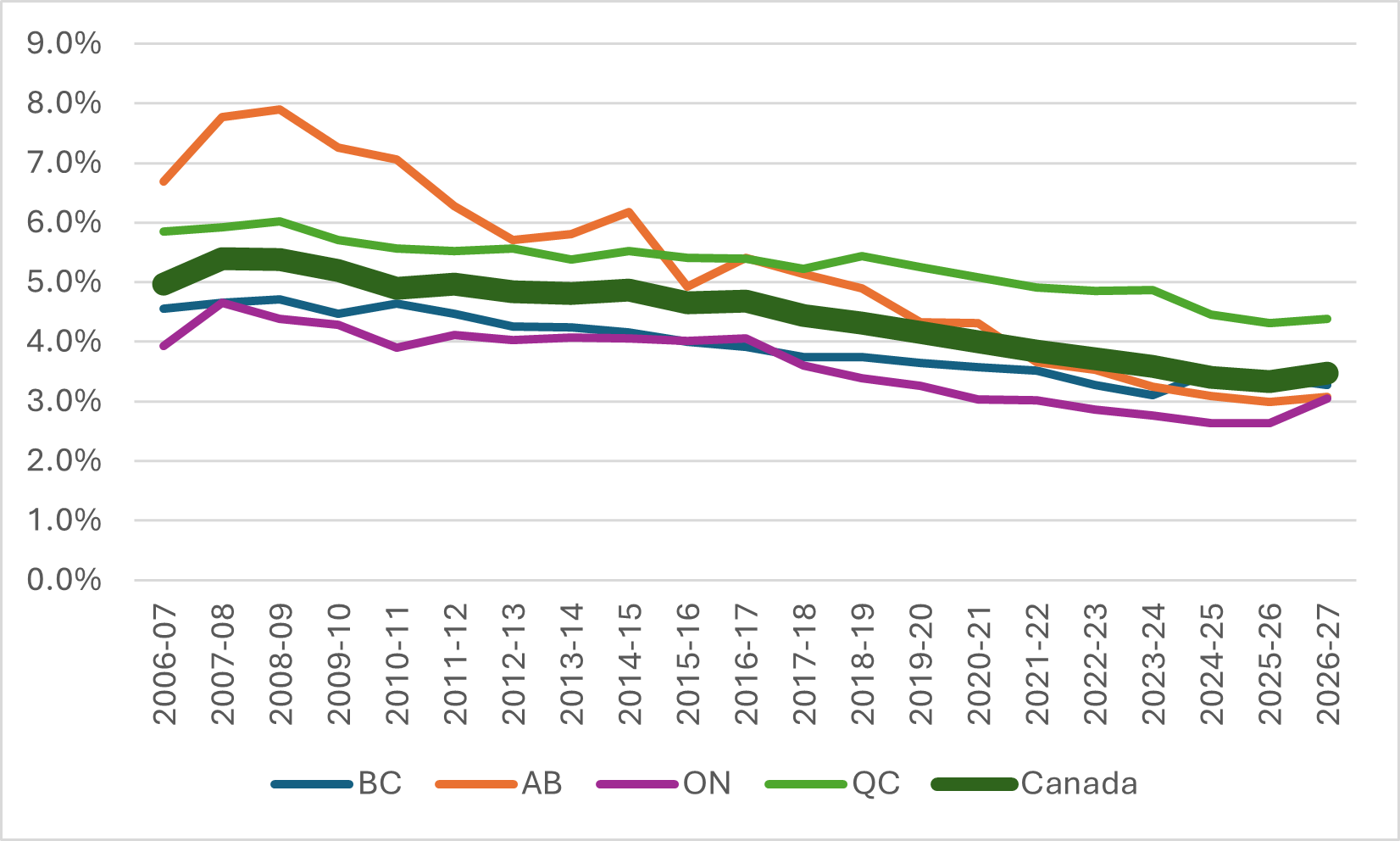
Anyways, one consequence of this change is that for the first time in over a decade, provincial expenditures on post-secondary education as a percentage of total government expenditures rose this year for the first time in over a decade. Not by much – 3.5% this year compared to 3.3% last year – but it’s still an encouraging sign. An interesting note here though: despite the big increase in spending this year, Ontario remains 10th out of 10 provinces on this metric, but is no only a hair’s breadth behind Alberta. If Ontario should pass Alberta next year, it would mean that Alberta, which for many years led the country on this metric, would have passed from first to last place among provinces in just 13 years.
Figure 3: Budgeted Provincial Expenditures on Transfers to PSE Institutions as a Percentage of Total Provincial Expenditures, Canada and Selected Provinces, 2006-07 to 2026-27
Now over to student aid, where we have a doozy of a puzzle on our hands. In most provinces, there is rarely any change in student aid expenditures from year to year. This year, however, the total budgeted national expenditure on student financial aid is expected to jump by 33% – over a billion dollars – because of a huge increase in expenditures in Ontario.
Figure 4: Total Provincial Expenditures on Student Financial Assistance, Canada and selected Provinces in real $2026, 2006-07 to 2026-27
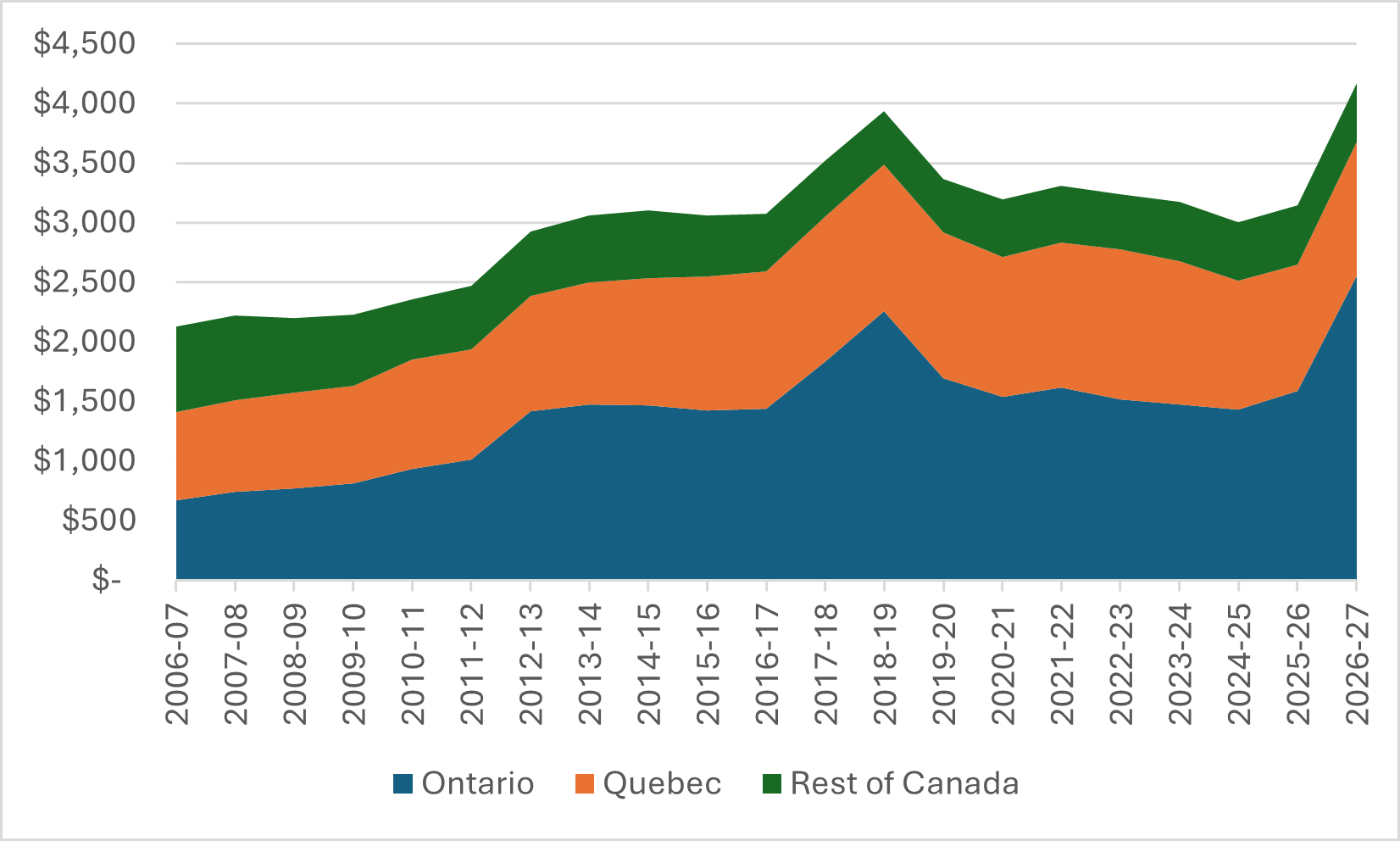
Now I know what you are going to say: “wait a minute, wasn’t that huge increase in institutional funding paid for by cuts to student aid?”. To which the answer is “yes, but”. I am fairly sure that what we are seeing here is an artifact of different year ends for the ministry (March 31) and for student loans (July 31). The big jump in student aid actually happened last year (2025-26), but is getting booked in fiscal 2026-27.
But of course, this just replaces on question with another: why on earth was there such a big increase in costs in Ontario in 2025-26? The excuse I have heard – that it was due to reductions in the federal program that the province was required to backfill – makes almost no sense to me. The big change in the federal program happened in the 2023-24 academic year and it shouldn’t have taken two years for the effects to kick in at the provincial level. The only other possible answer here is that there was a massive upswing in demand for student aid that occurred in Ontario and only Ontario that raised costs by vastly inflating the client base.
That would cast the Ontario government’s decision to raid OSAP to pay for increases in institutional funding, which I wrote about back here, in a slightly different light. Mainly, it suggests that from the government’s perspective, all those cuts were not cuts at all but just about keeping expenditures roughly in line with previous years’ totals: basically, that it needed to reduce program generosity in order to accommodate a much larger number of clients. Why the government was not bothered enough to explain this in the first place is an interesting question (it is an enduring mystery how a government than can’t comms its way out of a wet paper bag can have won three consecutive thumping majorities), but it does seem to be the only explanation which satisfies all the known facts.
In any event: the level of increases we are seeing does not come close to covering the losses institutions sustained by the continuing exercise in knee-capping that is the federal Liberals’ student visa policy, which is why even these increases will not, in most cases, be enough to stave off cuts at the institutional level. But it is beginning to look as if like we hit bottom in terms of public funding two years ago and are now on the way back up. That’s a good thing, and we should be thankful. There might not yet be light at the end of the tunnel, but at least it isn’t getting any darker.