






A couple of weeks ago, the Times Higher Education printed a kind of farewell interview with the University of Waterloo’s outgoing President Vivek Goel. Like many THE interviews of this nature, it’s a bit of an odd duck, spending half the time explaining to a global audience who this person is and why they and their institution are important and leaving only a couple of hundred words for the subject to say anything useful about their own legacy and the future. But what Goel did say about the future was interesting enough that I thought it worth bringing to the attention of a wider Canadian audience.
There are a few passages in particular I think are worth underlining.
First, speaking about co-op programming – or, more generally, work-integrated learning – in an age of artificial intelligence, Goel said:
“Those sorts of things are going to be what institutions…will have to provide, and if we’re just in a model where we continue to provide lectures and ask students to write essays and then grade them, I don’t see that that’s going to be something that will survive for very long.”
He then went on to say
“As I look to the future, university leaders that believe that somehow there’s a genie that can be put back in the bottle and locked away and we just continue to operate the way we always have are not going to succeed in maintaining their institutions.”
“We have to look at these technologies very critically and very quickly because they are moving really fast, and our students are adopting them way faster than we can understand them.”
Now, when Goel talks about education and technological change, people should listen. Very few university presidents have spent as much time thinking about education and technology as he has: recall that he was the Chief Academic Strategist at Coursera back in the days when MOOCs were still kind of all the rage. He knows what he is talking about and his opinions should need to be taken seriously.
Fundamentally, what he saying in this article is that in the age of AI, academic work is going to change. The core tasks of universities with respect to teaching and learning – that is, taking semi-formed teenagers and turning them into useful, engaged members of society that can contribute positively to their communities and workplaces – will remain the same. But the methods by which universities pursue these tasks, both in terms of pedagogy and assessment, are almost certainly going to change and – this is the important bit – universities risk losing the trust of society if they do not.
This really shouldn’t be all that controversial a statement. Academia changes the ways it educates people in response to technological change. Anthropology and anatomy departments don’t use museums as a major teaching technology anymore, for instance. Universities have adapted to the digital age in myriad ways. Saying that lectures and essays might not be the ideal way to prepare and assess students for the world of the 21st century is not, in the context of the long history of academia, all that radical a notion.
It is, however, a challenging one. We have settled on lectures and essays largely because they were both efficient and effective. The arrival of internet video posed a challenge to the “efficient” part in the sense that it suddenly became possible both for lectures to reach much larger audiences, and for audiences to partake of lectures without actually being physically present. Large Language Models are eating away at the effectiveness part, because it’s harder to ascertain if essays represent student work and hence potentially threatening to make a mockery of assessment.
But it’s one thing to say that the present situation is untenable and another to figure out what the next equilibrium point is. We’re in that very Gramscian position: the old is dying, the new is struggling to be born. We know we need to work out new methods of providing learning experiences for students and we know we need different methods of assessing student knowledge/mastery. The real problem, as I see it, is that we are terrible at experimenting with new methods.
By this, of course, I absolutely do not mean that there is no innovation in teaching and assessment. Profs are trying new things all the time. What no one is doing systemically, is:
- Documenting innovations. As profs change up their teaching and assessment methods in a variety of ways, there is little systematic effort being made to capture what is being attempted.
- Capturing lessons. In a very loose sense, every new attempt at innovation can be seen as an experiment. Not a particularly controlled or scientific one, obviously, but data is nevertheless produced which can be captured (even by those much-maligned instruments, teaching evaluations). Yet, again, we aren’t doing so systemically.
- Sharing results. This is the big one. Even if we are documenting innovations and capturing results, if we don’t find ways to share and spread results of these innovations in a systemic way then we’re basically leaving every individual professor to deal with these challenges alone.
- Discussing implications. Just because we have some ideas about how to change learning and assessment doesn’t mean they are all necessarily implementable at scale (see my earlier discussion of the economics of assessment under AI). And in the end, what works at scale is what matters most at the level of the university.
Any organization that thought of itself as a learning organization would have done all this already. But, of course, universities are about the furthest things from learning organizations in existence, so this is perhaps not surprising. And yet, not only should every institution be doing all of these things, but also, they should be doing 3 and 4 together, jointly. No single institution built the current model of teaching and assessment. No single institution is going to invent a new one. Sharing these kinds of experiences should be de rigeur.
As Goel says, there is no putting the genie back in the bottle, but we can still work to make better bottles and trap better genies. It’s just down to a willingness to try new things and imagine different patterns of activity and investment. If any institution or institutions out there want to set up something like this, drop me a line – we’d be interested in helping.
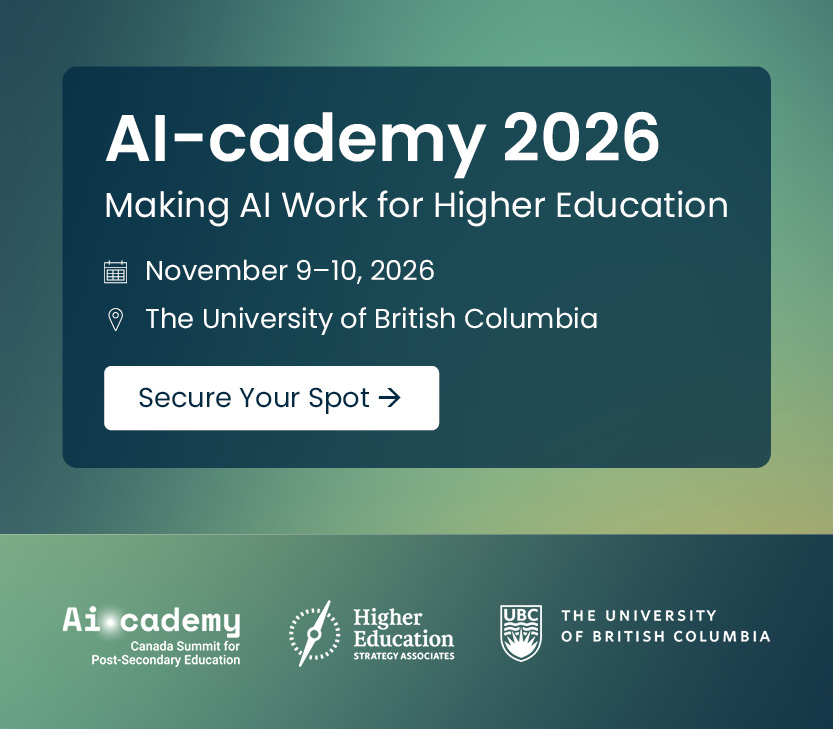
And of course, if your institution has work or innovations you’d like to share, the call for proposals for our upcoming AI-cademy conference is open. If you have something to share, are exploring new ideas, or are simply looking to learn from others doing this work in Canada and beyond, we hope you’ll join us for AI-cademy 2026 at the University of British Columbia on November 9-10.

One Response
“[R]ecall that he was the Chief Academic Strategist at Coursera back in the days when MOOCs were still kind of all the rage. He knows what he is talking about and his opinions should need to be taken seriously.”
I would draw the opposite characterization from that curriculum vitae. It sounds like he’s always been a hawker of something slightly off.