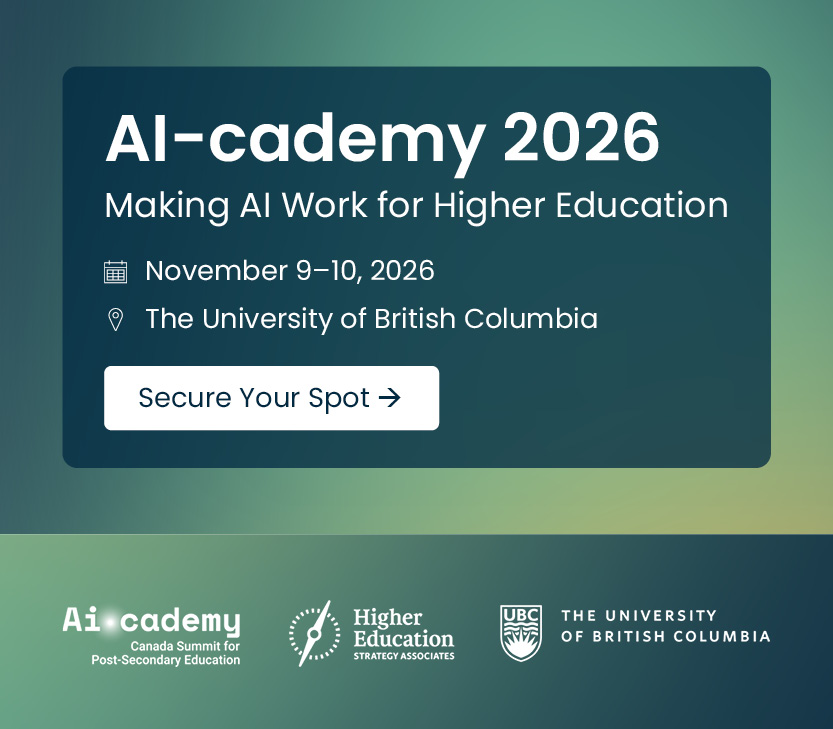




Hi all. Last week, HESA Towers packed up and headed to UBC for AI-Cademy 2026, HESA’s annual conference on AI in Canadian Higher Education. It was a pretty great event, not least because it’s pretty much the only conference that attracts leaders, tech folks and faculty in roughly equal numbers, which gives it a pretty unique feel. Thank you to all our delegates, speakers, and poster presenters, along with our partners and collaborators (see below) for joining us and making it such a success.
I won’t give you a run-down of the full conference, but I did want to give you an overview of where I think the state of the discussion on AI in higher ed is at this moment.
There are three discussions about AI in higher education which took up a lot of space a year ago but which I think are somewhat in abeyance for the moment: they haven’t disappeared, but they take up less space in the overall debate than they used to. The first is teaching with artificial intelligence: that is, having artificial intelligence tools or artifacts which are either designed by or for a specific professor and their class(es). The second is the use of artificial intelligence to replace non-academic jobs and reduce paperwork. At our 2025 conference in Calgary, one of the biggest mic drop moments was when Lev Gonick, ASU’s Chief Information Office, said the institution was on the verge of using AI for Research Ethics Board approvals, and that it believed it could drop process times by 80%. So far, anyway, workable applications within institutions seem relatively limited.
The third area where tension is down a bit is with respect to the jobpocalypse: that is, the fear that all jobs (or at least the entry level ones) are about to disappear and the purpose of universities is about to go with them. I would say some of this is still present in computer science departments, where applications have crashed along with graduate outcomes over the past 24 months, a casualty of the slowdown in hiring in the tech industry which is allegedly (it’s a bit unclear) caused by AI’s increased ability to execute coding jobs independently. But as it becomes clearer that businesses are not succeeding in re-organizing themselves around AI very quickly, it similarly becomes the case that the world of work – outside the software industry, anyway – isn’t going to be magically transformed anytime soon. Long term, there are still important issues to consider – generally speaking, a technology that mimics expertise is going to be a drag on the returns to actual expertise, meaning there will probably be an equalization of pay between blue collar and white collar workers and universities as a less desirable form of education, but that shift now looks likely to happen over 2-3 decades rather than 2-3 years, so everyone is ignoring it while they can.
So what topics are dominating the agenda? I would say two in particular. The first is the issue of how to assess students in the age of AI. Obviously, over the summer there was the story of the UNAM exam failure, where widespread cheating was found to have occurred in that university’s online entrance examination. Now, both the Norwegian Parliament and the UK’s Office for Students have told universities they need to stop administering online exams yesterday. In the age of AI there is, simply, no way to proctor an examination other than in big rooms with no technology in sight (given that no one teaches cursive handwriting anymore, could make for some interesting times).
If adopted, this will significantly change the way we design courses and assess students. There were more questions than answers at the conference, but there was a substantial line of discussion around the idea of “process education”; that is, teaching and evaluating the process of coming to answers – with or without AI – rather than evaluating outcomes themselves, which can too easily be produced by AI. Interesting idea, though, it might not be easy for all profs to adapt.
(An aside here. Quite apart from the financial implications of engaging in much more personalized assessment, which I described back here and here, there is an inherent tension between what assessment means in the Age of AI and almost everything we have done since COVID in terms of trying to widen access. It’s getting difficult to see, for instance, what kind of future there is going to be for asynchronous online education under current rules; and many of the accommodations that have been granted to students with disabilities are going to be made a lot harder, too. Watch for this to be a significant issue over the next few months).
But there’s an interesting and more complex question being put in play as well. What is the meaning of education when AI mimics expertise so well? What should we be teaching? What skills and qualities should graduates have to work in a world where the use of AI is widespread? Most people quickly come to the notion that higher education needs to help students be better at exactly the things AI can’t do well – imagination, for instance, or “judgement”, or things that involve a lot of social and emotional labour, like forging and maintaining relationships. Not everyone agrees on the specifics here: my pal Bryan Alexander pointed out that humans might not have as big an advantage in this area as we think – a majority of people really like the sycophancy of AI. But, generally speaking, there was a lot of support for the idea that teaching in the age of AI actually requires teaching against the grain – not to make education more AI-like, but to go in the opposite direction. (Pope Leo had some interesting things to say about this recently…making me wonder if Catholic higher education institutions might not be in for a bit of a revival soon).
I have some thoughts about all this. And mainly, they are that this is not going to be an easy transition. Even if we take it as read both that higher education will try to pivot its forms of assessment and the student outcomes it wants to produce – how easy do we imagine it will be to convince people outside the academy that this is the right call? At least a portion of the folks out there who want institutions to hard pivot towards AI are people who – to put it mildly – are social and cultural conservatives who find the idea that LLMs can come up with “one true answer” to any question quite congenial. I have my doubts that they are going to be thrilled with the notion of “teaching the process”, let alone the idea that higher education is going to be about developing social and emotional skills.
All of which is to say: there might be a “right way” to teach in the age of AI that is profoundly human while producing graduates who can work productively with AI and add value to it and which satisfies concerns about assessment. But are governments – particularly conservative ones – likely to buy it? This might be a harder sell than people think. And God forbid we start claiming that a university education is necessary in order to have “judgement”: I can think of no faster way to place higher education directly in the culture war firing line than to make such a claim.
Adapting to technological change has never been easy. The arrival of artificial intelligence will be especially hard because it calls into question so much of what we have believed about human uniqueness and irreplaceability. The good news is that as we deal with this challenge, we can do so consciously, constructively and collaboratively – and remake higher education for the better in the process.
Again, we thank everyone who attended and supported the conference, particularly our cohosts at UBC for creating space to convene these critical discussions. If you and your institution are keen to help cohost AI-academy 2027 or your organization would seek to partner in support, please reach out to jbalfour@higheredstrategy.com to discuss and explore ideas. We also look forward to continuing our conversations on the future of higher education at the upcoming Re: University 2027 conference hosted with TMU.