






Late last week, two Ontario colleges—St. Lawrence College ( in Kingston, with a substantial presence in Cornwall and Brockville) and Sir Sandford Fleming (in Peterborough)—announced their intent to “integrate as equal partners.” Many people (including me) at first thought that meant the two schools were merging. However, on closer reading of the announcement, I am not sure this is quite the case.
Let me quote here from the quite extraordinary announcement:
“We are committed to ensuring that students have the tools, programs, and support they need to succeed in a rapidly evolving economy,” said Glenn Vollebregt, President and CEO of St. Lawrence College. “This integration gives us the scale and capability to serve more students, offer more opportunity, and build a stronger institution for the long term.”
The announcement marks a significant step toward building a larger, more capable institution that can expand access and strengthen long-term sustainability. The integration reflects a shared vision to create greater scale and capability, while better aligning programs and capacity with regional labour market needs. Over time, students will benefit from expanded academic pathways, increased access to specialized programs, enhanced research opportunities, and broader work-integrated learning experiences.
The colleges have been working closely with the provincial government to ensure a smooth integration with minimum impacts on students and communities. There are no planned changes to local brands, programs, campuses, services, or student supports because of today’s announcement.”
Got that? They are “integrating” but otherwise claiming not to be changing a single thing. They should have titled this media release “Change But with Continuity”. How exactly is this integration meant to “create greater scale and capability” if no programs, campuses or services are going to be affected? What academic pathways can be expanded if nothing changes?
I mean, let’s face it, the opportunities for program expansion aren’t huge, since by design the two colleges mostly teach the same stuff anyway. Each does have a bit of a niche that it could expand to the other catchment area: St. Lawrence’s could offer nursing programs in Peterborough, and Fleming could offer some if its environmental/natural resource programming in Kingston or Cornwall, but both of those moves would almost certainly increase costs, whereas the clear premise here is cost containment.
Maybe – maybe – you could justify this kind of thing if it were genuinely about creating a regional supergroup of colleges, like The Traveling Wilburys of Eastern Ontario sub-baccalaureate education. But then of course you’d need to have Loyalist College in Brockville be involved, wouldn’t you? Why aren’t they part of this? First journalist to get someone from Loyalist on the record on this probably wins this story.
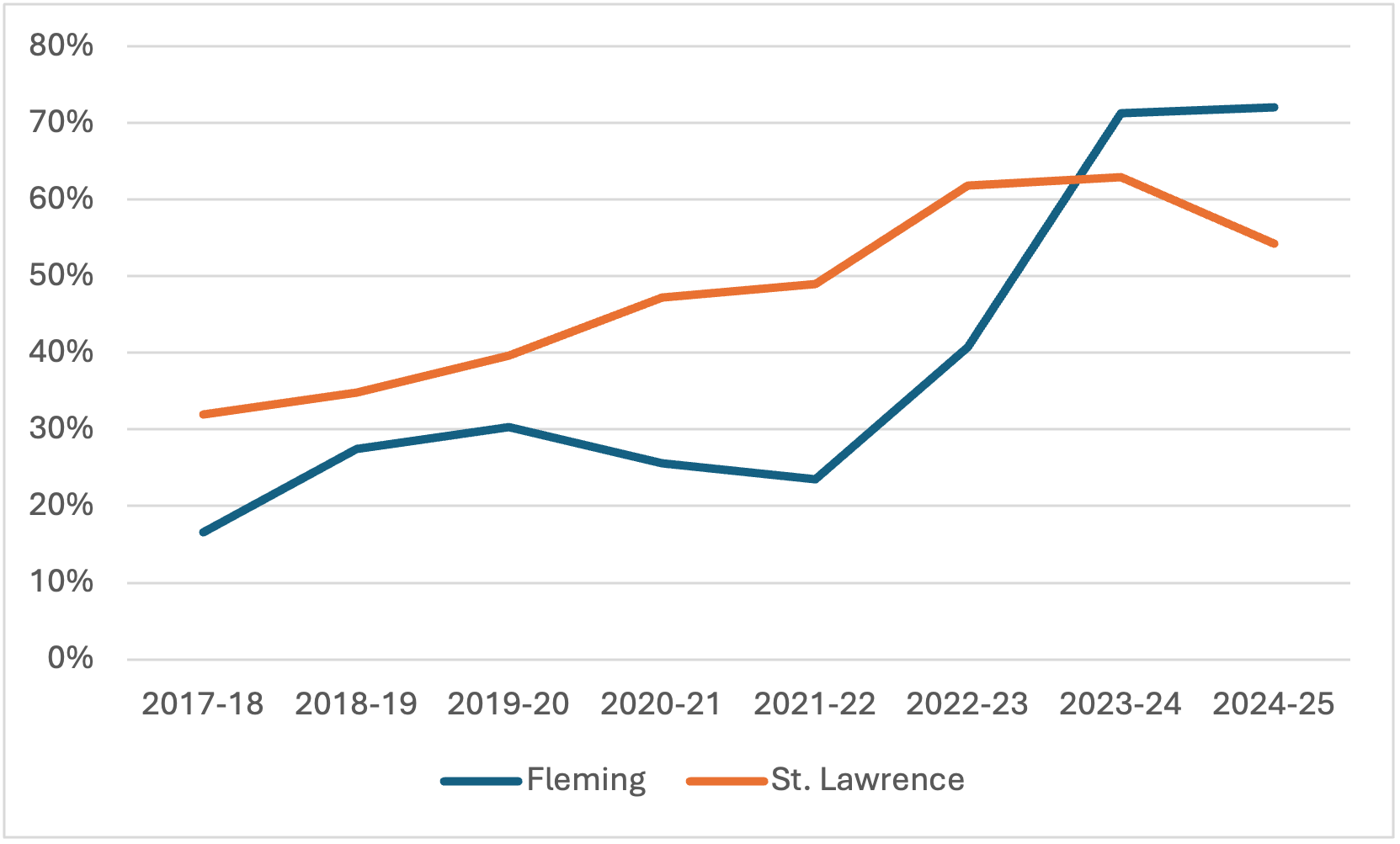
As for the idea that this is an integration of equals…well, look at the data. As figure 1 shows, these are two colleges that are hugely affected by the loss of international students. Both have had international students make up over 50% of their student bodies for the past few years, though in both cases most of those students were in GTA PPP colleges. This percentage growth is only partly a function of the growth of international students, though. In St. Lawrence’s case, domestic numbers are down about 20% from where they were in 2017-18, in Fleming’s case they are down 40%.
Figure 1: International Students as a Percentage of Total students, St. Lawrence vs. Fleming Colleges, 2017-18 to 2024-25
An interesting question here is: why did Fleming go so hog-wild for international students in 2022? Well check out figures 2 and especially 3. The answer is: with international students at just over 20%, Fleming couldn’t make ends meet. It was one of the few Ontario colleges in those years to record a deficit. And so, one might reasonably expect that the sudden disappearance of international students will hurt Fleming much harder than St. Lawrence. If you assume Fleming’s international numbers fall 80-90%, then you’re looking at total revenues falling by 50% by 2026-27.
Figure 2: Total Revenues, in Millions of Current Dollars, St. Lawrence vs. Fleming Colleges, 2017-18 to 2024-25
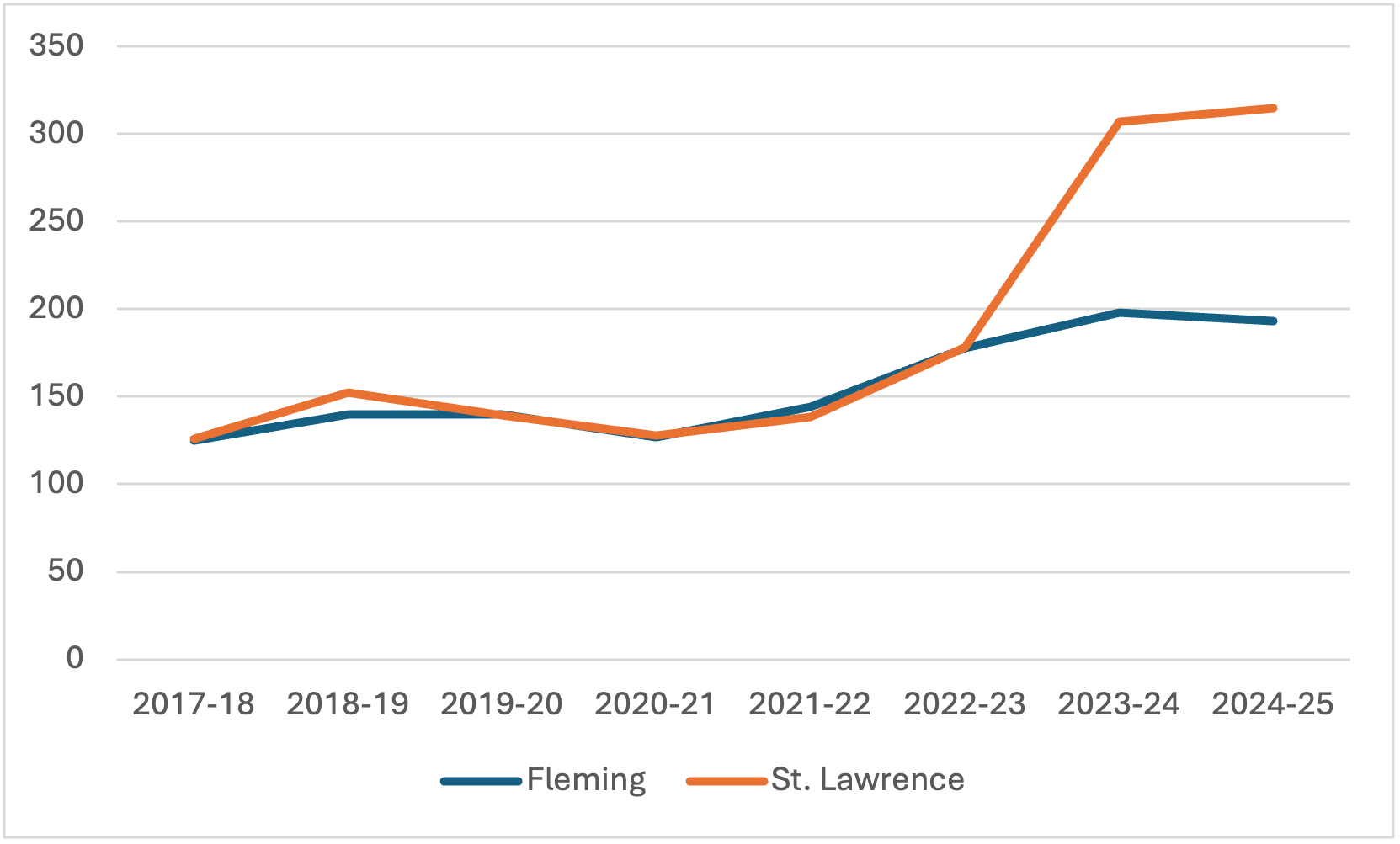
Figure 3: Surplus/Loss as a Percentage of Total Revenues, St. Lawrence vs. Fleming Colleges, 2017-18 to 2024-25
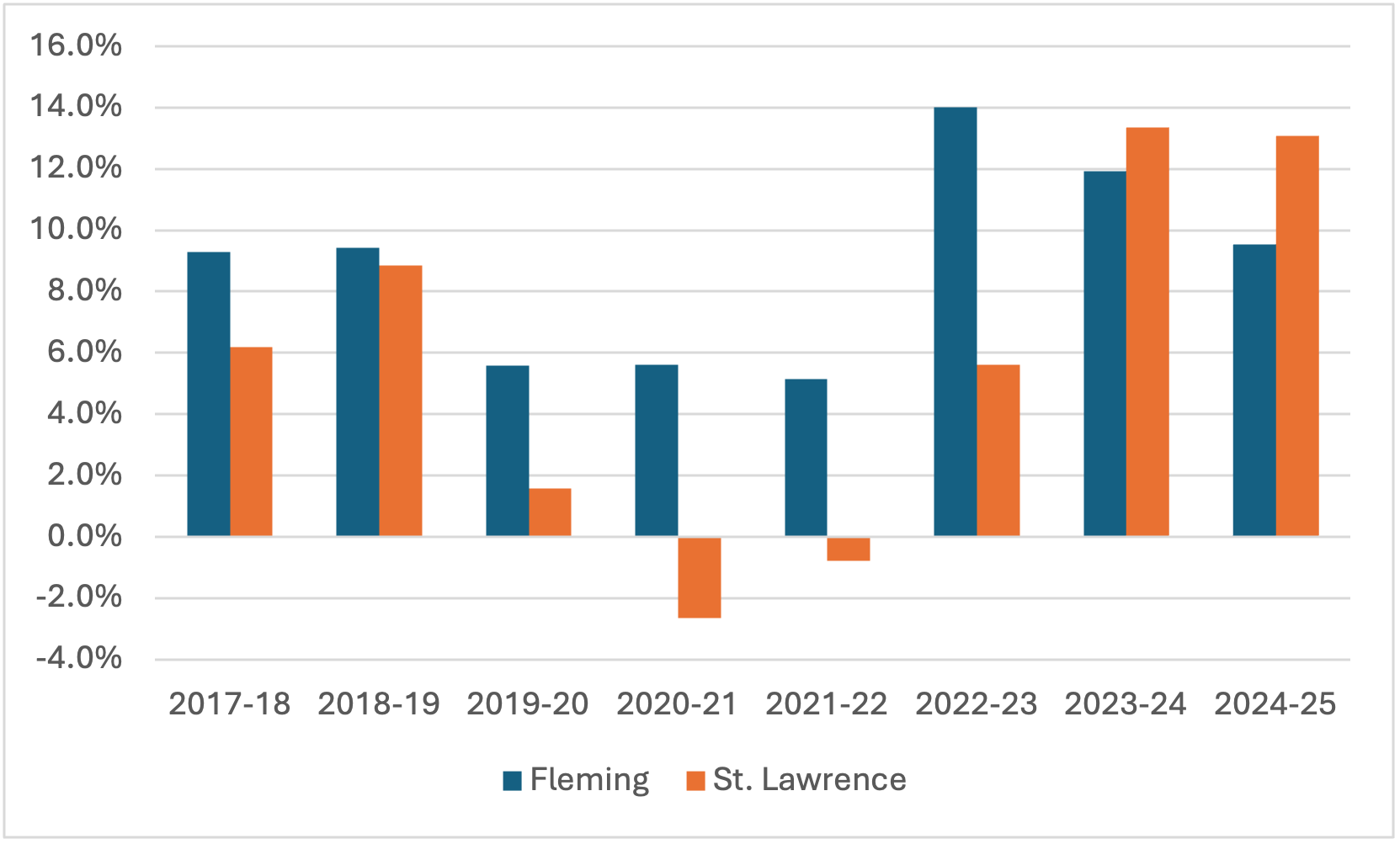
Not that St. Lawrence is going to get off easy. If you look at its 2025-26 annual budget (something Fleming does not appear to release publicly), it shows that the 13% surplus it posted in 2024-25 turned into about a planned 8% deficit in 2025-26 (I suspect it was actually worse than that, given what we now know about the decline in international student numbers). It has plenty of accumulated surplus to cover that this year, but it can’t reasonably be expected to maintain that level of deficit in future ones.
So, what’s going on here? Well, first of all, it’s probably not a merger of equals. St Lawrence isn’t in great shape, but to me the data shows that it is not in as dire a position as Sandford Fleming. It is therefore probably not a co-incidence that it’s St. Lawrence’s CEO who is going to head up the merged-not-merged organization.
Second of all, although they don’t quite say it this way, the prime motivation here seems to be finding ways to slash administrative spending. There are hints of academic synergies, but they seem a) small beans and b) require higher spending. This means that the classic first condition of successful educational mergers—that the two organizations have largely complementary offerings, not overlapping ones—just isn’t in play here. The only way to save is by deduplication, and if the while exercise rests on not cutting programs, then it means the logic is one of severe administrative efficiencies.
Maybe there are a ton of back-office synergies that could occur here, but it seems to me they will take a while to show up. The big savings I suspect will come from merging IT systems, and the payoff on that takes years. The one programmatic cut that might be easier with this new system would be to get rid of Fleming’s arts-focused Haliburton campus, which one suspects is losing money hand over fist—hard to be otherwise when your full-time headcount is just 59—just blame it on the new and more distant administrators.
(If Fleming is in financial difficulty, one culprit surely must the decision twenty-five years ago to build a 33,000 sq-ft building for an arts school that only once cracked enrolment of 100, and then to double down on this decision just three years ago by building a $16 million, 47-bed residence for a campus with only 60 students. I mean, I get that the campus is an important piece of regional development for the City of Haliburton but perhaps then some of the money could come from other relevant ministries…?)
Anyways, time will tell, I guess. All I am saying is this might not be as big a deal as it at first seemed.


2 Responses
This is a weird way to not quote “the full integration of the two colleges into a single new institution” as evidence of a merger… very selective and biased.
Loyalist College is in Belleville, not Brockville.