






Since last Tuesday, there have been a lot of stories (like this one and this one) talking about how the federal government is reducing the number of new student visas and, as a corollary, how this will negatively impact college and university finances. Many people have asked me why the HESA budget blog didn’t make a bigger deal out of this last week. The answer is: we did in fact write about it in the full Budget Commentary (pages 7-8), we just didn’t make it one of our top five stories of the night, and so I didn’t talk about it in the blog. I thought today I would take a bit of time to explain why.
Below is the table that has everyone so upset. It’s on page 97 of the budget, but it actually comes from a completely different document, containing supplementary information for 2026-2028 Immigration Levels Plan. It suggests very significant limits on new student visas – 155,000 in 2026 and 150,000 in 2027 and 2028.
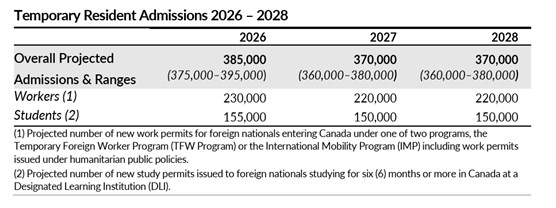
Now here’s where it gets a bit complicated, because you really have to keep track of different definitions and methods of counting to understand what’s going on. Recall that in 2024, the government capped permit applications at 485,000 students, excluding students studying at the graduate level, and in 2025 at 437,000, this time including graduate students. The budget numbers are way, way below that, but remember that permit applications are not the same as visas issued. Once a student is given leave to apply, not all actually do so. Of those who apply, not all are accepted. Of those who are accepted, not all show up in Canada.
To get a sense of how leaky a pipeline this is, let’s look at the data for 2024. Applications were capped at 485,000, but the actual number of new study permits issued was much lower – just 267,890 according to this source, and 293,220 according to this one. I have a feeling the discrepancy is about counting graduate students but never mind – the point is that it’s a lot lower than 485k. And the number of visas kept declining through 2025. Here’s the data that the government is currently touting (it’s not clear to me if grad students are included here or not).
Figure 1: New Student Arrivals to Canada, by month, 2024 vs. 2025
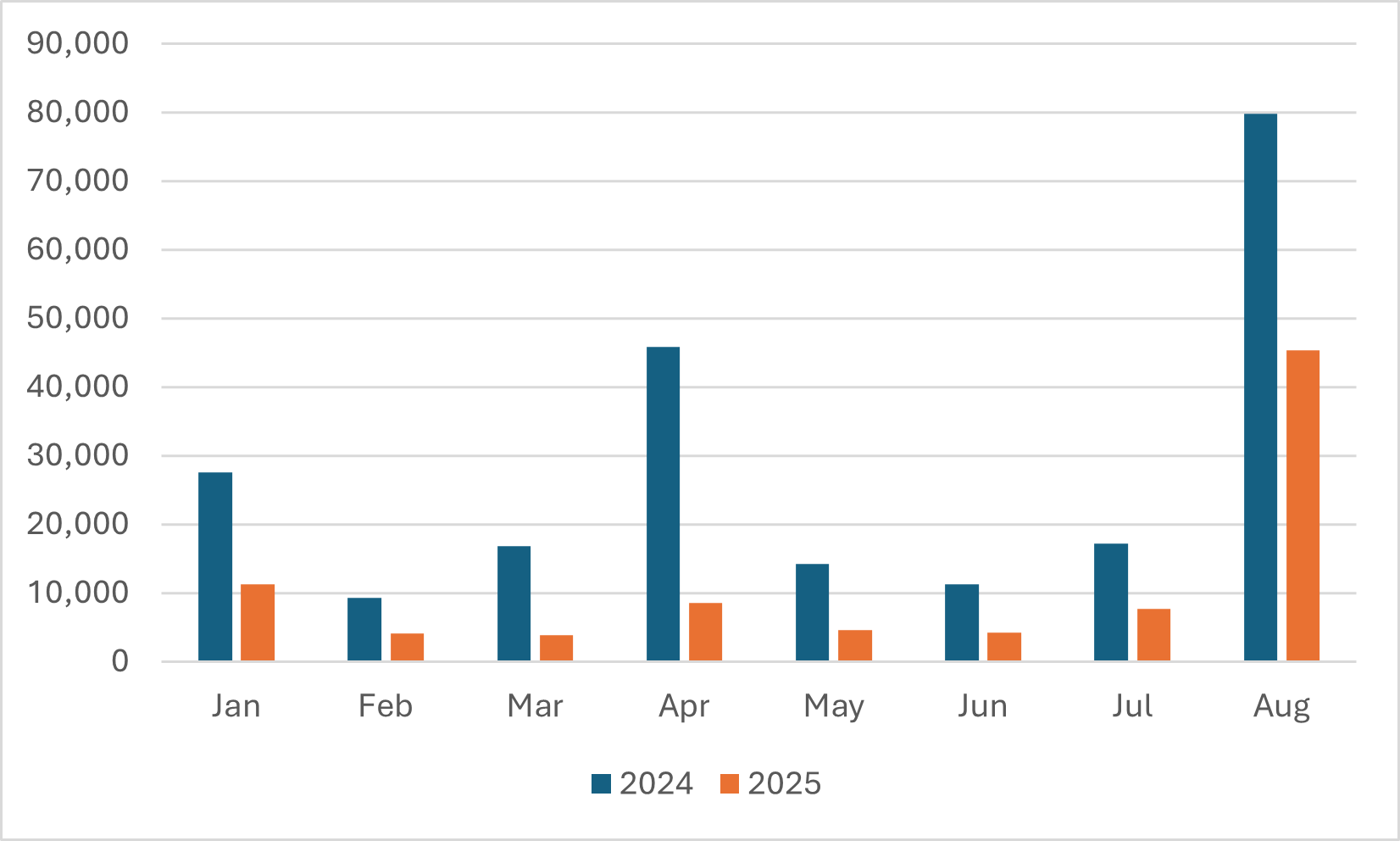
As you can see, these 2025 numbers are down on the previous year. Sixty percent, in fact. Meaning that this year’s total of new visas issued is on pace to be around 120,000, which is quite some ways from the visa application cap of 437,000. In other words, if the government actually wants to hit 150,000 arrivals/new visas issued, it might need to raise the application cap (though I have a feeling that line of argument might not end well if anyone actually tried it).
Anyways, what this means is that – even on budget night – it was obvious that the new targets, far from smacking institutions over the head with new restrictions, actually leaves them room to increase their new intakes in 2026 by anything up to about 29%. And this was true even before we learned from the 2026-28 Immigration Levels Plan that some graduate students will be excluded from the cap. With all of this context, we weren’t inclined to make this one of our top stories of the evening.
Now, some might take issue with our view for a few reasons. At universities, at least, raising new arrivals by 25% from this year’s abysmal totals might not prevent an overall drop of international students (and revenue therefrom) because the new intake might well be smaller than the 2022 undergraduate intake that will graduate this spring. Even if that weren’t true, where these new totals will really bite is not 2026, but rather 2027 and 2028. As universities continue to get short-changed by provincial governments, they need significant additional sources of revenue. What’s important about these numbers is that while they allow some small improvement, they won’t allow the kind of sustained growth that would permit institutions to rebuild their finances. The new numbers might allow the current bleeding to be stanched, maybe, but they don’t really allow the patient to recover.
Well, maybe. The government revises these numbers every year: there’s still the possibility that the 2027 and 2028 targets could be revised. And, of course, there’s the possibility of big growth in international graduate student numbers too.
So, let’s keep up the fight here. Canada needs more international students. The Ford government’s utter incompetence at building housing shouldn’t be holding the country’s higher education system hostage this way.


One Response
No mention of the possibility of and need for provinces to fund their universities adequately, to the point that using international students as a cash cow is not necessary. Foreign students are important for contributing to diversity within universities and, since they and their families have not paid taxes in Canada, it makes sense that their tuition should be higher than that of Canadian students, but this should not be a financial model for university funding.