



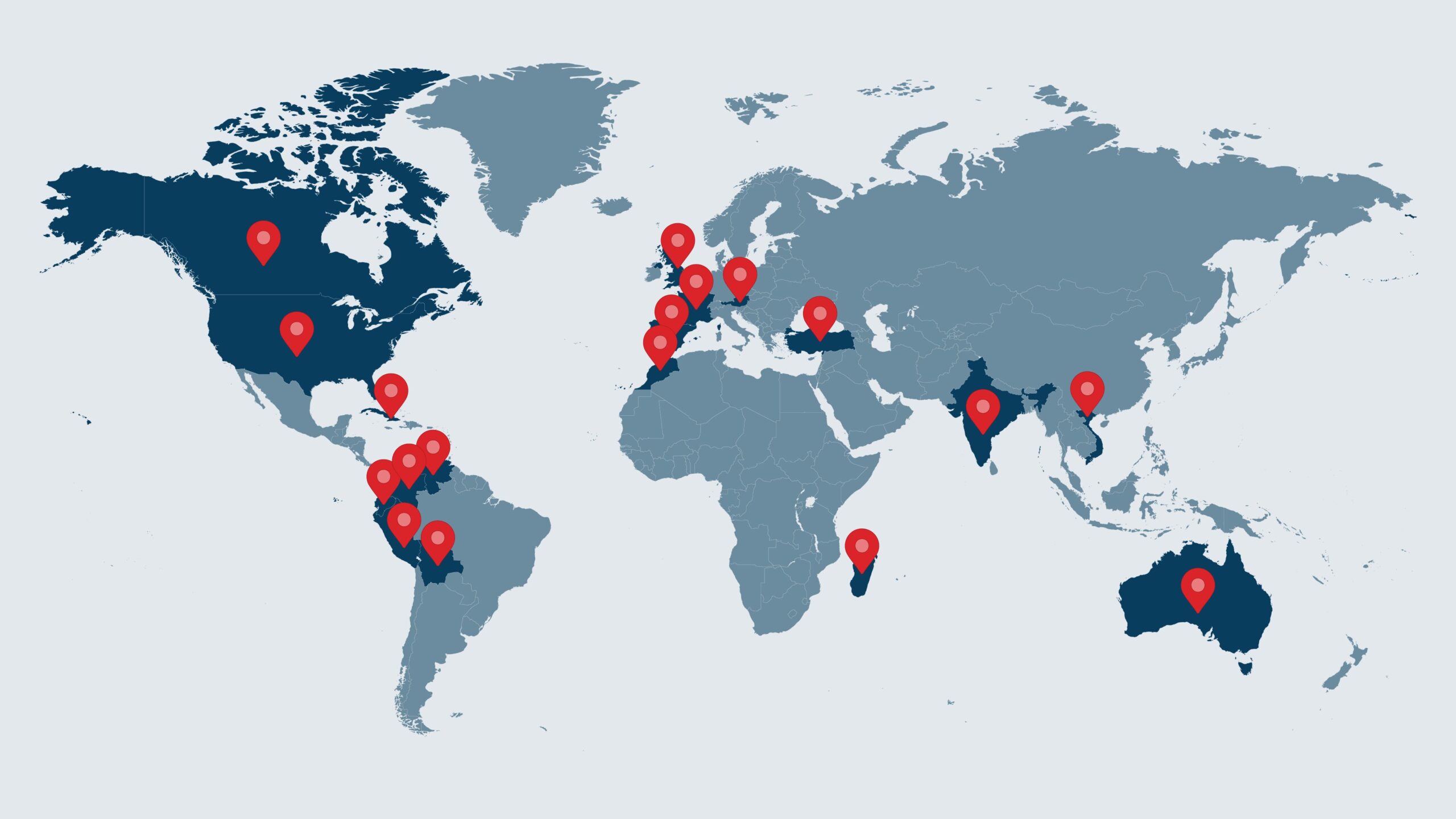
Morning all. It’s been a pretty crazy couple of weeks, with all sorts of bizarre stuff happening in Latin America, a strange construction deal in Madagascar, politically-motivated campus closures in Türkiye, budget news from Austria and Australia, mergers in the UK, and much more. Let’s get to it.
- Let’s start with two big multi-national publications. UNESCO published a useful state-of-the-globe document called Higher education global trends report: towards inclusive, equitable and quality higher education in an internationally mobile landscape. It delivers less than it promises because countries don’t submit that much useful data on access to UNESCO directly (not surprising: most don’t collect it for themselves either), but it does highlight implicit trends with respect to program completion which I thought was interesting. And King’s College London published a set of essays called European Higher Education in the 2020s: where are we heading? which I not would in any sense call groundbreaking but is nevertheless a decent overview of the continent’s major systems at mid-decade. Give them both a read.
- Speaking of King’s College London, it gained an airport last week when it took over Cranfield University – a small post-graduate institution with a decent line in aeronautical engineering 50 miles outside London – in what was politely called a merger but was quite evidently a takeover. Here’s a good WonkHE piece on this “merger” as the future of university tie-ups in Great Britain. Shortly thereafter a poll of UK VCs conducted by Universities UK suggested that 40% of institutions were contemplating mergers. Elsewhere in the UK at the institutional level, the University of Nottingham seems to be in the biggest trouble this week: a budget deficit that has widened from £17M to £85 has led to the possibility of about 600 job cuts. Sussex and Sheffield are also looking at significant program closures.
- Things got very interesting in Türkiye this past fortnight. About seven years ago, Bilgi University in Istanbul was bought by Can Holdings from the US firm Laureate Education. More recently, the company’s founder Kemal Can bought a number of press and media outlets – a move that put him squarely in the sights of Türkiye’s President, Recep Tayyip Erdogan. A few months ago, Turkish police threw Can in jail on various counts of corruption, which in Türkiye…maybe the allegations are true, but enforcement of rules is, shall we say, selective. Then, last Friday, the government suddenly ordered the university – which has a had a liberal orientation since its founding – to be closed immediately and all its students transferred to nearby Mimar Sinan university, which in fact lacks a number of programs that Bilgi had. Cue several days of student protest. Amazingly, the government backtracked on Tuesday, suddenly ordering it to be re-opened.
- Morocco announced a two-phase plan to open 49 university campuses over the next few years (a mix of new institutions and breaking up of old institutions), with the first 24 to be announced later this year and the balance at an unspecified later date. On a completely unrelated note, unemployment among recent Moroccan female graduates is hovering around 30% and men around 18%. Please make this make sense.
- Ecuador’s First Lady just earned a bachelor’s degree from a private university in just six months. Totally legit of course. Cue a great deal of handwringing about private sector standards.
- The Spanish government is finalizing a new decree on University Students which, among other things, changes the composition of governing boards in students’ favor, recognizes students’ right to strike and their right to mental health supports, as well as rights with respect to external internships/work placements and with respect to digitization. You can find a decent summary here.
- From the United States, some more evidence on the effects of free tuition, at least as offered to students in Tennessee through the Tennessee Promise program. The paper, available here, shows that making tuition completely free does marginally increase participation and completion, and that the program pays for itself under reasonable assumptions about longer-term graduate outcomes and taxation rates. However, expenditure per student in the program is quite low – about $1200 per student per year – because it builds on a host of other fairly generous subsidies. Free tuition, depending on the conditions under which it is implemented, might not deliver the same result.
- Fuel crises continue to cause disruptions in higher education around the world. In Cuba, which has effectively been without reliable fuel supplies since the Maduro regime was semi-replaced in Venezuela back in January, the lack of fuel has led to the cancellation of national university entrance exams this month. Meanwhile, in India, the government of Narendra Modi asked institutions to begin preparing plans for a switch to virtual in the near future in light of high energy prices.
- The French government has taken a half-step backwards in its quest to charge tuition fees to international (that is, non-EU) students. France has had fees for nearly a decade now, but institutions routinely chose to waive them. A few weeks ago, the government told institutions to stop waiving them, causing a wave of protests (it’s France, of course it did). The government has now partially backed away from its earlier measure, telling institutions they can waive fees for up to 20% of international students.
- Some quite bizarre news out of Madagascar where the government has signed a deal with a Malian construction group to build six new university campuses. The catch? The construction group had a similar contract in Niger a few years ago and…nothing. Did it abscond with the money? Did it lose its construction rights when the old government was swept away in a coup? Inquiring Malagasy want to know.
- The Australian government released its budget last week. Universities asked for: i) increase in PhD stipend rates, ii) a restoration of the Education Investment Fund (for capital purposes), iii) the government to make good its now five year-old promise to replace the previous government’s “Job Ready Graduates” funding program (actually, a humanities de-funding programs, but that’s another story) and iv) more research funding. In the end, what they got was some new science funding (paid for by cutting other science funding) and $2.5 billion over a ten years (yeesh) for growth and equity. Oh and a visa crackdown on private higher education providers. Better than a kick in the teeth, but still not brilliant.
- In Ontario, a story appeared which sheds a bit more light on the government’s sudden swingeing cuts to student aid a couple of months ago: turns out there has been a massive increase in the amount of grant aid going to private schools. Since this isn’t happening anywhere else in the country, there is something very fishy going on here. There is a lot more to this story yet to come.
- Here’s a very interesting story from the Times Higher on the appearance in Vietnam of some quite generously-funded corporate universities, in particular VinUniversity. It’s not an entirely unique model – it reminds me a bit of POSTECH in Korea, a country with which Vietnam is engaging in some deep partnership. Keep an eye on this institution, it could go to some interesting places.
- It’s been a bananas couple of weeks for higher education in Latin America. In Venezuela, there was yet another round of faculty strikes protesting the underfunding of higher education, and the 95%+ fall in the value of staff salaries seems to have finally pushed President Delcy Rodriguez to create a new fund for the “comprehensive recovery” of the sector. We’ll see soon what that amounts to in practice, I guess. Meanwhile, in Peru, two overlapping sets of student strikes – one starting at the University of San Marcos over moves in Congress to permit rectors to seek re-election, and the other about tuition increases at Pontificia Universidad Católica del Perú – have spread across the country at the same time as faculty in public universities launched a strike over the government’s failure to implement promised salary equalization measures. It’s chaos, and unlikely to be resolved until after the Presidential run-off vote on June 7. And finally, in Bolivia, students have joined national protests in favour of Indigenous rights and against the centre-right government which was elected twelve months ago.
- Austria has been one of the very few good news stories in Europe with respect to funding in the last few years. An 11% increase in the science budget last year and a 30% increase in institutional funding in the 2025-27 triennium over the previous one. Institutions had been expecting another big boost, asked for an additional €1.5 billion in funding for the next triennium but instead got a cut of €1 billion (which, let’s be clear, is still substantially better than what they had four years ago). But universities simply freaked. They warned about layoffs, science being crippled, a collapse in medical science, yadda yadda. Very dramatic. Expect this one to play out for a few more weeks.
That’s it for now. Back in two weeks for the last fifteen before the summer break.