





Over the past two days (see Part 1 and Part 2), we have been comparing the autonomy granted to public universities by all ten provinces, along four different dimensions (organizational, financial, staffing and academic), using a methodology originally devised by the European Universities Association (EUA), with a few modifications from me to make this project work in Canada (see the Monday blog for details). Now, it’s time to tie all that together and show how provinces compare to one another across all dimensions, and how Canada as a whole compares to Europe.
Let’s start by looking at Canadian provinces across all four dimensions, presented below in Table 1. As noted on Monday, I use modal scores rather than mean or median because I am trying to show the “most typical” experience in each province. In cases where a modal score is impossible, I have used a mean score (marked by an asterisk). The national score is also a mode, but because 22 of the 67 universities examined in this exercise lie in Ontario and there is very little variation between schools in that province; it should not be a surprise that the national and Ontario modal scores are identical.
Table 1: Modal Autonomy Scores by Province
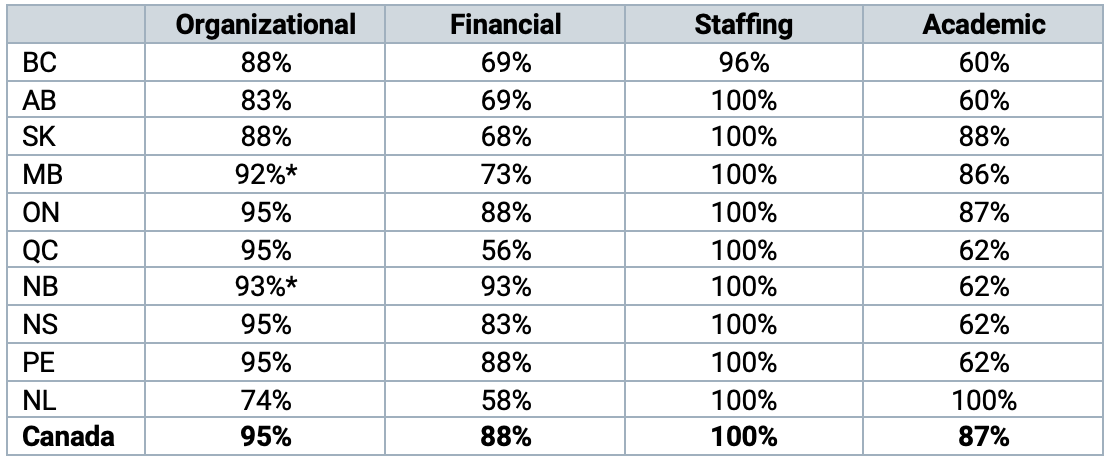
On the whole, Ontario stands out as having the highest scores across the board. The basic reasons for this are that universities are not under the Government Reporting Entity (which drags down Alberta, British Columbia, Newfoundland, and, to an extent, Manitoba), allows its universities more autonomy around starting and closing programs than other provinces, and does not really have any provincial policies around quality assurance. Lowest scores are in Alberta and BC, which keep institutions on a much shorter leash, and in Quebec, where government control of tuition fees really bite.
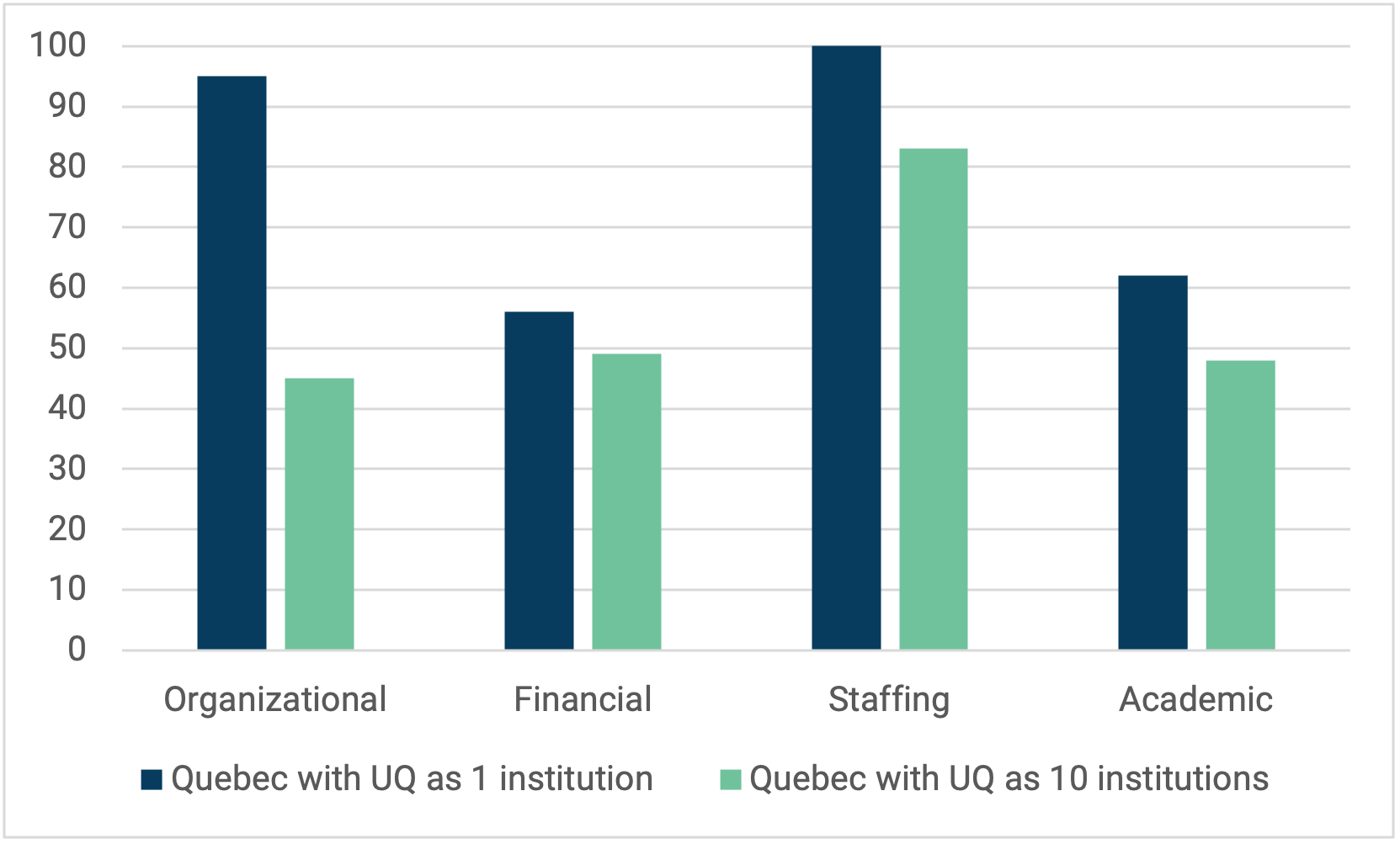
I should point out here that Quebec’s score is largely due to a methodological choice to score Université du Québec as one big institution rather than ten separate ones. Because I use modal scores, in effect, the Quebec score ignores the UQ sector completely, because it is always a very low outlier; had I gone the other way, the UQ score would itself be the norm. Just so we’re clear on what a difference that makes, figure 1 shows Quebec’s score as is, and if UQ were treated as ten institutions.
Figure 1: Alternate Quebec Scores
Now let’s compare Canada to European countries. In figure 2, I have shown the result for all 35 jurisdictions which took part in the 2023 EUA exercise, plus ten Canadian provinces and the national mode as well (this isn’t an exact comparison because the European numbers date from 2022, and so aren’t quite up to date, but it’s an imperfect world). To show them all together in a single chart, I have done something which I am quite sure my EUA colleagues would disapprove of, which is to order the jurisdictions according to their total score across four areas, thereby collapsing a multi-dimensional score into a unidimensional one. But you know, it just looks a lot better on screen this way.
Figure 2: Autonomy Scores, Canadian Provinces and EUA members
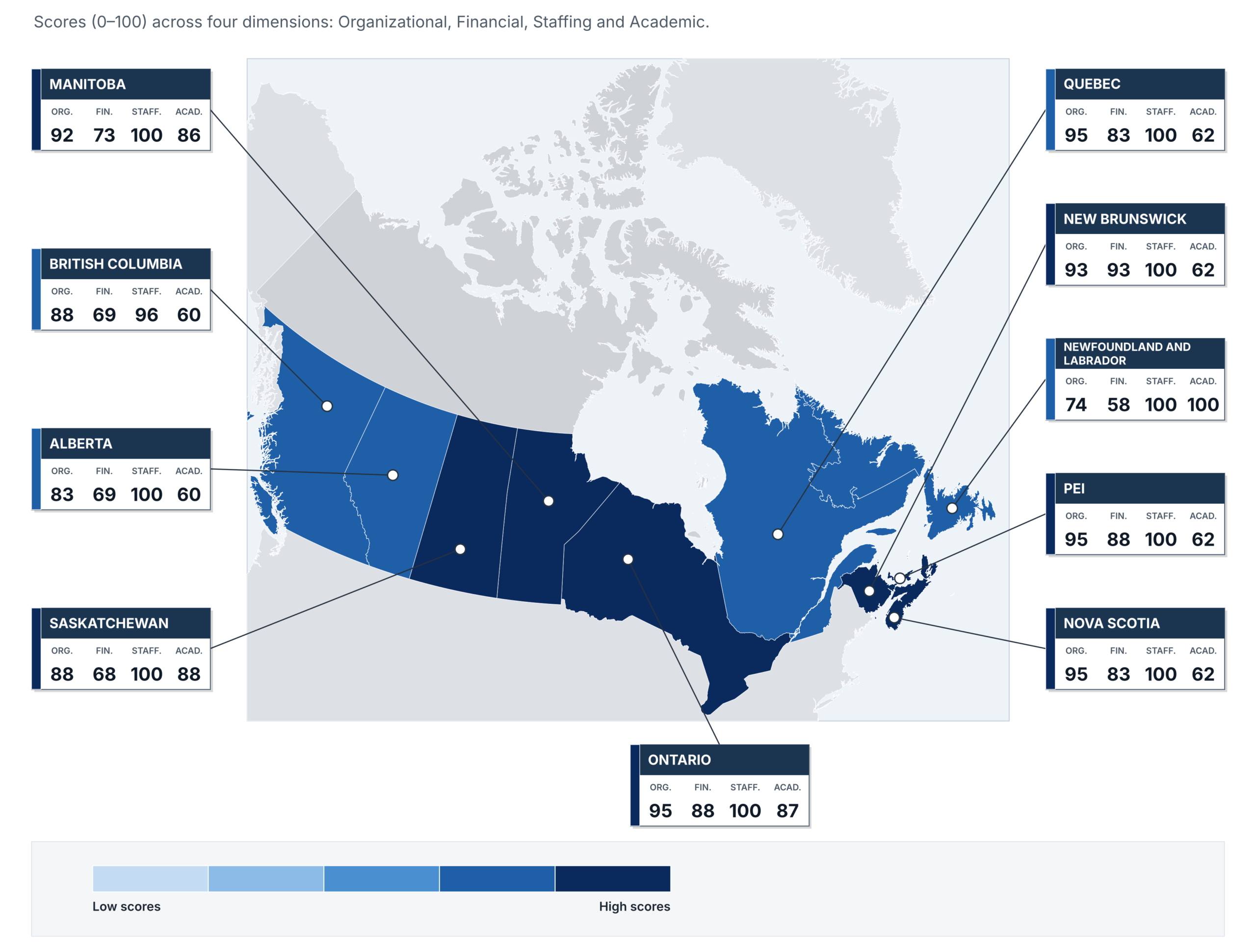
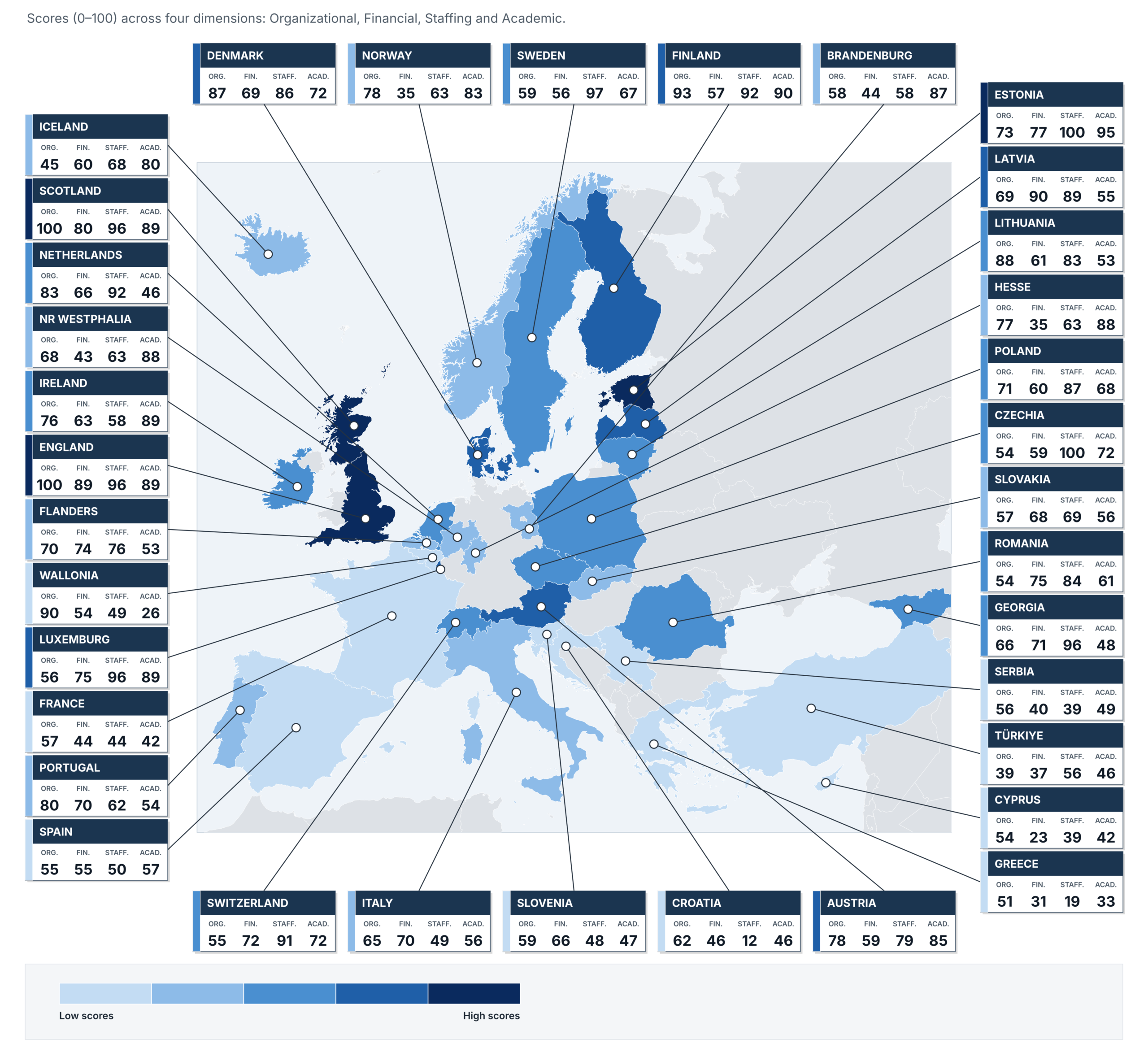
What Figure 2 shows above all is that while there is some diversity in autonomy scores between Canadian provinces, when compared with Europe, these differences are pretty minor. Even the lowest-scoring Canadian provinces – that is, British Columbia, Alberta and Quebec – look better than all but the very top European countries (though, again, if I used the alternate methodology for Quebec, that province would be somewhere between Italy and Slovenia on this list). And there are some areas where some Canadian provinces really stand out: Newfoundland and Labrador is the only jurisdiction where academic autonomy is scores at 100%, which probably makes Memorial University – by my reckoning anyway – academically the most autonomous university in the world.
Does any of this say anything about educational quality? Not necessarily. Autonomy is a necessary ingredient to quality, but not a sufficient one: things like money and talent matter. And, of course, one might well argue that at least some types of autonomy-impinging regulation is a good thing. Canada’s highest scores in academic autonomy, for instance, come from provinces that have no serious external quality assurance practices rather than ones which have smart external quality assurance practices.
But what I hope this exercise has shown over the past three days is that it is possible and useful to compare legislative and policy frameworks around institutional autonomy to highlight differences across the country, and to put the country as a whole into international comparative perspective. And, as is usually the case for Canada, yes, there are little differences from one place to another. But on this subject, as in so many others, cross-provincial differences are pretty small, all things considered and, on the whole, universities elsewhere would consider themselves lucky to have the kind of autonomy our institutions have.