





Institutional autonomy is one of those things that is hard to pin down. First of all, because it’s a multi-dimensional concept – institutions may have more freedom in some areas of action than in others – and, second of all, because it’s hard to come up with practical measurements of autonomy that might allow for standards and comparison.
Long-time readers will know, of course, that the European University Association (IMHO, the world’s coolest university club) regularly produces a comparison of levels of university autonomy in Europe called the Autonomy Scorecard (I interviewed the report’s lead author and rock star Enora Bennetot Pruvot about the issue on the podcast back here). As these things go, it is a pretty rigorous analysis, measuring autonomy in four different areas: organizational autonomy, staffing autonomy, financial autonomy and academic autonomy. For the curious I encourage a quick read of the Autonomy Scorecard.
For some time now, I have wanted to do this for Canadian institutions – both to compare levels of autonomy between provinces, and to compare the Canadian norm to the European one. However, there are a couple of problems with doing so here. The big one is that in most European countries, all institutions are under the same law. Canadian provinces, in their infinite wisdom, mostly provide every institution with its own legislation. They don’t vary that much within a province, but enough that it’s difficult to generalize the way the EUA does. Some provinces of course have legislation that affects all institutions (the BC Universities Act, Bill 12 in Nova Scotia, etc.) but they don’t cover the whole ground, and you still have to look at individual acts to get a sense of what is going on. And friends, this is a free blog: my ability to devote long hours to this stuff is limited.
(Also, EUA has national university rectors’ associations to help with the analysis. Over here, there’s just me with a bit of help from Claude.)
The other major issue is that there are some aspects of autonomy which are relevant to autonomy measurement which either lie in processes not referenced by Acts (institutional acts tend not to outline government authority over program approvals or about conditional government funding) or are simply by their nature “custom and practice” rather than legal. For instance, in Alberta, the government uses its appointed Board Chairs to micromanage all manner of things within institutions that are unimaginable elsewhere in the country, but this is not written down anywhere.
But there is good news! First, with some oversight and training, Claude is pretty good as a research assistant and is able to scan legislation for specific information such as the kind required to score the indicators that EUA uses. Second, yours truly actually knows a thing or two about custom and practice, and can in most cases fill in the gaps. And so – with a little AI assistance – I present to you my analysis of Canadian institutional autonomy on a province-by-province basis. Today, I will just look at comparisons on the dimension of organizational autonomy; tomorrow I will look at financial, staffing and academic autonomy. And on Wednesday, I will try to make comparisons between Canada and Europe.
Sitting comfortably? Let’s begin.
The first dimension that the scorecard measures is Organizational Autonomy. This dimension has eight indicators. Four of these are related to the selection of the executive head (does the government select or have a veto over selection, can it impose criteria for selection, can it set the executive head’s term, and can it dismiss the executive head). On top of that, it measures the presence of external members on the Board (good), the degree to which government controls the membership of the governing Board (bad), the freedom of institutions to decide on their own academic structures (the number of arrangements of faculties and departments, for instance, or their committee structures), and finally, their capacity to create their own legal structures. I am not sure this makes total sense as a set of indicators in Canada because – with the exception of Memorial and UNB – governments really have no say over presidential appointments and all institutions have the ability to create their own subsidiary corporate structures. But, these indicators matter a lot in Europe, where governments as much more likely to exercise control; this exercise is predicated using on the EUA model, so that’s the way we’re going to do it.
I am not going to get into the nuts and bolts of how scoring and weighting was done here, but if you really want to know, do look up Annex 2 of the EUA document. Each institution across the country was scored individually: provincial scores are the mode of institution scores; if there is no mode, I use as an average. The results are in Table 1.
Table 1: Organizational Autonomy Scores by Province
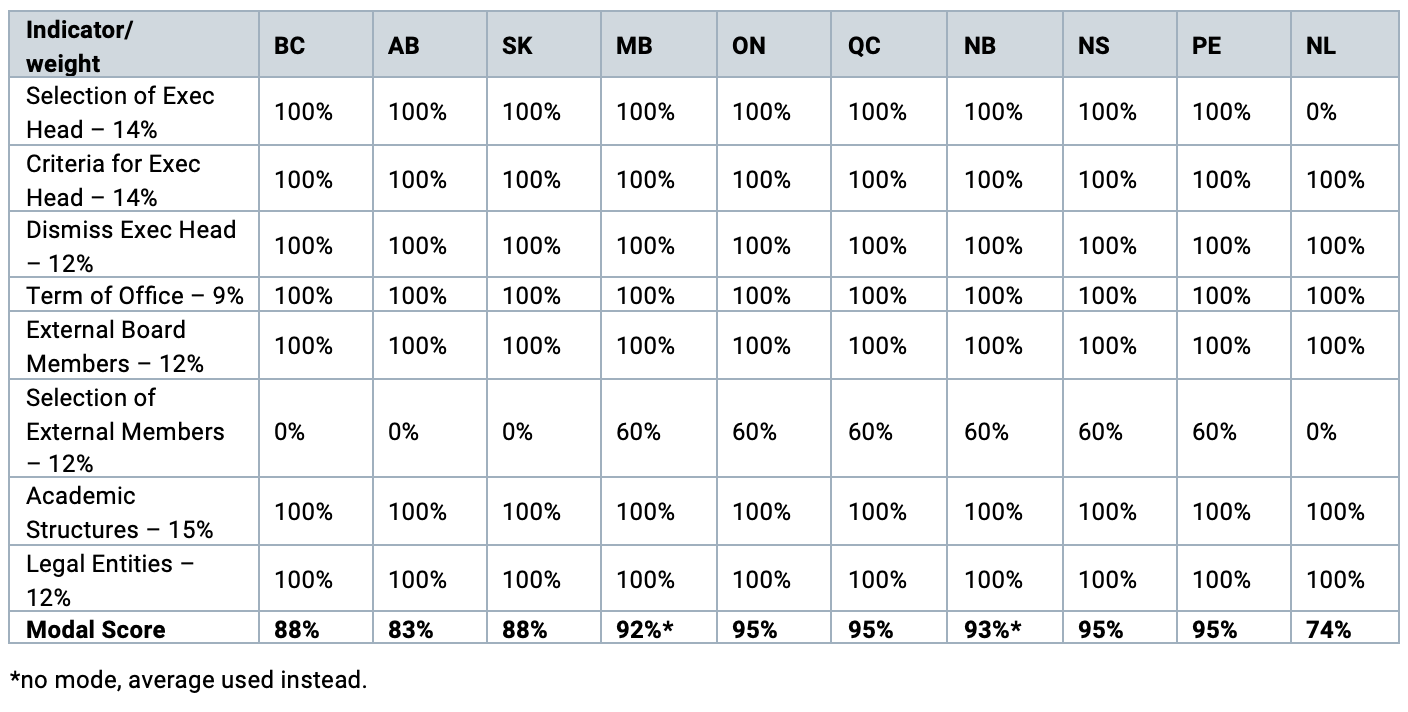
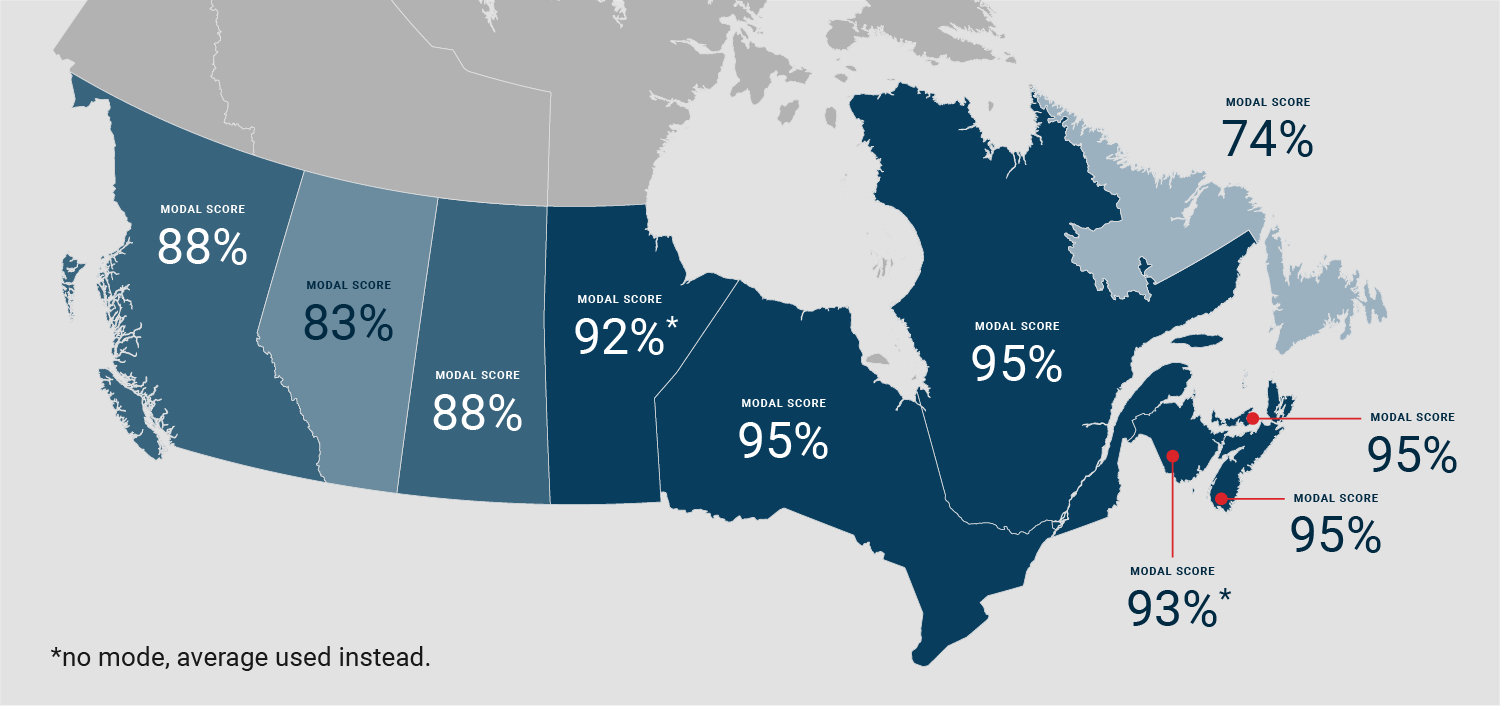
A couple of things to note here. The first is that most provinces have identical high scores on all of these indicators. In fact, with a bit of a caveat for Quebec, the whole country apart from Newfoundland has 100% autonomy on the selection of the Executive Head and external members of the board. As we’ll see when we get to comparisons with Europe on Wednesday, these are extremely good scores in international comparison.
But let’s dig into those scores on the “selection of external members” for a second. The EUA definition penalizes institutions if an “external authority” has the power to control Board seats. My reading of that is that “external authority” isn’t just provincial Lieutenant-Governor-in-Councils (LGICs), which nominates at least some external Board members at about 80% of universities across Canada; if a board has seats that are required to come from a particular source, like the University of Ottawa’s 8 seats (out of 32) that are named by the affiliated Université St. Paul (which is batshit crazy, by the way), or the smattering of mayors that sit ex-officio on Boards across the country, or the member of UNB’s Board elected by the provincial teachers’ association for some reason.
Now, to be fair, assigning scores simply on a straight read of legislation probably gives some universities a harsher score than they might deserve. For instance, a number of historically religious universities have seats reserved for certain denominations. Technically, that’s an “external authority”. In practice, often what happens is the denomination lets the university suggest names which it then “appoints”. It’s the same to some extent with LGIC appointees. Some governments ask the university for suggestions about appointments, which in the EUA methodology would bring a points deduction but not the full deduction implied by a straight LGIC appointment. The problem is that, with the exception of Dalhousie, this is not written down anywhere – it’s custom and practice. This informality and rules-which-are-not-written-down-anywhere is a very Canadian approach to governance – it would be basically unimaginable in much of Europe.
There’s another judgment call on this indicator; namely, whether or not elected alumni association members are considered internal seats or external seats. I have treated these as external, and therefore any institution that has elected alumni seats has at least some restrictions on its ability to select members for the Board and why only four universities in the entire country get a 100% score on this indicator (STU, Brock, Bishop’s and Concordia). There are, in fact, a surprising number of other institutions which have no LGICappointments on their boards (McGill, Queen’s, StFX, King’s, Mount Allison, Sherbrooke, Carleton, York, and Trent), but they are all legally required to have elected alumni reps and so are not “free” in this sense.
A final note here: I treat Université du Québec as a single institution. That matters for calculating the mode for Quebec, because it means UQ is one out of seven institutions rather than ten out of sixteen. This matters, for instance, on “selection of executive head” – Quebec gets a 100% on this because the non-UQs collectively make up the mode. Were it the other way around, Quebec would get a zero. I had to choose one or the other, and this was the way I chose. That’s enough for now. Tomorrow, we’ll look at scores for financial, staffing, and academic autonomy.