





Apprenticeships are the red-headed stepchildren of post-secondary education in Canada, mainly because while the instruction is considered to be at a post-secondary level, the learners aren’t actually enrolled in any institution. Rather, they are employees who i) have been registered as apprentices and therefore have regulated wage rates and working/learning conditions while at work and ii) who take classroom training for 6-10 weeks per year at some kind of learning institute.
(The second part of that is a bit more complicated than the first. First of all, not all apprentices follow a strict schedule of one set of courses per year either because there are waitlists for classes or because the employer doesn’t feel like letting them go during a busy period of work. Second, the class time can vary a bit outside the 6–10-week range. And third, while classroom experience used to mostly occur in community colleges, in recent years, provincial governments – particularly in Ontario – have discovered the political benefits of allowing construction unions to run training operations themselves in relevant trades.)
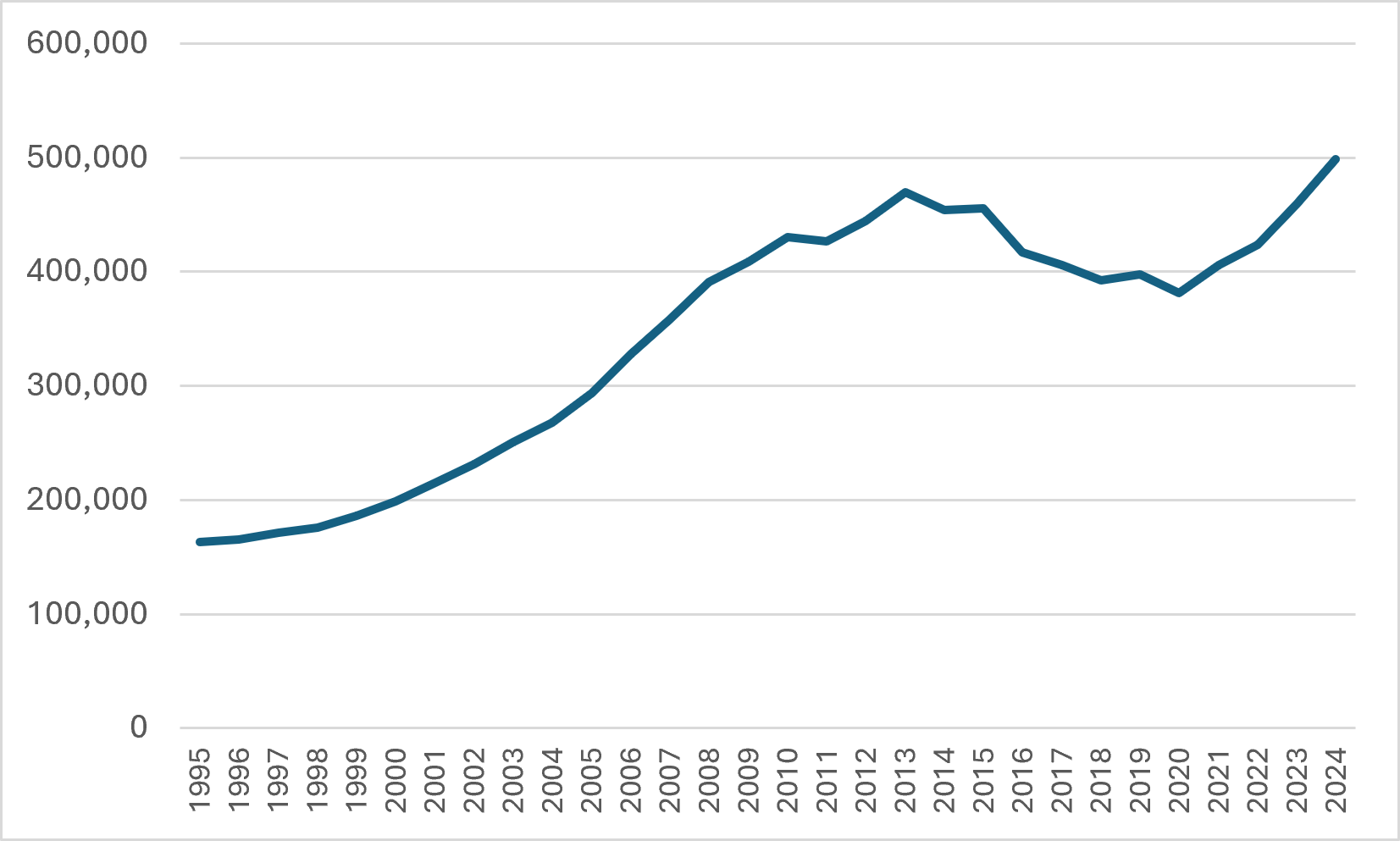
Anyways, enough preamble. Figure 1 shows the number of registered apprentices in Canada for the past 30 years. Numbers registered fairly steady growth from the late 1990s until about 2013 before taking a brief downturn. Partly, the downturn was about the collapse of oil prices and the consequent squeeze on energy companies’ payrolls (apprentices are often the first ones fired in a recession); it was also partly because of the sudden disappearance of about 25,000 apprentices in a category called “user support technicians” (i.e. call centre employees) due to an absolutely bananas Ontario tax credit loophole being closed. Numbers began rising again during COVID and reached an all-time high of 499,000 in 2024.
Figure 1: Registered Apprentices, Canada, 1995-2024
Now, if you listen to certain politicians, figure 1 might surprise you. Aren’t we always hearing about how we need more tradespeople, and the problem of “parity of esteem” with degrees, etc., etc.? Well, get ready for figure 2, which compares the growth rate of registered apprentices with the growth in the number of university and college enrolments over the past 30 years. While college and university numbers are both up by about 90% (significantly less if we exclude international students), apprentice numbers have tripled. It’s not even close.
Figure 2: Change in Learner Numbers, by Type of Post-Secondary Education, 1995-2024 (1995= 100)
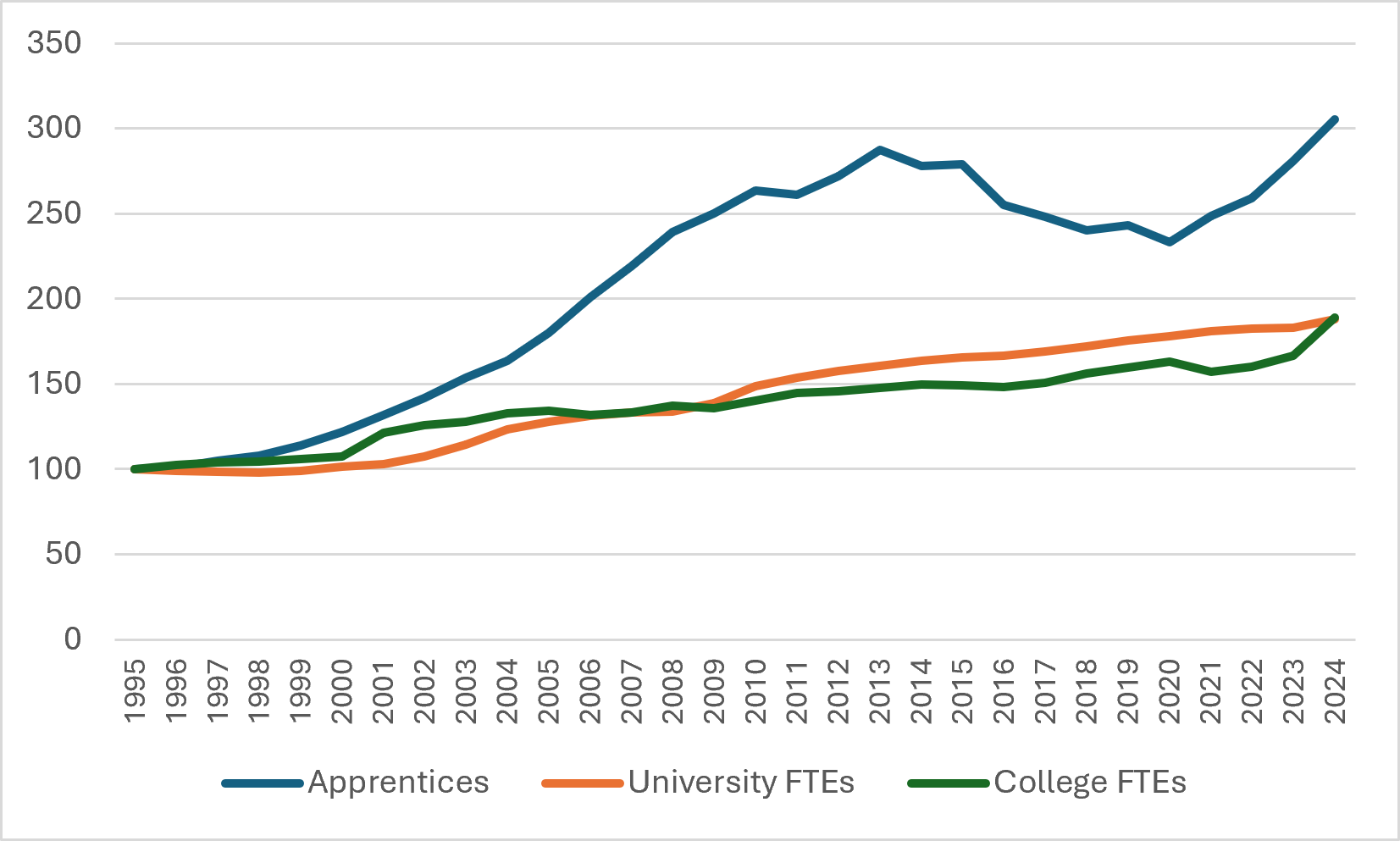
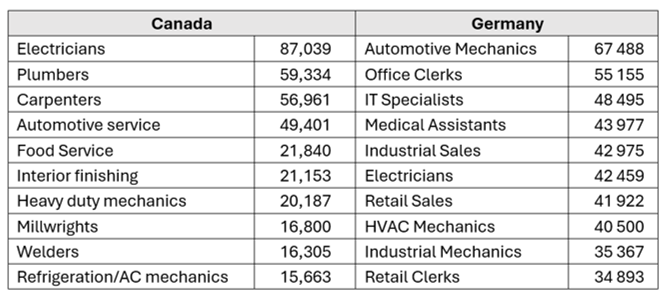
Figure 3 shows enrolment numbers for the top ten trades in Canada. Just over 50% of all apprentices in Canada are in just four trade groups: electricians (87,000), plumbers (59,000), carpenters (57,000) and automotive services (49,400). Beyond the top four, there is a long tail of trades that have between 10 and 20,000 apprentices apiece.
Figure 3: Registrations, Top Ten Registered Apprentice Trades, 2024
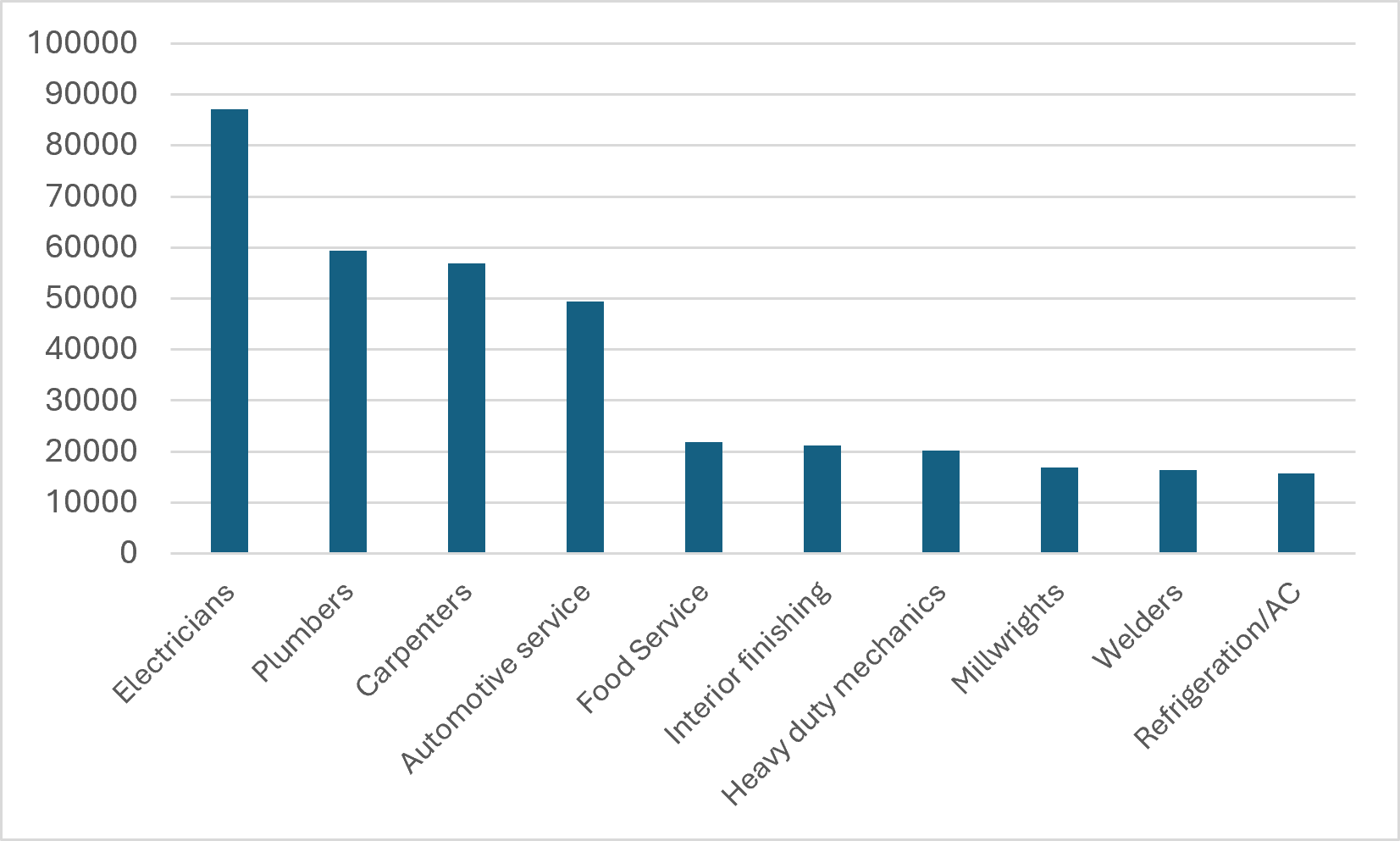
Figure 4 shows the growth rate among those trades that had more than 1000 apprentices in both 1995 and 2024. The biggest growth was in trades that were relatively small 30 years ago: the refrigeration/AC mechanics trade and landscaping trade have both quintupled in size over that 30-year period. Electrician numbers, by contrast, have merely tripled, but in absolute terms have seen the biggest increase (+58,000).
Figure 4: Growth in Number of Registered Apprentices, by Trade, Selected Trades, 1995 to 2024
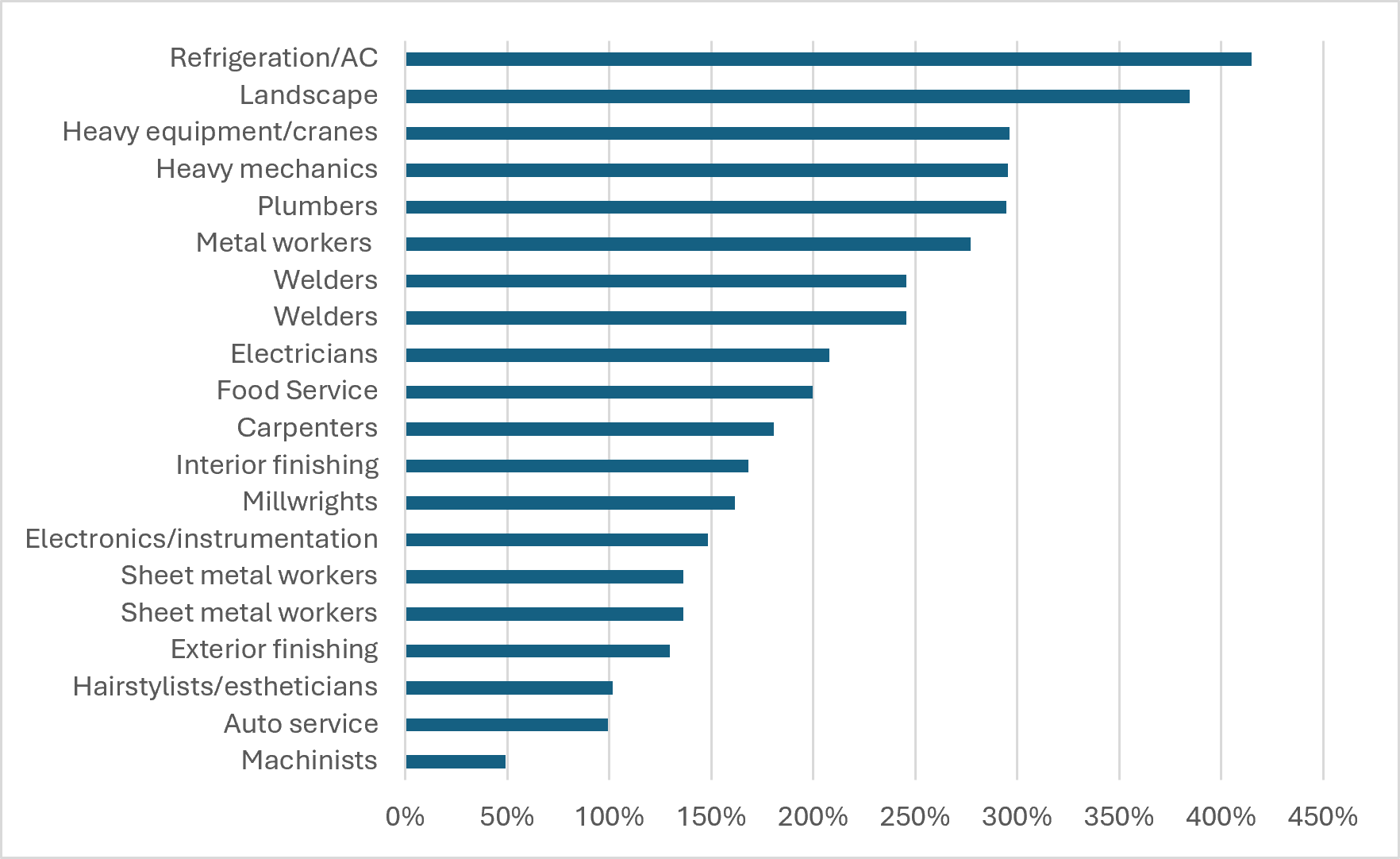
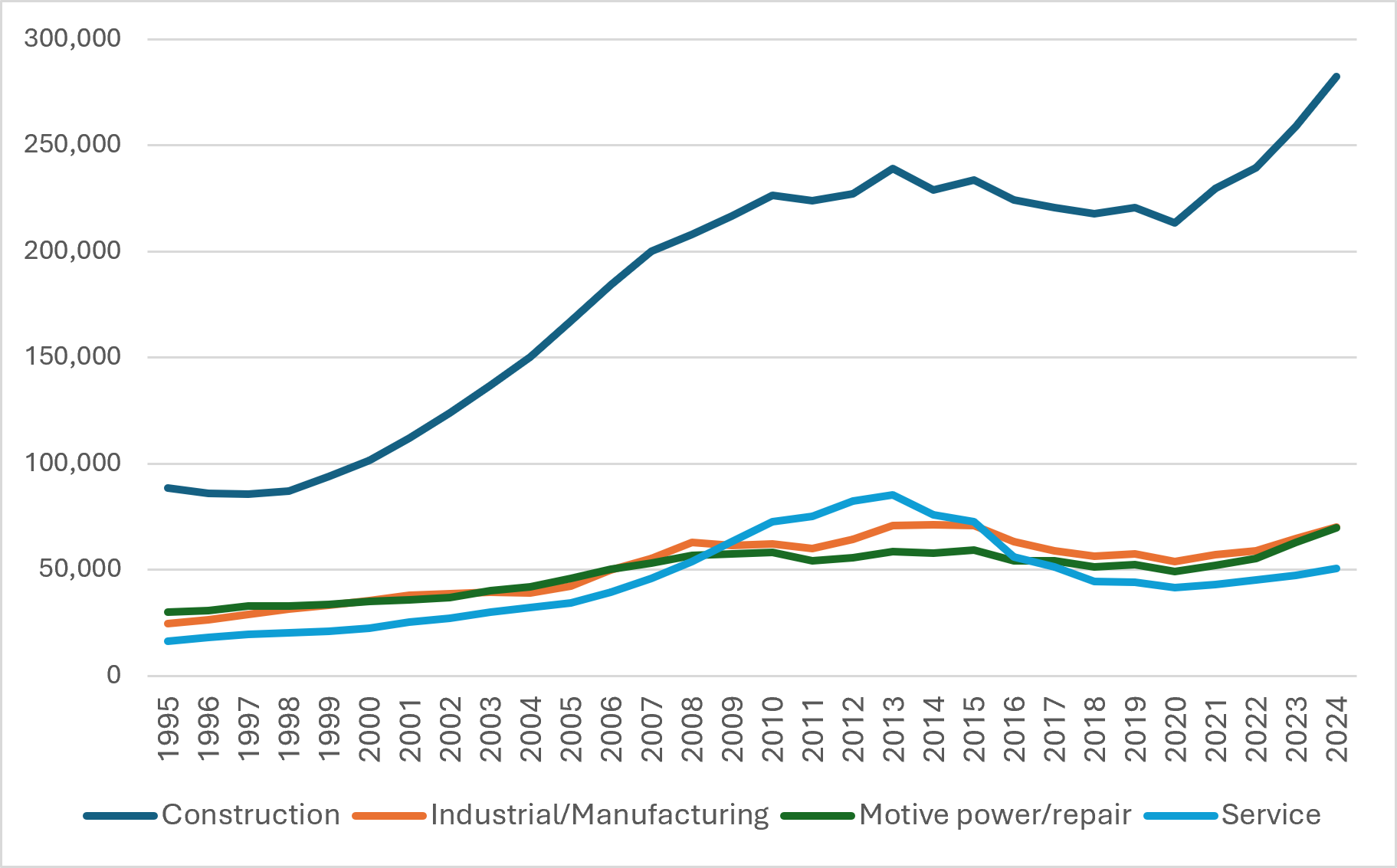
Figure 5 groups trades together in order to make it easier to see long-term trends. It shows registrations for four broad groupings of trades over time: construction (electricians, carpenters, plumbers, internal and external finishers, sheet metal workers, cane operators, etc), industrial/mechanical (machinists, metal workers, welders, electronics & instrumentation, etc), motive power trades (auto mechanics and heavy duty equipment mechanics), and service trades (food service, aestheticians, landscapers, community service workers, Early Childhood Educators, etc.). As the figure makes plain, apprenticeships in Canada are mostly about construction trades, with roughly 60% of all apprentices enrolled in this sector.
Figure 5: Registered Apprentices by Broad Sector Grouping, 1995-2024
Canada’s focus on construction trades stands in huge contrast to how apprenticeships work in Europe. Table 1 compares the top ten apprenticeship trades in Canada and Germany. Although Germany’s “dual system” of education is often credited with German success in manufacturing, in fact over half of the top trades in Germany are in white-collar occupations, such as retail sales, industrial sales, office clerks, and medical assistants. In Canada, only one of the top ten trades (food service) is not blue-collar.
Table 1: Top Ten Apprenticeship Registrations, Canada v Germany 2024
In short: if we restrict the notion of apprenticeship to what are called the “skilled trades”, Canada is arguably a world champion, with substantially more apprentices than Germany in the sector, once population differences are accounted for. What Canada is missing is a more formalized apprenticeship system for white-collar trades, an issue which is on exactly nobody’s policy agenda.
Enough for today. Short programming note: because of the federal budget this Thursday, the blog will, unusually, appear on Friday this week. See you then.