



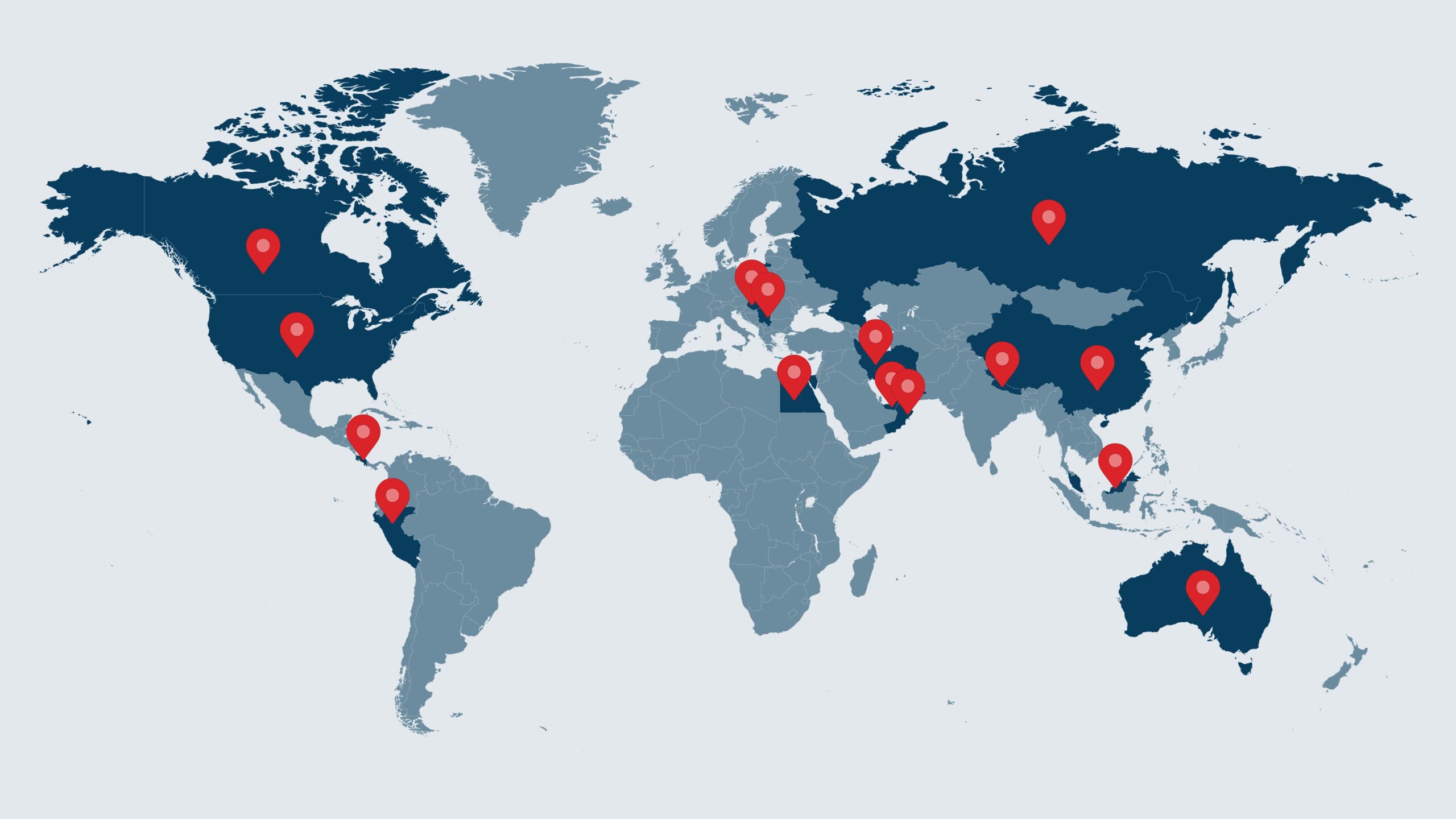
A lot has happened in the last three weeks, and there’s a lot that didn’t make it into this edition of the Fifteen, which is a lot heavier on events in Europe and Asia than usual. There’s a lot in here on science and research – from China looming supreme, to America punching itself in the face, to Australia being indecisive – as well as new evidence of a crisis of reproducibility. But politics gets a big place, too, what with elections in Hungary and Peru and a new Prime Minister eager to shake things up in Nepal. My favourite though is the story about an absolutely bananapants public policy process in Costa Rica (it’s #14). Anyways, hop on: let’s go!
1. Probably the biggest story of the last couple of weeks was the OECD statistical release on Research and Development expenditures which showed that China has, for the first time, surpassed the United States at just over 1 trillion dollars. Cue much hand-wringing from the US side along the lines of “Game over. The Chinese have won”. And of course, this is all based on data from 2024 – that is, before Trump returned to power.
2. Trump, of course, is trying as hard as possible to accelerate American scientific decline. His fiscal 2027 budget request involves $5 billion cuts to both the National Institutes of Health (NIH) and the National Science Foundation (NSF), as well as similar-sized cuts to NASA and the Environmental Protection Agency. Budget proposals don’t always come to pass; Trump proposed much larger cuts last year only to see them rejected by Congress (NIH actually received an increase in 2026). However, Trump’s response to losing in Congress is simply not to spend the money Congress allocates: here are some pretty astounding visualizations of how NIH and NSF money is being curtailed in practice. Meanwhile, at the state level, funding is up but for the first time in over a decade per student funding is down.
3. China, of course, continues on its merry way forward. Here’s a good essay on what the 15th Plan means for higher education. The conclusion is basically that it’s mostly about AI: both about how the top institutions can keep innovating in this space, and how academic programs keep up with the technological change.
4. Iran’s Science Minister announced that since the beginning of the bombing campaign in late February, the United States and Israel have bombed thirty different universities, with a total death count of sixty. In response, the Iranian government has declared all American educational institutions in the region legitimate targets for attack. American campuses in the region, which had hitherto left campuses open while switching to online teaching, quickly closed.
5. While countries like Cuba, Pakistan and Bangladesh went online in February and March due to fuel crises, in the last couple of weeks national systems have been going online in reaction to fuel crises in the last few weeks; in Egypt, universities went online in late March because of heavy rain, as did universities in Oman. Meanwhile, extreme heat in Malaysia has led the Ministry of Higher Education to give each university the freedom to move online in response to local conditions as they see fit. Seems like one of the long-term consequences of COVID is that all learning is ultimately hybrid.
6. In Nepal, the new government – which came to power in part as a result of a powerful youth movement in 2025 – has decided that one of its 100 priorities for governing is to interfere in student politics. As in many Asian countries, student politics in Nepal are contested by youth wings of actual political parties and are often seen as a proxy for national politics as a whole. The new Prime Minister, former rapper Balendra Shah, wants to ban political parties operating inside universities.
7. The Australian government’s Strategic Examination of Research and Development has released its final report, entitled Ambitious Australia. Like pretty much every other national review that has been conducted in the last few years, it suggests Australian commit more money to basic research (and increase stipends to graduate students) but focused on a more limited (in this case six) range of fields (or “pillars”), on the grounds of higher returns to specialization (see a summary from the Times Higher here). The sector was basically supportive, but – surprise, surprise – the Government has been basically non-committal in its response (remember, this is a government that took power almost four years ago partly on a promise to junk the previous regime’s university funding arrangements but has yet to move on it).
8. There are a lot of elections coming up. In Hungary, the governing FIDESZ party – which has taken a pretty active stance in controlling universities (good piece in the Times Higher here) stands a decent chance of being beaten this weekend. The opposition TISZA party’s manifesto is very detailed in its explanation of how it will reverse pretty much everything FIDESZ has done. Over in Peru, there are a dozen candidates vying to make it into the second round. Summaries of the candidates’ positions can be found here and here. Broadly speaking, all candidates agrees that student aid needs to be increased, but there is a left-right split on the subject of the higher education regulator, SUNEDDU – the left wants to strengthen it, and the right wants to weaken or dismantle it.
9. The Russian Ministry of Education and Science has issued an instruction to the country’s university rectors: make sure 2% of the student body signs up for military service or else.
10. In late February/early March two female students were (separately) killed in two incidents near two different campuses of the Universidad Autónoma del Estado de Morelos, just south of Mexico City. The students there began occupying buildings in order to demand better campus safety and security. Ending the strike took time because students didn’t believe the university’s promise not to engage in reprisals. Most of the big issues have in theory been addressed, but low levels of trust between the two sides mean negotiations keeping breaking off, most recently on Wednesday.
11. UNESCO published its Global Education Monitoring (GEM) report (highlights here, full text here). This year’s theme was “access and equity”. Though most of the report deals with K-12 education, Chapter 5 on post-secondary education is pretty interesting – it focuses primarily on completion and attainment, and notes specifically that attainment rates are growing more slowly than participation rates.
12. Thing are hotting up in Serbia again. On March 25, a female student at the University of Belgrade died after jumping from a fifth floor window, apparently in a panic after pyrotechnics were set off inside the building. Police took this as an excuse to raid the campus, and a government Minister to make an unbelievably offensive suggestion that parents not send their children to this university (a hotbed of opposition to the government) or risk seeing them come home in coffins. The University of Belgrade’s rector replied by making a defiant anti-government speech in which he hinted he might become a candidate for President in next year’s elections.
13. Canadian readers will have heard this one already, but for everyone else: checkout the report of Canada’s Auditor General on the operation of the International Student Program. There is much to chew on here about the process that led to Canada’s international student catastrophe, but the most stunning piece of information is the graph on page 6 which shows that total new student visa approvals in 2025 were NINETY PERCENT down on 2023 levels. Absolute policy vandalism from the Liberals.
14. Costa Rica is going through its triennial re-negotiation of public subsidies for institutions. This is a process basically unheard of anywhere else in the world in the sense that the division of public funds is left up to the institutions to decide themselves via negotiation. Read that again: they decide among themselves. No formula. Just arguing. What I wouldn’t give to watch one day. Anyways, since the University of Costa Rica has always had the largest share, negotiations are really about the other institutions ganging up on UCR in order to reduce its share, but it’s unclear for now how things will play out in this round.
15. Last week, Nature reported on the finding of a massive research project concerning the reproducibility of social science research showing that only half of such research could actually be reproduced. Ungood. For a more detailed examination of why social science does so poorly, I recommend a look at a recent article by the University of Guelph’s Ryan Briggs.
And that’s it for this week. The Fifteen will return three weeks from today on May 1. See you then.