







Yesterday we looked at how individual institutions within Canada fared in the last round of international rankings. One of the key phenomena that we saw was that while the eight Canadian institutions in the top two hundred of the major rankings were more or less holding their own, the slightly less research-intensive were seeing their numbers slip across all. Today, I want to show why that phenomenon is more about improvements in higher education in other countries than it is about Canadian institutions being in decline.
To do that, I need to first explain a little bit about the three major international rankings and how they differ. The oldest – and in theory the staidest – of the three is the Shanghai Rankings (methodology here). It prides itself on using “independent” data – that is, data which does not come from institutions themselves – which has heavy skew towards bibliometric indicators, and in particular ones which emphasize publications in prestige journals. The THE (methodology here) and QS (methodology here) rankings, on the other hand, rely much more on i) data provided by institutions and ii) surveys of academics and/or employers (the similarity in metrics are due to the two having a common ancestry (QS originally did the THE Rankings, until THE decided to do them alone and QS decided to keep producing its own rankings). As a result of this reliance on more subjective criteria, these two institutional rankings are usually seen as being more volatile than the Shanghai Rankings.
Anyways.
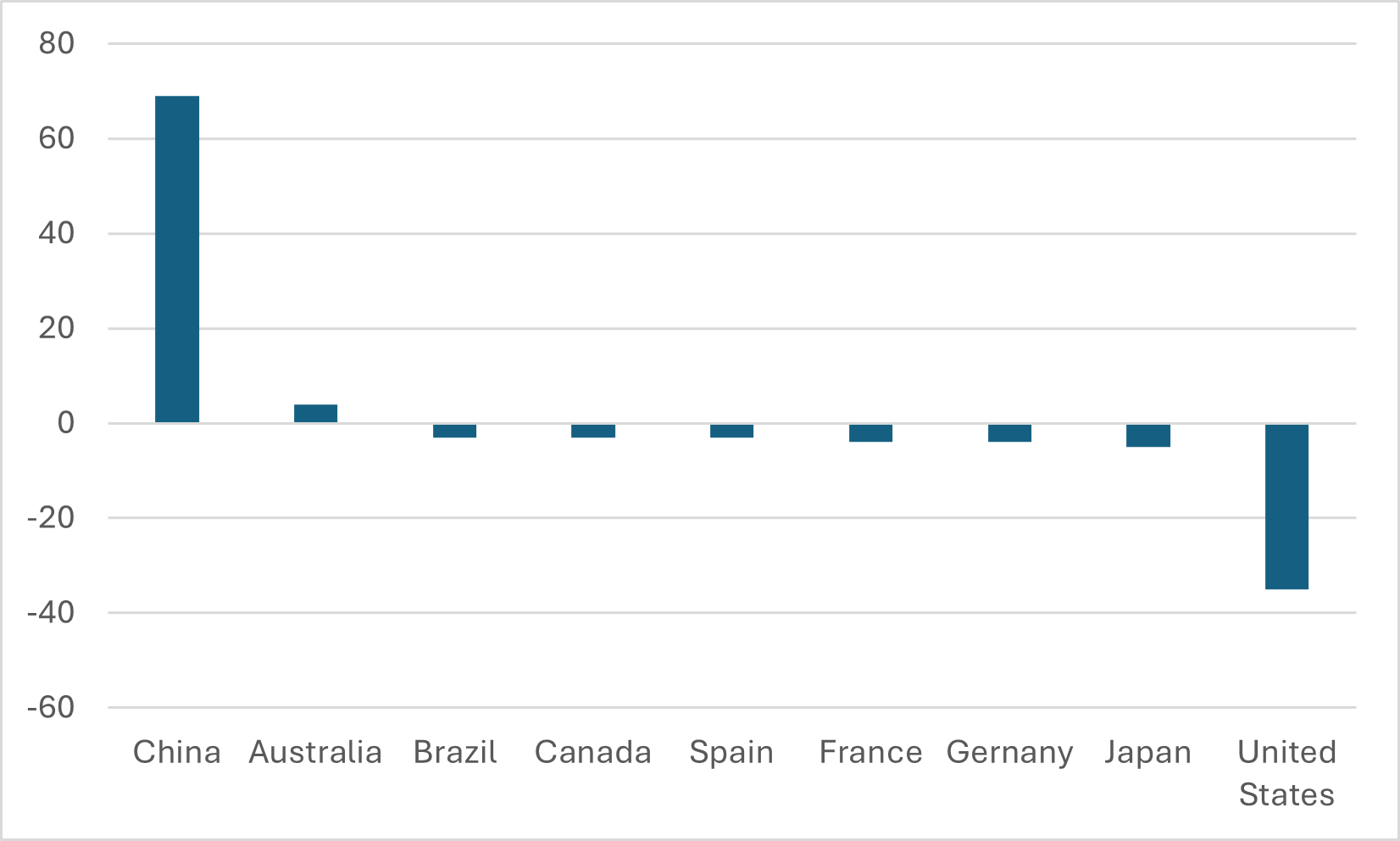
Figure 1 shows what has been happening with the Shanghai Rankings top 500 over the past 10 years. In that time, the number of Chinese institutions in the top 500 has risen from 32 to 101 (+69). The only other country registering a gain of more than two places is Australia (+4). Almost every other country has seen a decline in the number of institutions placed in the top 500; almost every other county has seen declines, most importantly the United States, which has gone from 146 spots to just 111 (on current trends, China will pass the US in these rankings either next year or the year after). Because rankings are a zero-sum game, institutions that rise in the rankings necessarily push others down. Canada is in good company: Brazil, Spain, France, Germany and Japan are all, according to the Shanghai Rankings, in the same boat.
Figure 1: Changes in the Number of Institutions in the Shanghai Rankings Top 500, 2015-2025, by Country
Moving over to the THE Rankings, in figure 2 we see a similar but slightly more attenuated picture: China is way up (+24), and America is way down (-15). But Germany is also up, and Italy, France and the UK are also big losers. Canada does not look quite so bad in this analysis, but the same dynamic is at work: a flood of institutions with an upward trajectory are putting pressure on institutions in the lower half of the top-500.
Figure 2: Changes in the Number of Institutions in the THE Rankings Top 500, 2016-2026, by Country
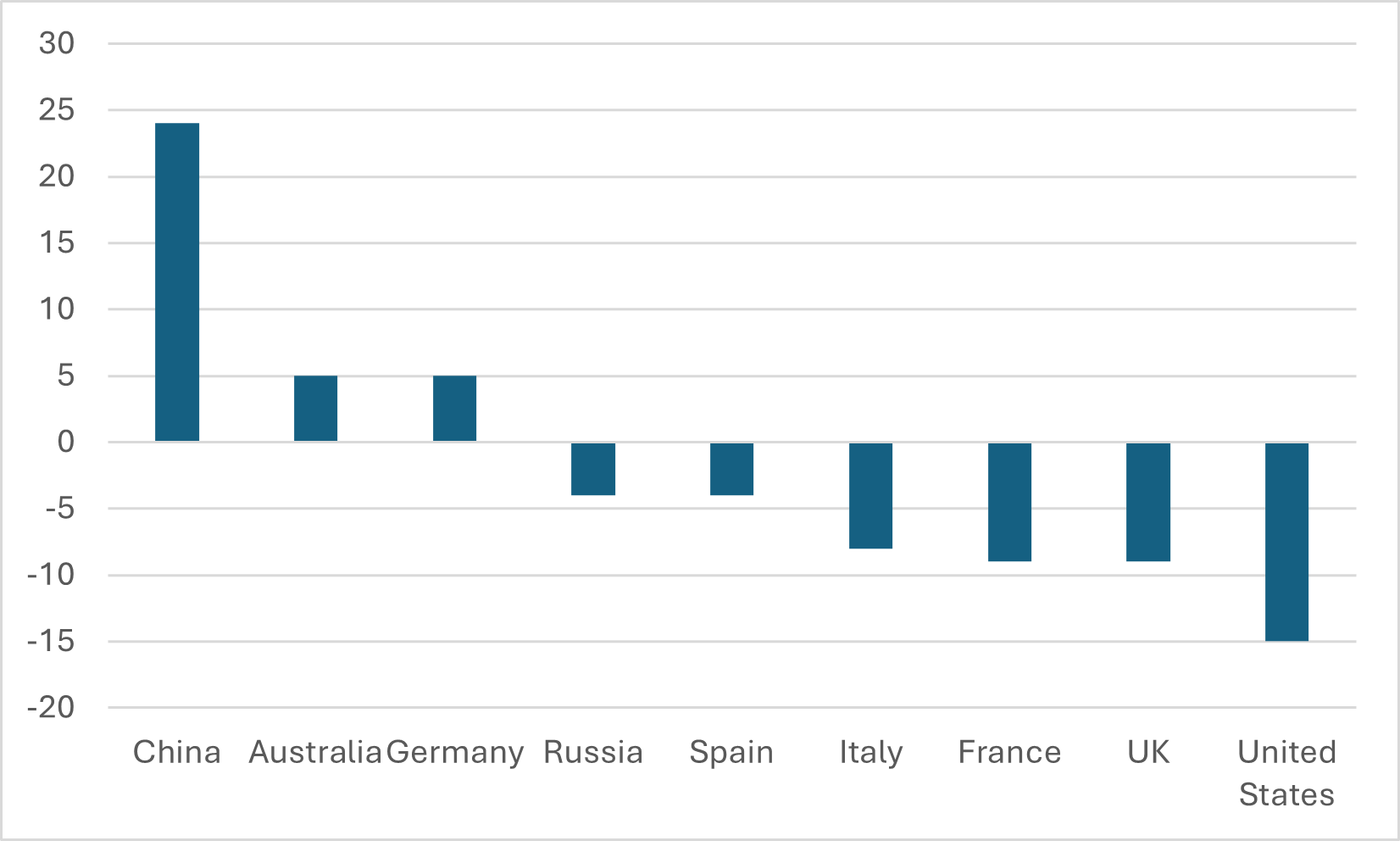
Figure 3, which shows changes over the last decade in the QS rankings, shows a different picture. Here, China and Australia are up, along with Italy, Japan and Spain, and the USA is way, way down, but it has company, with significant drops for the UK, France and Germany. Many of these results directly contradict those seen in the other rankings, but the more interesting result in figure 3 is that there seem to be a lot more institutions exiting the top 500 than entering it. This is, of course, impossible, so there is an answer to this puzzle: namely, that in the QS rankings, the new institutions in the top 500 are coming from outside the countries which are the “usual suspects”. QS has always cast a much wider net than the other rankings – in the Shanghai Rankings the top 20 countries represent about 90% of the top 500, whereas in the QS the top 20 only represent less than 80%. So, QS still is seeing lots of “rising” institutions – they just aren’t mostly from China.
Figure 3: Changes in the Number of Institutions in the QS Rankings Top 500, 2016-2026, by Country
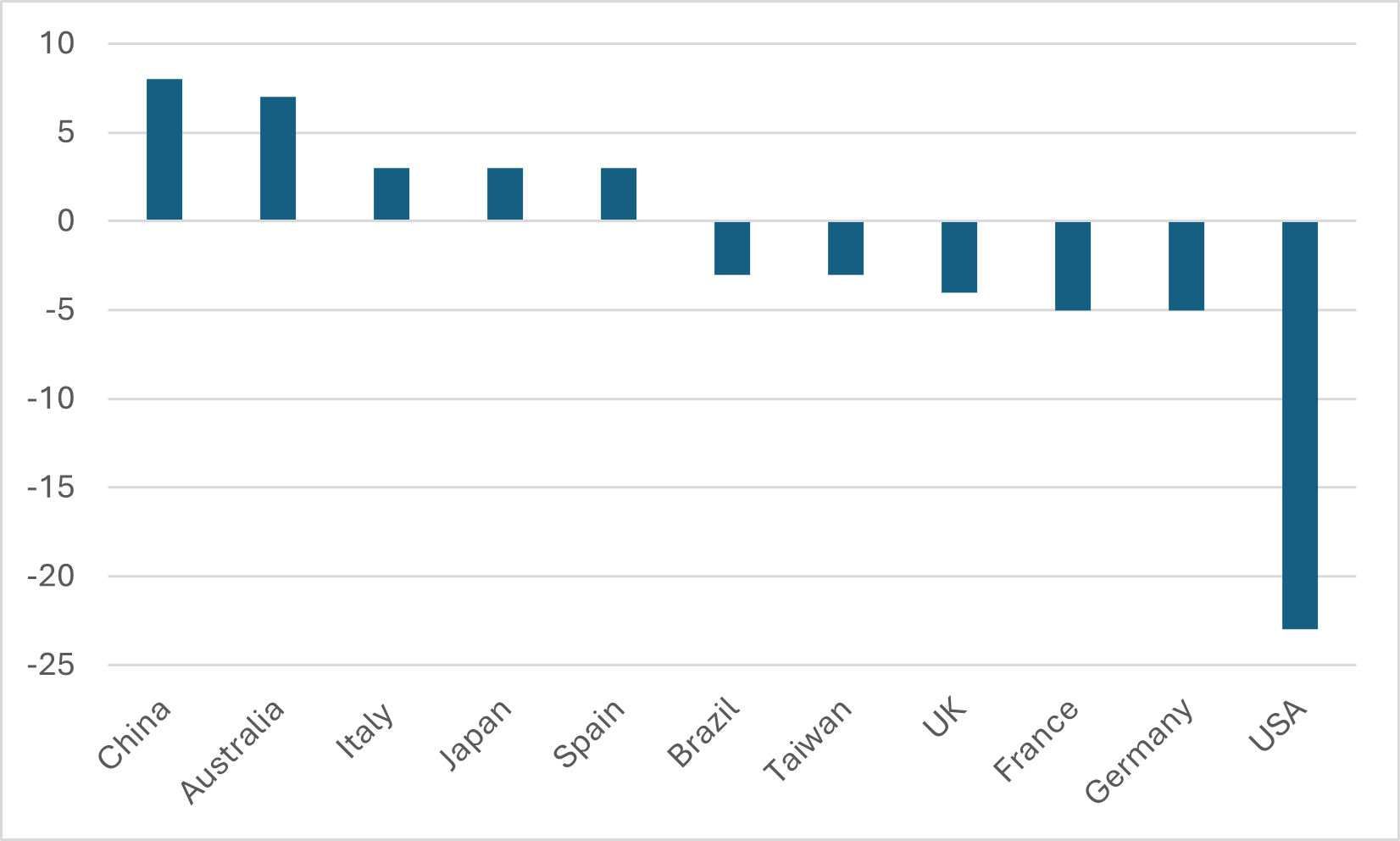
Briefly, then, the three rankings agree that China and Australia are on the rise and that the US is on the decline (France too, but in much less drastic way). They disagree about how a number of specific countries (Germany, Japan, Italy, and Spain) are faring; some saying they are up, others saying they are down. Canada is usually not among the poorer performers, but it is clear that the same factors that are pushing other countries down are also acting on Canada.
(Another interesting observation: despite the fact that the Shanghai Rankings are built around a set of indicators which are theoretically quite reliable and stable, it has nevertheless had much greater institutional turnover in the past decade than the other two rankings. What this should tell you is that on pure bibliometrics, Chinese institutions are rising quickly, but these institutions are not seeing a concomitant rise in esteem from the academics who fill in the prestige surveys from QS and THE.)
It might be tempting to see this all as a one-time transition. Chinese institutions are not going to continue this streak indefinitely. Indeed, given funding trends in that country, it’s easy to imagine that China may have already peaked. But China isn’t the only country on the rise. This is maybe a story for another time, but there are a boatload of other countries, particularly in Asia, who are strengthening economically and investing in higher education. These countries have a lot of institution which are not yet in the top 500, but it’s easy to see how they might end up there fairly soon.
Competition, in short, isn’t going to go away. Maintaining a globally competitive set of research institutions here in Canada will therefore require both more money and smart management. There is absolutely no space for complacency.


One Response
Very interesting. I suspect that China will catch up in other rankings as reputation lags publication. Obviously the rankings are backward looking. In terms of facts on the ground in high demand disciplines – think AI – the wheels are coming off the bus in terms of Canada’s ability to compete for solid talent. My top10 Canadian university was trying compete for a strong candidate who really wanted to be in Canada. They also had an offer from a US state school in the 100-150 ARWU range. We offered them 1/3 of the salary that the other school did (with a straight face, knowing the other school’s offer in advance I might add). We all know that strong faculty have come to Canada over the US for quality of life historically and now for funding certainty. It used to be a 20% pay cut to be in Canada. But will people really take a 66% pay cut to be in Canada? In our case no, and I am sure many others would make a similar decision. Given that we cannot compete – this seems partly driven by a new union policy to pay everyone the same regardless of market conditions – I expect our rankings and quality to slide much more. The point you have made before that the only people writing OP-EDs opposing university funding cuts are in the sector is totally on point. The sector needs to massively revamp what it is doing to garner support and I am not seeing much signs of that. I hope that we have not yet fallen in the rankings hugely does not breed complacency in the sector.