



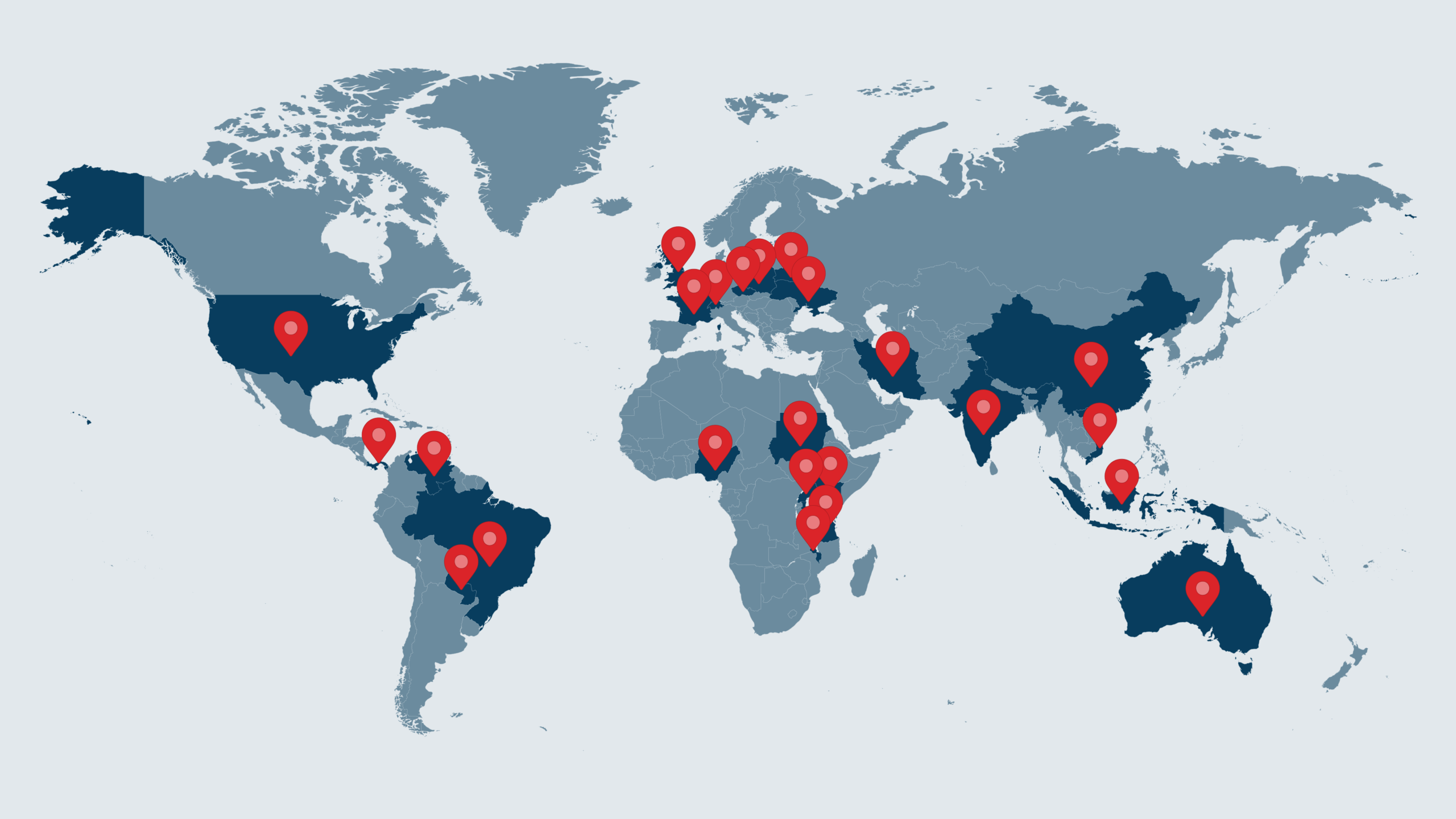
Hi all. A big, big fortnight in higher education: unprecedented private financial commitments in Pittsburgh, unprecedented public investments in Jakarta, huge demonstrations in Paris, big ambitions in Hanoi, and significant policy changes out of Beijing. Hop on board for the quick tour!
- Probably the biggest piece of news this past fortnight is word from Pittsburgh that billionaire Ken Griffin donated $3 Billion to Carnegie Mellon University, the largest-ever philanthropic donation to a university. Two-thirds of this money is earmarked for the creation of a new campus just north of downtown Miami, Florida to be organized academically not around traditional majors but “societal challenges”, with the other billion being split between the Computer Science faculty (to be named after Griffin) and a general purpose “institutional priorities” fund.
- Elsewhere in the US, stories continued to leak out about how the Trump administration has been defying the will of Congress in order to attack and defund universities. The first was that the administration imposed a set legally dubious “pocket recissions” – that is cutting funding to specific Congressionally-authorized programs through a kind of “line-item veto” – including $70 million worth of money for “woke International Education” and $28 million in “woke” Health research. It also emerged last Friday that the National Science Foundation withheld $1.4 billion in Congressionally-approved funding for basic research last year. There was some good news though: enough Republicans stood up to Trump to put the kibosh on the idea that the executive branch could start to interfere with individual NIH research grants.
- In late September, high school students (lycéens) in France began a series of increasingly violent protests over underfunding and poor learning conditions. On October 1, the Union étudiante, a student faction more-or-less-aligned with the leftist La France Insoumise, decided to join the protests with a set of demands that include the removal of tuition fees and the restoration of housing aid for international students, an increase in the number of university places, an end to Parcoursup (the student admissions platform), and an increase in funding to student restaurants through CROUS (the last one at least was instantly granted by the Ministry). Other student groups backed the demands. Protests grew to a quarter-million people on Tuesday. On Wednesday student groups met with Higher Education and Research Minister Philippe Baptiste, but the meeting appears not to have gone well. More to come.
- The President of Indonesia, Prabowo Subianto, has directed the public service to draw up a plan for free tuition at state universities which he wants implemented “as soon as possible” (his higher education minister seems to prefer a more gradual approach). It is not clear exactly where the money will come from; the President has pointed vaguely to “savings from eliminating corruption”. And, of course, many have pointed out that eliminating tuition alone does not solve all financial problems. Indonesia had about 4.8 million students in public universities, out of a total of 9.35 million in higher education in total (not including a million or so in either public or private institutions reporting to the ministry of religious affairs). About 20% of these students already study essentially free of charge.
- Bananas story of the week: Belarus’ National Beauty School – a state-backed Beauty School in Minsk – decided it wanted to run a survey. So, it got the Deputy Minister of Higher Education to issue a note to all of the countries’ universities requiring all of their female students to fill in the questionnaire, which contains questions about their height, marital status, hobbies, participation in beauty contests…and also to divulge their social media accounts. Not sketchy at all.
- In Sudan, five were killed and nearly fifty injures when a drone struck a student dormitory at Kordofan University in the city of El-Obeid. In Ukraine, classes have been moved online as Russia has begun directly targeting academic and scientific facilities, including the Kyiv Science academy and the National University in Zaporizhzhia.
- Until a year or two ago, there was a thriving essay writing industry in Kenya. Now, GenAI applications are causing huge job losses in the sector.
- A lot of rankings out in the last few weeks, most notably the THE’s “World University Rankings” (guess what? Asia is rising!), which has caused excitement in some quarters (Nigeria having 29 universities in the rankings is, for some reason, being attributed to President Tinubu’s wise policies, even though that’s clearly nonsense), disappointment in others (the Swiss seem to be taking it especially hard), and puzzlement (many in India wonder how private universities can possibly be doing so well). QS also released its Latin American regional rankings, and somehow placed 4 Venezuelan universities – that’s the Venezuela where professional salaries are less than $1/month – in the top 100, which I guess proves rankings are a lagging indicator. At the national level, India’s National Institutional Rankings Framework (NIRF) Rankings were released to much fanfare (IIT Madras was #1, if you are interested). Iran announced the creation of a new social impact ranking. Nigeria announced that its new ranking system will release its first results on December 15th.
- Vietnam has released a new strategic plan for higher education for the next decade (available here, in Vietnamese). The strategy sets eight big targets for 2035: i) a reduction in the number of higher education institutions by 20%, ii) an HE enrolment rate of 45, iii) 15% of the student body to be at the post-graduate level, with 40% of both undergraduate and graduate enrolment to be in STEM fields, iv) 90% of graduates to be in “suitable” (term undefined) employment 12 months after graduation, v) 50% of faculty to hold doctorates, vi) to have 20 “centres of excellence” which are considered “leading at a ‘regional level’” (“centre” and “regional” are undefined as yet but seem to mean “labs” and “ASEAN” respectively), vii) 15% of all institutional income to come from knowledge transfer activities (good luck with this one), and viii) 10 institutions in Asia’s top 100 and 2 in the world’s top 100 by field (this appears to refer to Times Higher Education rankings).
- Lots of fakery going on all over the place. Fake universities in Brazil, fake degrees in Paraguay and Panama, a President of a Nigerian university being discovered with fake credentials, and a quite elaborate fake student status ring as a way to get workers from outside the Schengen area work credentials.
- Attention in North America is rightly focused on the Cornell rape scandal. But the case is garnering a lot of headlines the world over and nowhere more so than India, where a series of similar occurrences have rocked several campuses. Lovely Professional University (it’s a professional university, owned by a company named “Lovely”) was shut for several days due to violent protests following an alleged rape in one of its hostels. The University denies anything occurred. Students at Delhi University are also protesting over a gang-rape in a park near the university. Students say all too little has changed in the fourteen years since a female student died by sexual assault in Delhi.
- In Africa, there are increasing demands to see universities pay for themselves. In Malawi, the focus is on gaining international students (and hence valuable foreign currencies). In Tanzania and Uganda, the focus is on making universities focus on research commercialization to drive economic growth. Meanwhile, in the United Kingdom, one of the country’s most respected scientists is warning the government that trying to drive growth through research is fraught with problems.
- Australian universities’ annus horribilis continues. The New South Wales Parliament released its report into university governance, which was predictably scathing (“not fit for purpose”) about over-commercialization, etc. Then, the country’s newest and shiniest university, the University of Adelaide (product of a merger discussed back here on the World of Higher Education podcast) reported that it might end the year with a revenue shortfall of $90 million due to a big shortfall of international students.
- In China, the Central Committee and the State Council (roughly, the cabinet) issued a document entitled “Opinions on Promoting the Reform of Higher Education Institutions by Category”. This isn’t a law, exactly, but it sets out this bodies views on a particular issue, and other ministries and bodies will be expected to implement policy in a manner consistent with it. As the country continues expanding higher education at a time where demographics will soon mean a vast shrinking of the system, the central authorities have decided that the system governance needs to change. Times Higher Education describes the changes as encouraging institutions to engage in more mission differentiation, but local analysts seems to interpret the document somewhat differently, implying the opinion is more about categorising institutions and ensuring they do not stray from narrower, category-based missions.
- In the Czech Republic, universities are facing a cut to their government grant. Their solution – which would never be considered in a country where students paid tuition fees – is simple: simply reduce intake by 15%, starting with high-cost programs.
That’s all for now – see you back here in two weeks!