


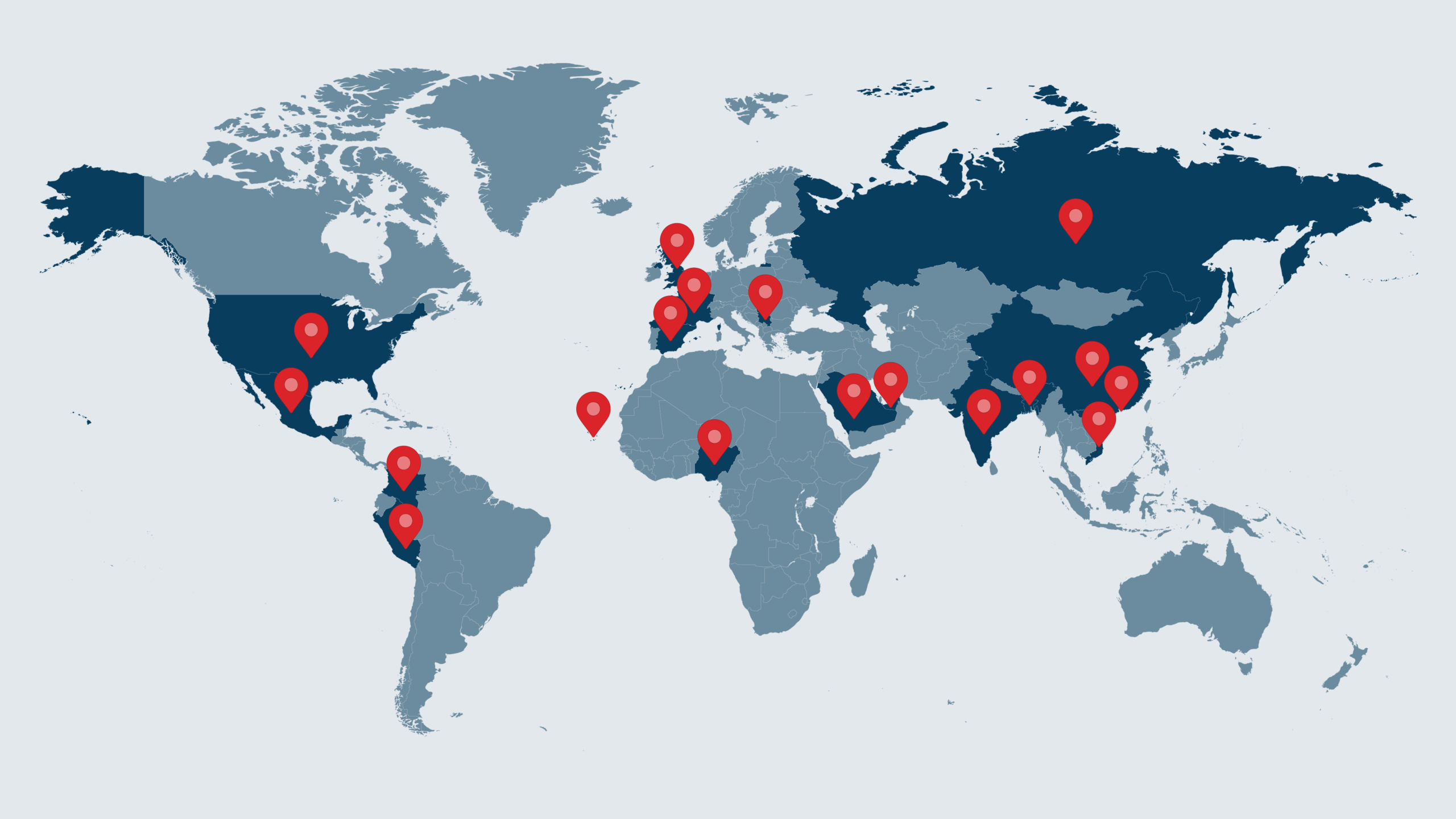
Most universities in the northern hemisphere are now back to school and, bow howdy, they are generating a lot of stories. While the big global story this outing has to do with a new global report on academic freedom, there is some quite amazing news on private universities out of India, important new quality assurance measures in Spain and the UAE, and simply countless instances of national self-harm in the United States and the United Kingdom. Buckle up!
- The annual report on global academic freedom published by Scholars at Risk, Free to Think 2026, came out last week. Brazil and Hungary were among the countries showing the biggest improvement. Russia was singled out as a poor performer (see here for its recent attempt to blacklist academics with independent views). But the country where the report got the most play was India, where academic freedom was described as “severely restricted”. Cue much handwringing.
- English has been on a roll as a global lingua franca since World War II, but now there are signs the tide many have turned. Vietnam has announced it will no longer give bonus points to university applicants for high IELTS marks. North Korea has decided to cut back English classes and replace them with Russian (on a related note: turns out Russia has been importing workers from North Korea to help build drones and giving them student visas in order to get around UN sanctions rules). In China, a prominent mathematician is making waves calling on the government to remove the “core status” of English as a subject of study. China is, of course, rethinking language delivery in the age of AI and, as such, has been removing languages such as Portuguese from universities, to much wailing from Portugal and Brazil.
- There was a potentially cataclysmic turn in a Supreme Court case in India last week. In a seemingly low-stakes case between Amity University and one of its students, the Court seemingly decided that Amity was acting as a for-profit entity, which is not permitted in India. It therefore decided that all private universities in India needed to show that they were not de facto acting as for-profits, even if they held non-profit status. It therefore instructed the central and state governments to collect data from every private university on their finances (how university resources are generated, managed and deployed), their fee structures, details of admission procedures to every program (including the names of all individuals involved in setting exams), details of all benefits received from governments (allotment of land, and any special privilege or concession extended to the institutions), faculty recruitment procedures, and faculty remuneration (full list data request here). Oh, and the court set a six-week time limit for data collection. Good times.
- Last year, Hong Kong announced plans to create a new “Northern Metropolis” along the border with Shenzhen to expand the territory’s higher education sector. Now, the government has announced more specific plans to develop three separate “university towns”; one focused on Medicine and AI, one on Smart Manufacturing, and one on “Arts and Blue-Green development”. Priority is being given to the Smart Manufacturing campus in Hung Shui Kiu, and the government is now accepting applications from universities wanting to open facilities there. Priority is being given to institutions that can self-fund their operations.
- Elections have begun in Serbia, where President Aleksandar Vucic called a snap election and also announced he would be a candidate for Prime Minister. In the absence of a serious opposition party, the student movement has created its own electoral list to challenge the government. The Government-aligned Faktor Plus polling agency has the student list running about 15 points behind; but other pollsters put them marginally in the lead.
- In Cuautla, Mexico, a Spanish exchange student at the Autonomous University of the State of Morelos (UAEM) was found murdered last week. She became the fourth female student killed at that university in the last seven months in the Mexican city, a fact which her home university in Granada was unaware, and has led to serious recriminations in Spain and calls to restrict female students on exchanges to dangerous locations. A number of Spanish universities have now suspended exchange agreements with Morelos, and the Spanish Rectors’ conference has issued new guidance on risk assessment in student exchanges. In other university-related tragedies this month: a Bangladeshi student was apparently beaten to death for stealing rice at a cafeteria, and in Kenya, a cholera outbreak has been reported at Kenyatta University.
- In Latin America, universities in less populated areas need to be wary of takeover by various militia movements. In Peru’s Southern Andean mining corridor, several universities have allegedly been infiltrates by Sendero Luminoso guerillas, while in Colombia up to ten universities are believed to have been infiltrated by ELN and FARC guerillas and used as places of recruitment. In somewhat-but-not-entirely-unrelated news, new Colombian President Abelardo de la Espriella wants to end the treatment of universities as sanctuary spaces from which security forces are forbidden. Students, as you might imagine, are opposed; rectors are somewhat split on the matter.
- The newly-elected centre-left government of Cape Verde has decided to make tuition free at the country’s only public university. I know zero about Cape Verde (other than its football team) and so cannot provide any further context.
- The Government of Nigeria has decided to pay for every student to have 100Mb of free data per day to be used at specific approved websites with digital learning platforms. Meanwhile, the Saudi government has paid Google to provide 1 million of its students with access to Google AI Plus.
- The US Congress passed a bill that blocks funding to any university that decides to boycott Israel. Meanwhile, the journalistic co-operative Investigate Europe published an exposé of Israeli universities’ use of legal tactics to try to prevent institutional boycotts spreading across that continent.
- China used to be a site for western universities to open exciting new branch campuses. Now, increasingly, Chinese universities are themselves setting up abroad. The PIE has a good story summarizing new Chinese campuses sprouting up across Asia.
- Job and program cuts at United Kingdom universities are absolutely off the scale. In Scotland, the University of Edinburgh announced cuts of 90 degree programs starting next fall as part of a £140m cuts programme which also involves 1800 job losses; The University of Dundee is cutting 200 jobs on top of the 450 it cut two years ago, and smaller cuts are happening at Heriot-Watt and Glasgow Caledonian. In England, Essex University is aiming to cut 200 jobs, while the University of Exeter is going after 400 jobs, mostly in Arts & Humanities. And the list goes on: Nottingham, Sussex…I could go on, but you get the point. It’s a bloodbath. All under a supposedly friendly Labour government.
- The latest horror in the United States is that President Trump wants control over medical research grants. According to Politico, Trump asked his budget director, Russ Vought, to draft an executive order to create a board answerable to the President that would oversee grant funding directly. The New York Times suggested this might be a move designed specifically to punish Harvard University, which has to some extent defied the President over the past two years.
- A new report on access to higher education in France is causing waves. For decades it has been a cornerstone of French access policy that if you obtain a baccalauréat (i.e. succeed on the high school matriculation exam), you should be guaranteed a place in university. Now the country’s senate suggests that making universities somewhat more selective would not be a terrible idea. The country’s higher education minister says the idea is one that should be debated by parties in the run-up to next spring’s Presidential elections
- The Spanish Prime Minister Pedro Sanchez announced a new decree imposing stricter conditions on university program delivery. The decree, which imposes new minimum in-person teaching requirements for some programs as well as new requirements with respect to institutional hiring standards, is fairly transparently aimed at making it harder for some private universities to operate. Meanwhile, in the United Arab Emirates, a new system of institutional licensing which will toughen criteria for opening new programs has taken effect. New performance indicators with respect to labour market outcomes have also been imposed.
Never a dull moment, is there? See you back here in two weeks.