


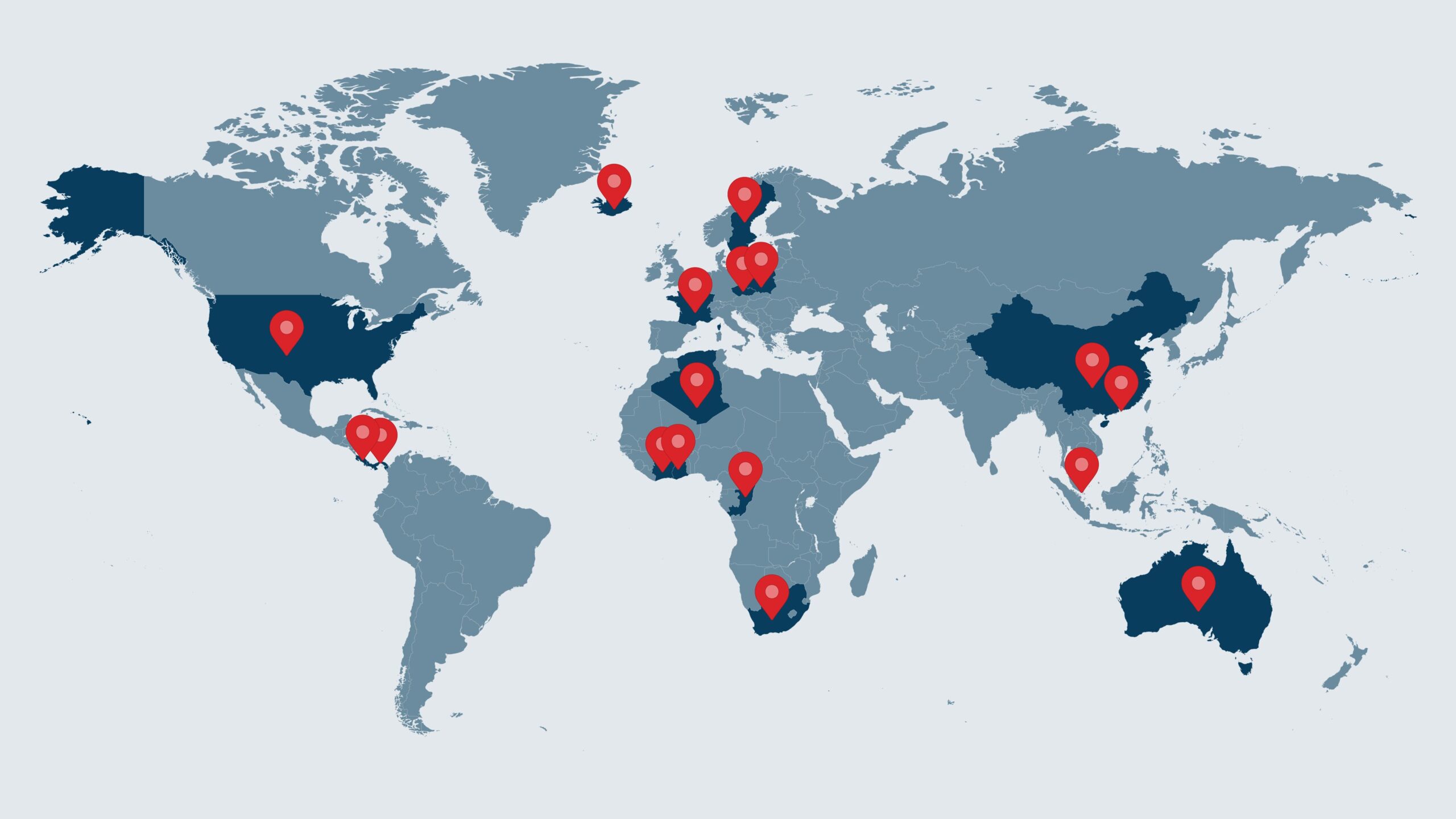
Morning, all. The higher education news never stops. In addition to the usual stories of American universities being subjected to increasingly absurd right-wing assaults, there’s some interesting stuff happening in places that don’t often make the Fifteen, including the Czech Republic, the Democratic Republic of the Congo, Iceland, and Panama. Let’s go check it out.
- Algeria has decided to ban impromptu graduation celebrations on campus. The problem seems to have been that the defence of master’s and PhD theses were turning into impromptu street parties as family and friends gathered to eat and party, disrupting normal campus life in the process. The word “killjoy” comes to mind.
- The Czech Republic is considering a new law on higher education. Several such bills have been proposed this century, but the 1998 bill – the only one passed since the revolution in 1989 – remains in force. The current effort is largely based on a policy paper (see here for full volume in Czech) published by the Institute for the Development of Higher Education (which, without necessarily casting aspersions on their work, feels a bit astro-turf-y to me), which suggests a number of ways in which Czech university practices are behind the times. Not everyone is convinced: one professor with long experience outside the country basically calls the whole paper a hack-job based on cherry-picked evidence. Stay tuned – this will hit Parliament in the fall.
- There were a few good general reads on higher education this last fortnight. I very much enjoyed N. Angel Pinillos’s The Honest Case for the Humanities, which is much more rigorous that the usual lazy “but we teach critical thinking!” argument the field often falls back on. Martin Nillson Jacobi, the President of Chalmers University of Technology, wrote “The Excellence Trap” that faces institutions striving for research excellence solely based on competitive project funding (he’s talking about Sweden but most of it rings true in Canada as well). And finally, Dave Cormier wrote a really wonderful little piece on how to think about artificial intelligence in education and absolutely everyone should read it.
- Sticking with artificial intelligence for a second, there has been a lot of news on this lately. Cote d’Ivoire announced that it would be building a new AI-focused university sometime before 2030. Singapore announced that it will be creating a common foundation of AI competencies with which all undergraduates will be expected to graduate (not quite the same thing as requiring all students to take an AI course, as Pakistan and Kazakhstan have recently done, but this policy could still lead there). In Sweden, the roll-out of a set of AI teaching tools at Linköping University led to a faculty protest. And in the US, the NYT published a piece on teething troubles with California State University’s ambitious attempt to introduce AI across the institution. Leave aside the obvious difficulty of partnering with OpenAI, and ignoring all the faculty vs. administration framing, I think what you see are faculty really grappling hard with what education means in the mid-21st century. Many institutions could benefit from these kinds of discussions.
- The last two weeks have seen a tsunami of university corruption stories from around the globe. In the United States, the President of Nex Mexico Highlands University, who was put on administrative leave in May, sued his own university alleging that he was canned for refusing to steer a construction contract to a friend of a regent. The state government is now investigating. In Australia, the vice-chancellor of Wollongong University has stepped down amidst an investigation into conflict of interest over the awarding of a massive re-structuring consulting contract. In Panama the headlines have been dominated by revelations of scandalously high administrator salaries (for Panama, anyway) at the Autonomous University of Chiriquí which have led to an investigation into the assets of the university’s President and her family.
- China’s gaokao examinations took place last week. For the second year in a row, the number of people taking the test has declined, mainly for demographic reasons. China’s long ascent in higher education enrolments isn’t over yet, but the peak is beginning to come into view.
- Some mainland Chinese students are starting think that Hong Kong might not be for them after all, since jobs all require Cantonese or English, neither of which is their native language. A challenge, perhaps, to the idea that bringing mainland students to Hong Kong will in the long run be a talent attraction strategy.
- Poland is one of the many, many countries where the higher education sector has been pushing for more international students to replace falling domestic enrolment. However, in Lublin, the organization of an African Day festival led to a vile outburst from the country’s far-right with respect to mass-immigration of non-whites. Now that internationalization has been politicized, will the sector keep pressing ahead?
- I know everyone thinks institutional mergers are the product of neoliberal managerialism, but when you see a story about the merger of two public universities in famously not-especially neoliberal Iceland, you might think that maybe, just maybe, other logics might be at work as well. (Possibly the real story here is how Iceland, population 400,000, can support four public universities and two private ones, but that’s for another day).
- There is an interesting situation developing in the Eastern Congo, much of which is under the control of the Rwandan-backed M23 rebel army. Local residents very much want their undergraduate students to be able to take the examen d’etat and graduate with nationally-recognized degrees required for much public-sector employment, post-graduate study, etc. Last year, the rebels allowed the exam to take place without incident, which allowed students to graduate. Since then, M23 has replaced the University of Goma’s rector, which has the central government in a tizzy, threatening to not recognize any actions of the new university administration – a threat which implicitly suggests that students’ degrees would not be valid outside Goma.
- In South Africa, universities are asking the government to fix the problem of nearly ZAR 60 billion (that’s about US$4 billion) in student debt. This is not student loan debt – this is simply unpaid student fees owed to institutions, some of which is owed by NSFAS-receiving students and some not. You see, a number of years ago, the government realized it couldn’t fund all students through the NSFAS program. Rather than find more funding or disappoint students, it simply told universities that they had to admit students without requiring fee payment upfront. Another example of governments promising things in higher education that they cannot actually afford.
- Costa Rica held a bar exam. 98.8% of the test-takers failed. This is causing some problems and a lot of finger-pointing.
- Last year, the State of Iowa set up the Iowa Centre for Academic Freedom at the state’s flagship university, so students could benefit from a more right-wing (sorry, “traditional”) perspective. The problem was that students didn’t enrol in its courses, and that created a financial problem. The solution? Make the centre’s courses mandatory for all students. Again, in the name of freedom.
- The French Senate has finally passed legislation concerning private universities. It’s been a tricky road, mainly because “private” includes not just for-profit institutions, but also a large number of so-called “grandes écoles” who deeply resent the new regulations. A good summary of the legislation is available here but basically it requires privates to submit to a set of consumer protection rules, and a new set of quality assurance processes both to offer degrees and apprenticeships (an increasingly big deal in French higher education). The bill now goes to the national assembly, where it will likely be debated within the next five weeks.
- Finally, in Ghana, a very interesting example of economic development through transnational education – maybe. The South Korean and Ghanaian governments held a joint press conference to announce that Korea (or Korean entities) would be making a host of investments in the country, among which were solar irrigation systems, a Hyundai plant and a new university. Absolutely no word on where the university will be located, what it will teach or who will run it. Note, though, that China handed Ghana $30 million for the creation of a new university in the Prime Minister’s home district just five months ago we could be looking at something similar here.
That’s it for now folks, see you back here in September.