







About a month ago, I was doing one of my absolute favourite things in the entire world, which was browsing the shelves of Amy’s Used Books in Amherst, Nova Scotia (IYKYK) for old books on higher education. I picked up a simply ludicrous amount of loot there – the entire back-list of the Bulletin of the International Association of Universities from the 1960s to the 1980s, a copy of José Ortega y Gasset’s The Mission of the University, bound background papers to the Hurtubise/Rowat Commission, a 1964 study undertaken for Universities Canada (then going by the name National Conference on Canadian Universities and Colleges) on “Year-Round Operation of the University”…ok, I can see why others might not find this exciting, but trust me, I was giddy.
Anyways, maybe the most interesting document I found was a copy of the CAUT Bulletin from May 1963. It’s main interest is an article “the Evolution of Canadian University Governance” by CAUT’s Executive Director J.H.S Reid (this was an epoch where every male academic seems to have simply gone through life being referred to by three initials, like Tolkien), on the occasion of his being awarded an honorary doctorate by the University of Manitoba (try to imagine that happening today). I will get to that article in a second, but before that I want to show you some of the advertisements that the Bulletin used to carry, which are a pretty interesting way into the psyche of academia in the age of Mad Men.
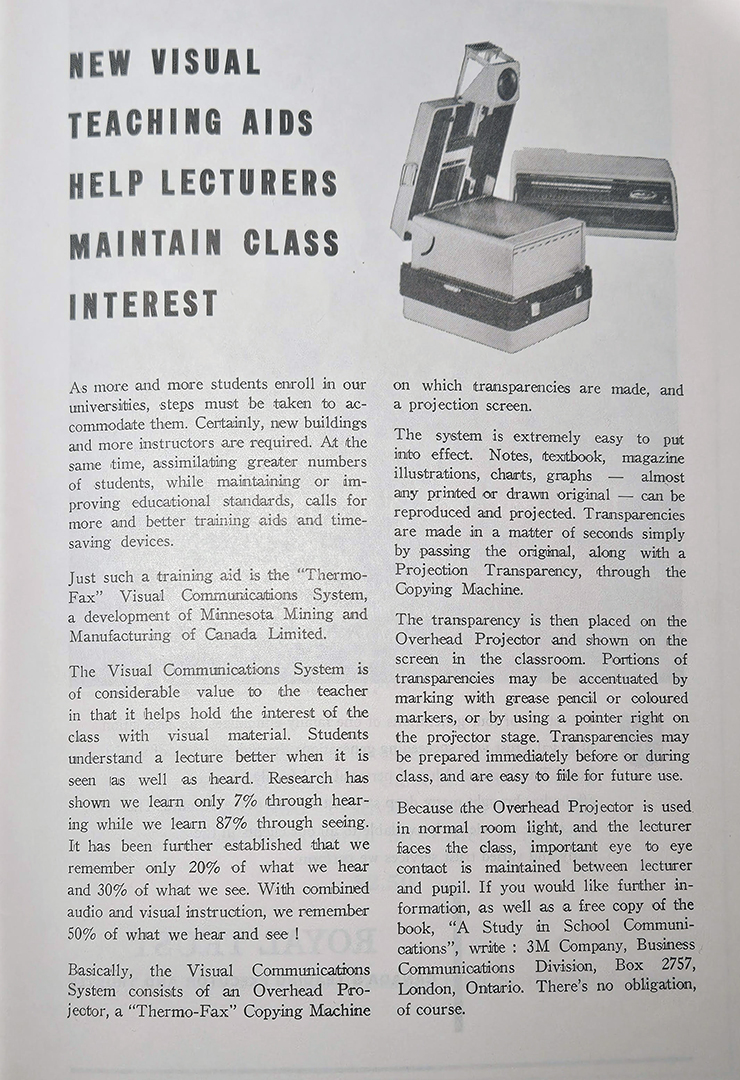
First, here’s an advertisement from 3M for a “thermofax” – basically an overhead projector plus a copier that transfers images from paper to transparency – which is billed as a crucial tool to hold the attention of students in the new mega-classrooms that were popping up to accommodate the expanding student body. Interesting not just because of the technology and the spur to adoption but also the ad itself – this is pitched at individual professors, not purchasing departments. That’s interesting in and of itself.
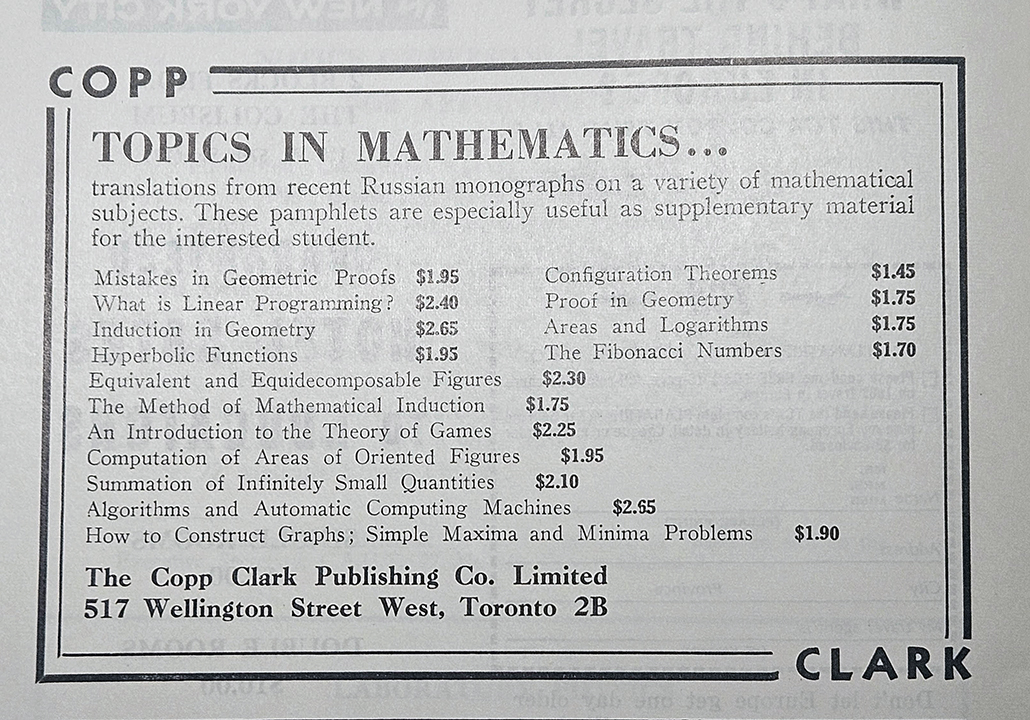
Second, here’s an interesting advertisement for a specialized type of journal in mathematics. This is back from an age where the Soviet Union was a) still a place at the cutting edge of mathematics and physics and b) a place where everyone published in Russian. Being a competent mathematician therefore required high levels of Russian fluency, which let’s face it is pretty rare. The work-around, of course, was to create specialized journals that did nothing but translate Russian journal articles (wonder how that would count in modern bibliometrics?).
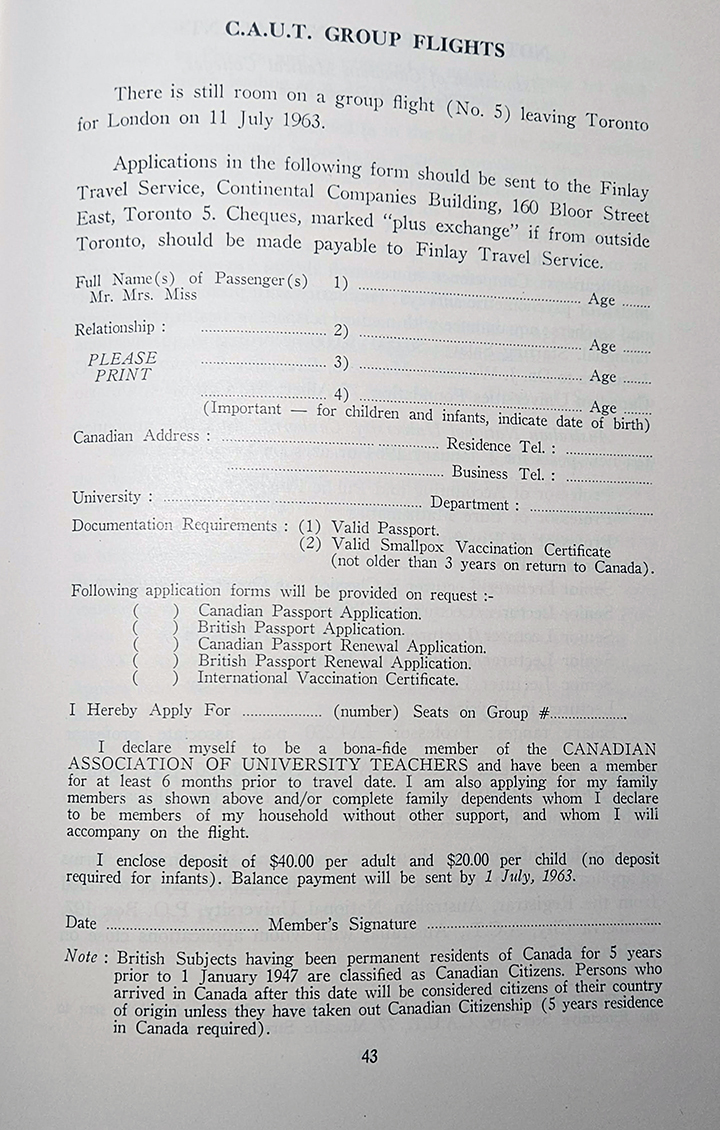
And finally, here’s my favourite – not an advertisement per se but an invitation to join a profs-only charter flight to Europe (charters being significantly cheaper than regular fares at the time). Apparently, one of CAUT’s membership activities at the time was to charter airplanes like this (there’s another advertisement in here from a Montreal company which allowed people to pre-purchase automobiles in Europe that you could use once your flight landed, which is also pretty amazing. Summers in Europe were apparently pretty de rigeur, at least for a segment of the professoriate).
Anyways, on to the central article, which is quite interesting even only as a period piece if it is more about governance than administration per se. It basically outlines a hierarchy of ideal (to faculty) governance arrangements. Top of the list was the English universities of the era, where Boards were vestigial and contained a large number of faculty or faculty-friendly individuals. Next – a long-way back – came American universities, which were obviously terrible because Boards were stacked with industry types and historically felt empowered to meddle in academic affairs as much as they wanted, BUT, as of the early 60s, seemed to be starting to be less activist and letting Senates get on with the business of making universities great.
Canadian institutions, of course, were worse than American ones. The article sets out how Canadian governance arrangements were built on the American model (and makes some the excellent but today almost totally ignored distinctions between governance at public institutions like U of T and the big western institutions on the one hand and places like McGill, McMaster and the smaller Maritime institutions on the other – they’re not the same!). But the difference was that while American boards were learning to back off, Canadian ones remained deeply interventionist, as the American ones had been prior to the war. The condition of academic freedom was therefore, in Reid’s analysis, much more perilous here than in the US and the UK.
Sixty-odd years on, things have changed quite a bit. For one thing, I suspect that given the way institutional governance arrangements have changed, few if any analyses of these three countries would still put Canada at the bottom of this ranking. But for another: it’s interesting that for the most part the threats to academic freedom – to universities generally – are seen as being mainly from private sector Board members. Governments are sometimes portrayed as threats to institutional autonomy, but despite references to McCarthyism in the US, it never really seems to occur to Reid that governments might be a threat here, too.
Things change. It’s nice to stumble across things that remind you of that, occasionally.


3 Responses
“The work-around, of course, was to create specialized journals that did nothing but translate Russian journal articles (wonder how that would count in modern bibliometrics?).”
The most important Soviet math journals had their own dedicated English-language translation journals, which are twinned in the relevant bibliographical databases.
Mais plus ça change…
It sounds like the central article writer put his finger on the dangers of interventionist boards, long before red-stake takeovers. Too bad nobody listened when they could have been thoroughly de-fanged.
Any chance you could share a scan of the article you described?