







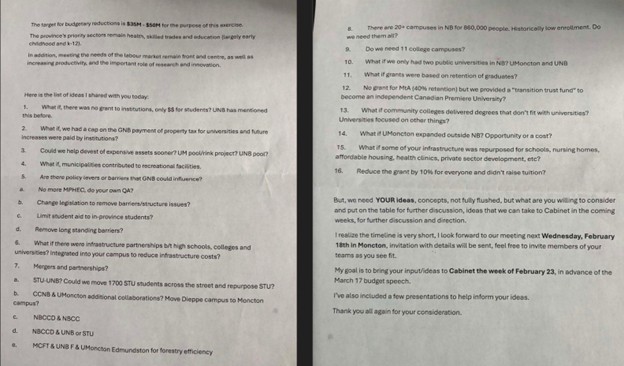
You may have seen a story last week from CBC about the New Brunswick provincial government wanting to slash $35-50M from post-secondary funding this year. The story was actually about four days old when the CBC ran it – l’Acadie Nouvelle had all the goods the previous Friday based on one quite astonishing piece of paper that the Minister of Post-Secondary Education, Training and Labour circulated to university Presidents at a meeting two weeks ago. Here’s the picture L’Acadie Nouvelle ran with the story.
Now, if you have any experience with politics, your first six thoughts upon seeing this document can almost certainly be summarized as follows:
- OMG!
- WTF?
- The Minister himself actually wrote that?
- And his officials let him circulate it?
- AND NO ONE THOUGHT TO MAKE SURE NO COPIES LEFT THE ROOM?
- So, it’s a total amateur hour, huh?
Now, you may be asking why the government of New Brunswick has suddenly decided to slash 8-12% of its spending on post-secondary education, and the short answer is that the Holt government’s fiscal record in its first fifteen months in power is among the worst in Canadian history and bills are coming due fast. The budget passed last March (that is, after Trump had come to power and made it clear that it was going to commit innumerable atrocities on the trade front) estimated that the deficit for 2025-26 was going to be $549 million. Now, it turns out the deficit is going to be somewhere in the neighbourhood of $1.3 billion, or about $1500 for every inhabitant, with the difference being about 40% overly-optimistic revenue forecasting and 60% signing a health deal the province couldn’t even vaguely afford. The government needs money and it’s not going to be especially particular about the way it gets it.
In any event, the funniest thing about this list, which has by our count 23 specific questions that the Minister wanted to kick around (think of them as 23 strands of spaghetti thrown against the wall… or as some say “concepts of a plan”), is that damn near none of them actually create savings in the short-term…and the Minister appears not to be aware of this.
Just for fun, we have divided up the 23 questions or suggestions into five categories— ranging from completely irrelevant to completely misguided, purely on cost-saving grounds. (There are plenty of other objections to be made, but that’s for another day).
Ideas that do not save money at all: Ideas1,2 and 14 are “ideas” inasmuch as these are things people can suggest. They just don’t save any money – the one about U Moncton expanding outside New Brunswick especially.
Ideas where Savings are Dubious/Depend on Details: Ideas5a, 5b, 5d, 10, 11 and 13 all might save money, but it depends on the details. Based on what the Minister has written, it is genuinely unclear what savings would materialize and how.
Ideas that Amount to Robbing Peter to Pay Paul: Idea 4, getting municipalities to chip in for recreation facility costs might save colleges and universities money, but don’t reduce charges to the public sector, definitely not the provincial government.
Ideas That Might Save Money in The Long-Term But Not The Short-Term: Ideas3, 6,12, 15 and all the ideas under 7 all come under this heading. I mean, just to pick out a couple of these: if you merge STU with UNB, the first thing that’s going to happen is that all those STU employees are going to go on the UNB pay grid, which given the higher salaries at the latter probably means UNB gets stuck with an extra $3 million in annual costs (not to mention the significant outlays that will be required to harmonize IT systems, payroll, student records, etc.). You also can’t merge institutions very quickly. For Adelaide University, it took no less than 3 years and cost several hundreds of millions of dollars. Of course, scale matters, but the point is that it’s expensive upfront and it’s not the quick fix the government is desperate to find. Similarly, cutting Mount Allison loose from the Treasury would definitely save the government $27 million or so per year, but if you’re planning to do so by giving them a functioning “transition trust fund” – which would need to be huge if you weren’t planning on bankrupting the school immediately – that’s not saving any money up-front. This shouldn’t be rocket science.
Ideas that actually save money in the short-term. Ideas 5c, 8, 9 and 16 – that is, 4 out of the 23 ideas (17.4%, if you’re counting) all save money in the short term. But also, they are pretty horrific. Save money by making it harder for students to leave the province? Can do, but it’s really gross policy and whatever benefits New Brunswick sees from this will disappear when Prince Edward Island and Nova Scotia retaliate by doing the same next year. Shut campuses? YES! This is one thing that is guaranteed to save money. It’s also the surest way to lose votes (small communities hate losing services) and my view is this government lacks even the tiniest amount of spine on this issue. How can I be sure? Because of idea 16 (“cut grants 10% without raising tuition”), whose wording suggests that the government is less interested in protecting institutions than it is in doing anything unpopular.
So, look, it’s easy – probably too easy – to kick the Holt government over this. Epistolary hilariousness from the Minister aside, what New Brunswick is doing here isn’t that different from what we’re seeing across the country. A government that shows no imagination about what the province could be if it invested in the knowledge economy? A government that obtusely chooses to see institutions as cost centres rather than tools to make the province more competitive? In this country, in this decade, those are a dime a dozen.
As a country, we are very much in eat the future mode. We spent a ton of money on health care and new social programs in the last decade without bothering to tax ourselves to pay for it. Now that interest rates are higher again, we’re realizing that wasn’t such a smart thing to do. But instead of investing in the long-term, our provinces are taking the most short-term view imaginable. Universities and colleges are not seen as the mechanism that generates the human capital that every province needs to thrive in the future, as the gateways to international presence and partnerships that every province’s firm needs (especially when you’re trying to pivot away from the US), or that universities employ over 300,000 people across Canada (roughly twice what the auto industry does); all governments can see when they look at higher education is a sector for which no one goes to bat, a tempting source of short-term savings. It’s not just lacking in imagination; it is economic self-harm dressed up as “hard choices”.
We wish New Brunswick were an isolated case, but the conditions that led to this moment are far from unique to that province. There is no reason to think others may not opt for the same approach.


2 Responses
It seems from publicly available reporting that the letter was penned by the deputy minister, who also would have also met with the university presidents. If so, this may be as much a story about policy capacity in relation to higher ed as it is about politics.
My first response is rather glib, that this is the change and innovation that you seemed to be calling for a couple of weeks ago. Nothing is more of a change than destruction, after all.
My better response is that this seems a great waste of time. Even if the universities of New Brunswick can somehow fend off paying a sort of tithe for their government’s spendthrift ways, they’ll still have spent a great deal of time and energy — and money, if all the labour involved counts for anything — in refuting them. If they didn’t need people to respond to every new government asking why they do what they do, universities could focus more on teaching, research and the life of the mind.
Finally, I’d note that, should changes be brought about not with the goal of saving money, but with the more future-directed pretense of greater competitiveness, academics in New Brunswick would still be facing lots of distracting administration.