


I have been thinking a lot lately about the longer-term future of higher education and how demographics will change the nature of the sector. Today I want to share some data and thoughts on this subject.
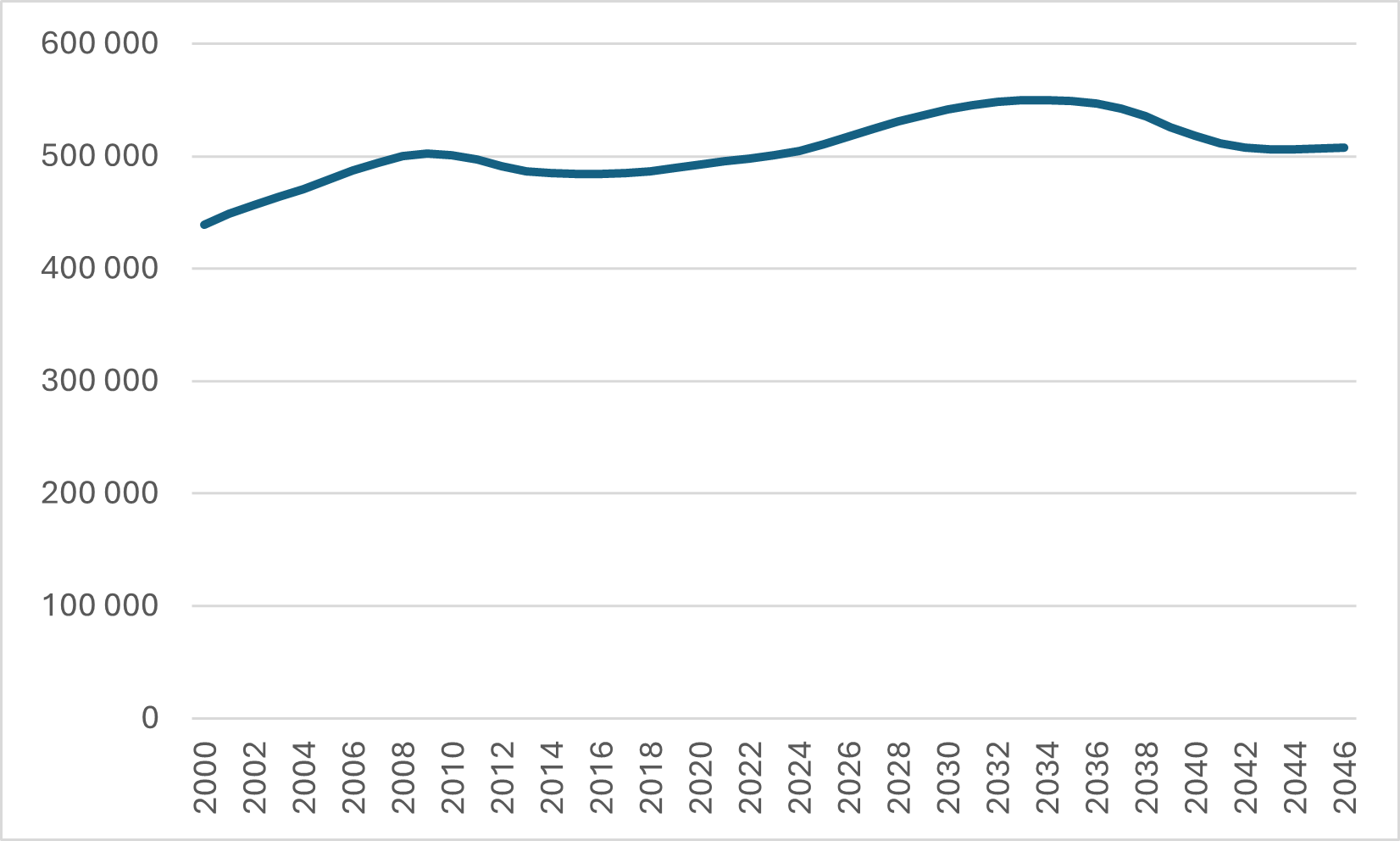
My basic observations are that 1) whatever else it may do, higher education exists mainly for young adults, and 2) the world’s complement of young people has already more or less topped out. We might be able to increase participation rates, but “peak 18-21” happens in 2033 and after that it’s all downhill, even though the global population as a whole will not peak for another several decades.
Figure 1: Total global population aged 18-21, 2000-2046
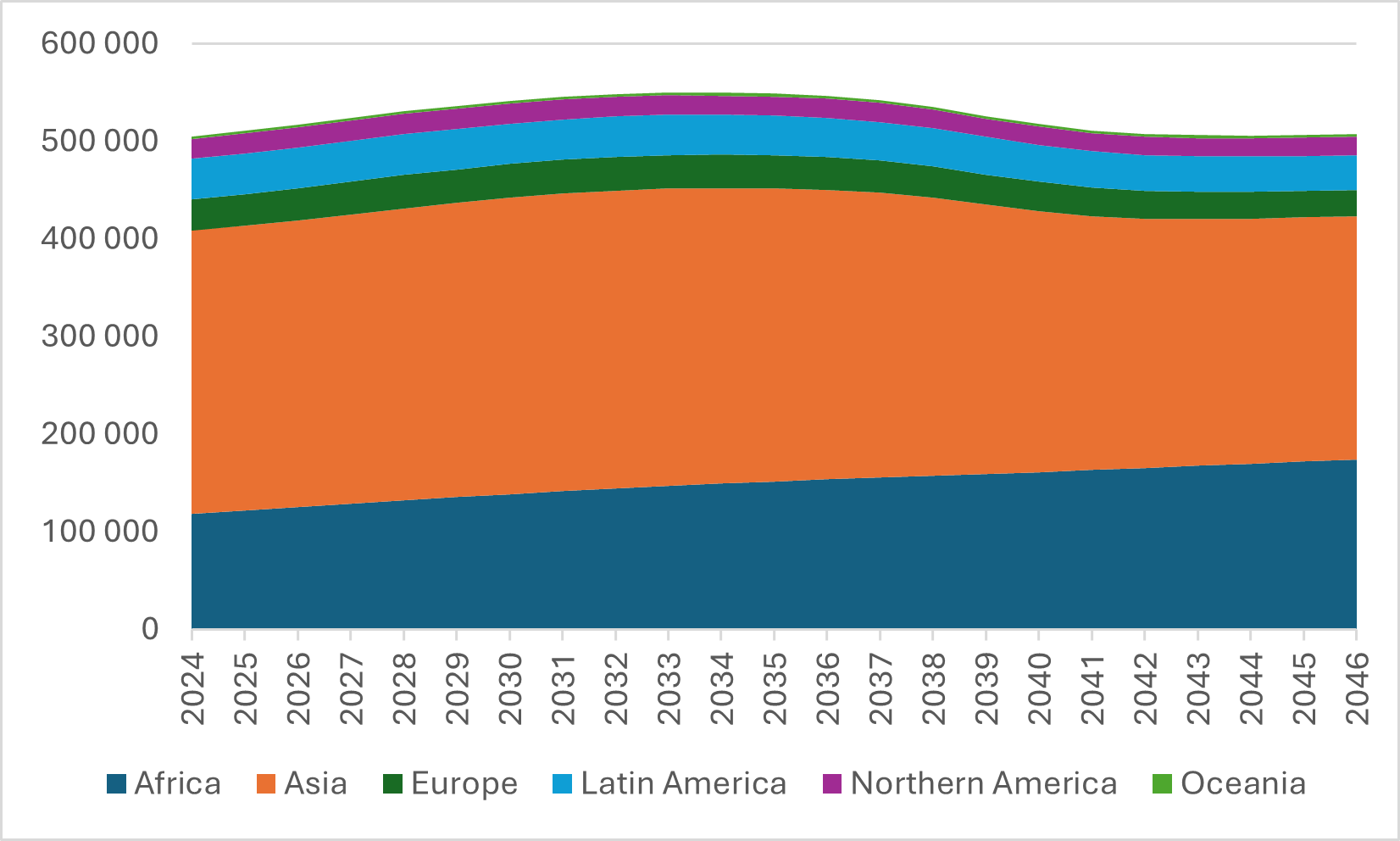
What will certainly happen is that the geographical distribution of young people will change. Basically, Asia will have a lot fewer of them, while Africa will have a lot more. Europe and the Americas will also lose share, but they are already close to a rounding error given the overall size of their youth populations relative to Africa and Asia.
Figure 2: Total global population aged 18-21 by region, 2000-2046
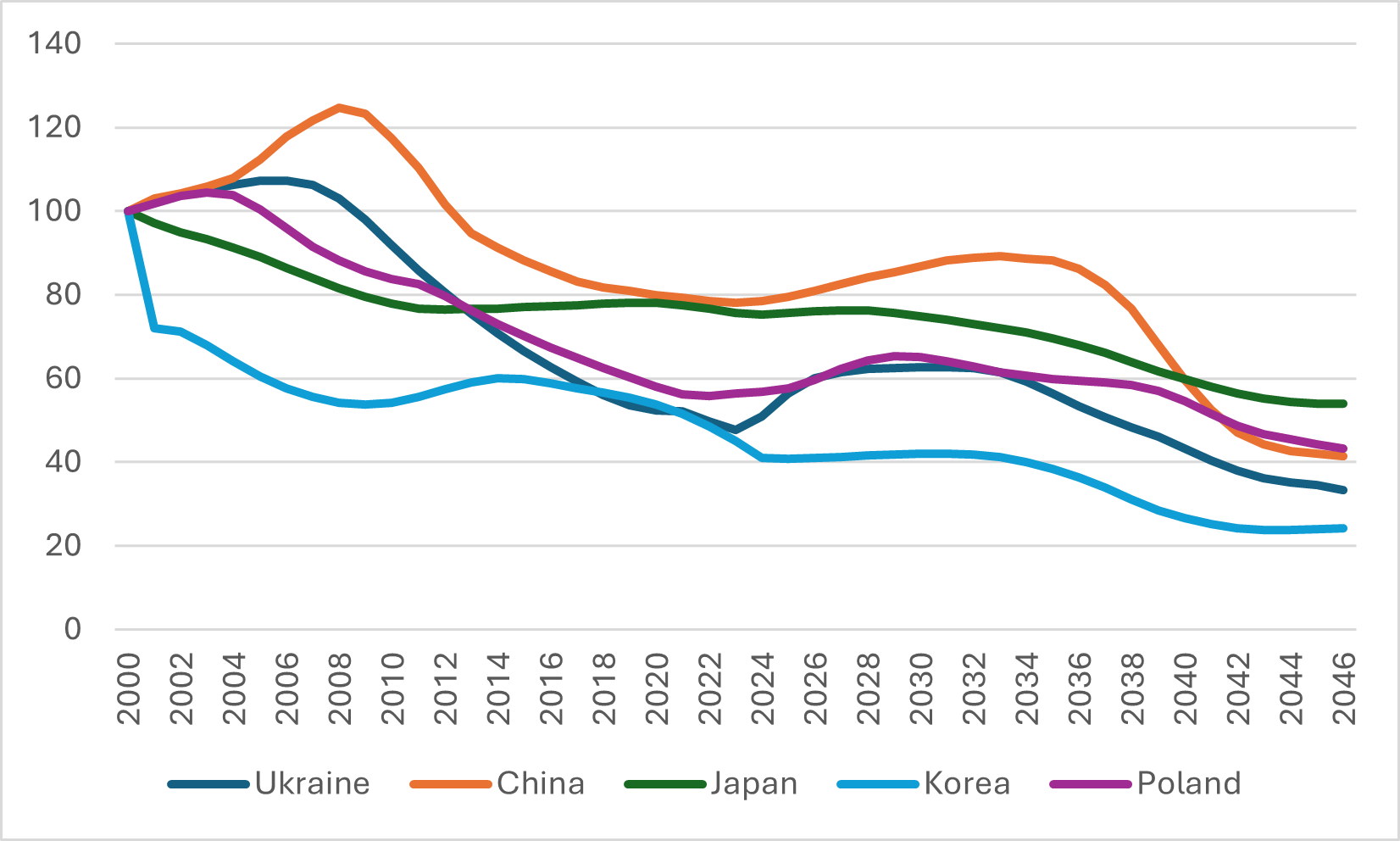
Though world numbers won’t change much, there are a few countries where the decline in youth population will be truly staggering. It’s no mystery which countries will have this fate as in nearly all cases, the decline has been underway for at least a couple of decades. Over the course of the first half of the 21st century, Japan will lose nearly half its youth population; South Korea will see a drop of over 75%. Poland, China, and Ukraine are all in similar boats.
Figure 3: Youth population indexed to the year 2000, selected countries, 2000-2046
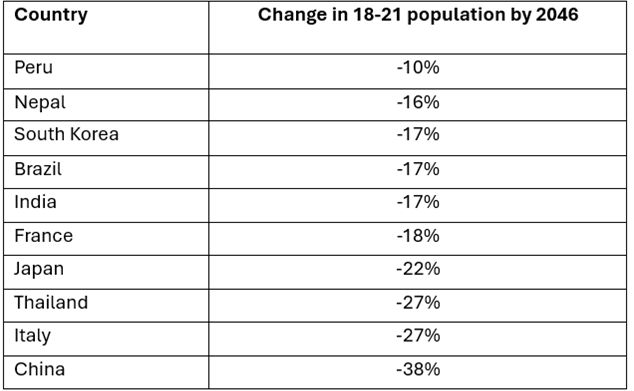
In the following analysis, I divide up the world’s 50 largest countries into four groups and examine data and medium-variant projections from the UN’s World Population Prospects database. The first group consists of the countries I call “the Decliners” – that is, where youth populations have already peaked and will continue to decline steadily from here on out (I limit my analysis to the year 2046 because I think it’s reasonable to project youth populations up to that point– mainly because almost everyone in such an analysis has already been born – but not much beyond it). Table 1 below shows that the country that is going to see the biggest fall in youth population is China, which is headed for an epic collapse in youth population in the early 2040s. But we are still looking at sizeable decreases in other countries in this group. This does not necessarily mean that student numbers in this group will fall: Brazil and Italy have been experiencing some youth population reductions for some time but have managed to increase their enrolments – sharply, in Brazil’s case – by expanding access through online enrolments. But it does mean that the headwinds to increased student numbers will be sharp. India’s appearance on this list is perhaps most surprising, though again this is a country that can still grow significantly by increasing its participation rate.
Table 1: The Decliners
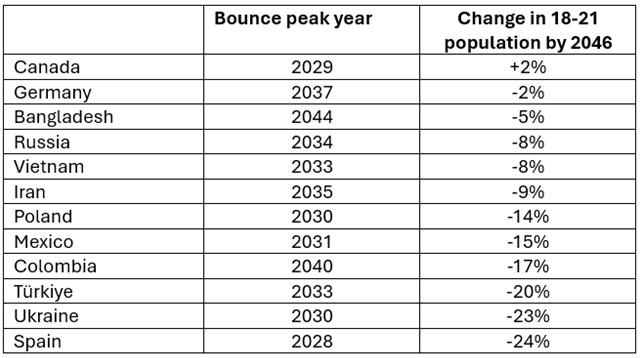
The second group of countries, shown in table 2, are places where youth numbers have already peaked and are declining right now, but where they may at least temporarily and partially recover before 2046. Canada is in this group, but is an outlier in the sense that it will actually grow between now and 2046, if not quite to the same levels it was 15 years ago (note that these projections do not quite appear to match the ones Statscan produces domestically, something I will have to dig into at some point). Some of these countries have already seen substantial falls in enrolment in the last few years, notably Russia, Türkiye, and Iran.
Table 2: Decliners with a Bounce
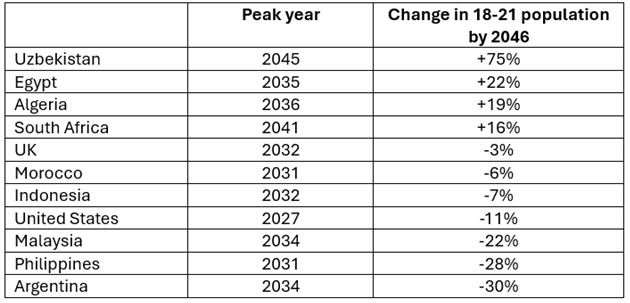
The third group of countries consists of those whose youth populations have yet to peak but will do so in the next twenty years. This is a bit of a mixed bunch. Those countries whose peak occurs between now and 2034 will all have smaller youth populations in 2046 than they do today. In a few of these countries – like the Philippines, Malaysia, and Argentina – the drop in the late 2030s will be extremely precipitous, reflective of very rapid declines in birth rates in the years just before COVID. On the other hand, countries who peak after 2034 will all have larger youth populations in 2046 than they do today, substantially so in the case of Uzbekistan, where total numbers are expected to increase by 75%.
Table 3: Future Peakers
The final group of countries are those whose youth numbers are expected to keep growing even past 2046. There are sixteen such countries on our list, of which eleven are in sub-Saharan Africa and the remainder are in Asia. These countries in many ways represent the future of higher education because they are more or less the only places where you can basically guarantee a growing higher education population twenty years from now. Moreover, these are nearly all countries whose post-secondary participation rates are pretty low. In all of these countries, we can expect future demand to be fed both by demographic change and by increasing educational demand. Given those twin pressures, it would not surprise me at all if the African countries in this list were to grow by a factor of five over the next twenty years.
Table 4: Far-Future Peakers
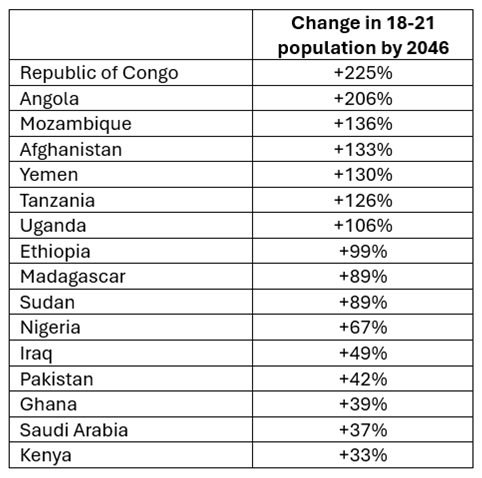
With the exception of Saudi Arabia, however, the countries in group four are not exactly what you would call “rich”. In fact, the population-weighted GDP per capita of these sixteen countries (including Saudi) is about US$2,400 per annum right now. In the 34 countries spread across the other three groups, that figure is US$15,500 or so. Now, I suspect that gap will be smaller twenty years from now than it is today, but one inescapable conclusion here is that the average 18-21 year-old twenty years from now, worldwide, is going to be a lot less affluent than they are today.
And that’s a really basic constraint on higher education worldwide that is worth recognizing and planning for. Delivery modes for higher education will need to adapt to serve people outside the 18-21 age group and they will need to find ways to achieve cheaper delivery in order to serve the world’s fastest-growing youth populations.