


Thursday morning, Ontario’s Minister of Colleges and Universities made a very big funding announcement: $6.4 billion in new funding over four years. It was certainly a welcome announcement, but as my analysis below shows, it’s not a magic cure by any means, and there is a big sting in the tail of the announcement for students.
The fundamentals of the announcement are that the provincial government announced that it was going to provide universities and colleges with three big new pots of money over the next four years. In declining order of size, these are:
$4.4 Billion in new operating funding. This funding appears to involve i) some changes to the base per-student value of the grant (somewhat more on the college side than on the university side), ii) some changes to the field of study weights and iii) some changes to the rules on the so-called “corridor” (see back here for an explanation of this deeply unhelpful term). No word on how this will be phased in, but if they do it the way they usually do, it will be something like $440 million next year, then another $440 million the year after, and so on until 2029-30 when funding will be $1.76 billion over where it is today.
$1.7 billion in targeted funding for 70,000 spots (40K outright new, 30K previously unfunded) in priority fields of study. I have not yet seen what fields of study are being focused (it’s a bit tricky what with computer science applications plunging so quickly but one assumes it will be heavy on engineering and health), nor how this money will be distributed across institutions. It’s a continuation of the approach to funding we have seen from this government over the past few years of recognizing that student demand is shifting to more expensive programming and that without extra funding for those disciplines, more and more students will end up missing out on their program of choice (which is, of course, the kind of thing that makes parents mad enough to vote against the government). It’s not clear how this will be phased in, but safest assumption is the one I detailed above.
$284 Million in targeted funding for small, rural and francophone institutions. The $1.7 billion in targeted STEM/health program money is going to skew heavily towards research institutions. Think of this pot as make-up money to keep these schools relatively whole (the University of Ottawa will benefit from both).
Now: that much you can glean from the press release. There is, however, a bit of an issue with how the whole “6.4 Billion over four years” is characterized, though. It is not “$6.4billionover 4 yearsmore than if 2025-26 was the base year”. At least some of the money that has been handed out to universities and colleges in the last two years was not considered “in the base” (this is budgeting-speak for “technically temporary, we could take this away at any time”, much like how the feds did with the COVID-era increase in student grants.) Therefore, it’s actually something more like “$6.4 billion more than if 2023-24 were the base year”, or, if my sources are correct, it’s “$5.3 billion more than if 2025-26 were the base year.” It’s still nothing to sneeze at, although see the section below on student aid for more reasons for skepticism.
In addition, tuition is going to rise…a tiny bit. The government is allowing tuition to rise at the rate of inflation (roughly) for the next six years. Which means of course that it will not rise in real terms from the point it is currently at, which is about 25% below where it was a decade ago in real terms.
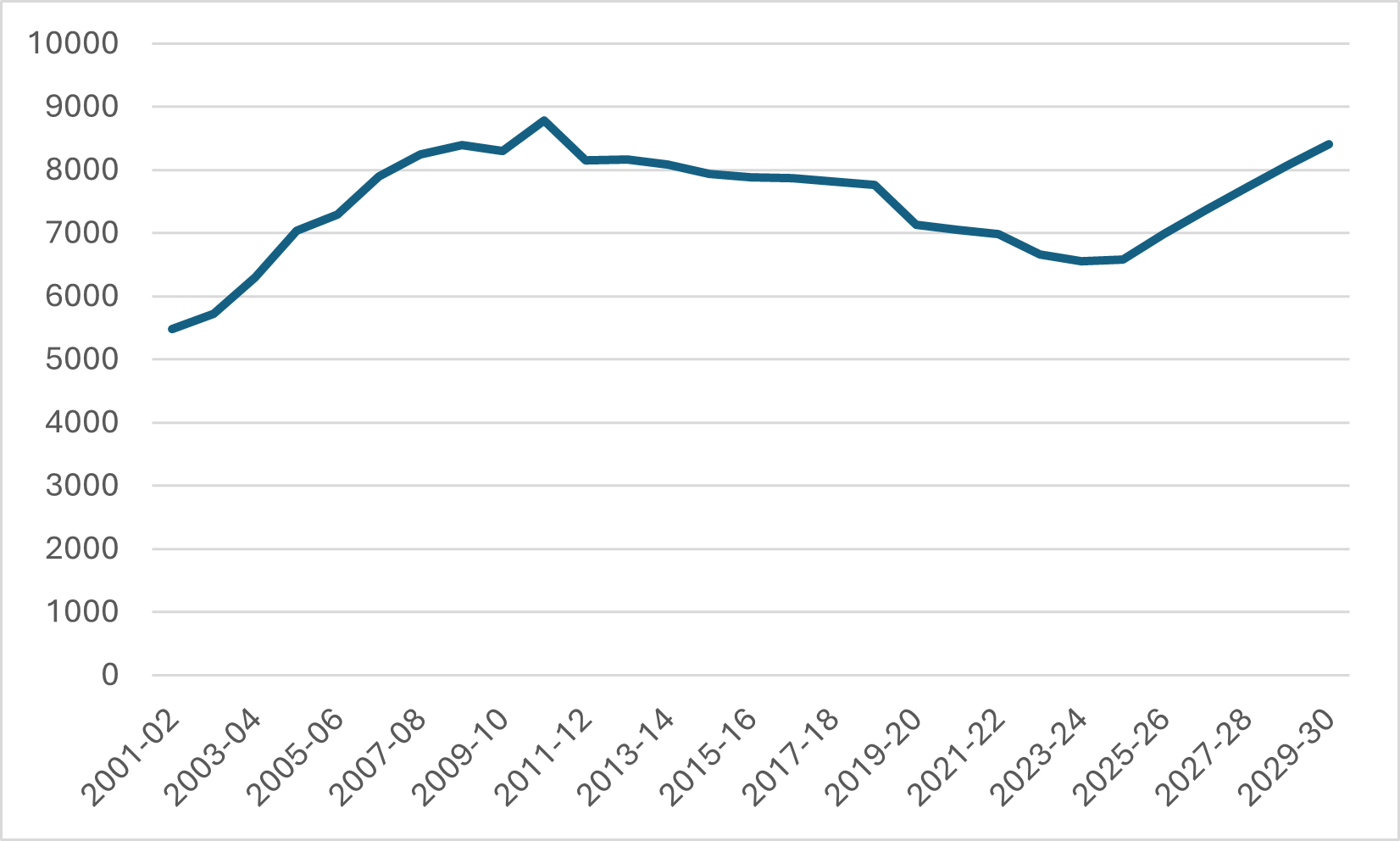
All of the foregoing is good news, of course. But it’s worth seeing this in a slightly larger context to understand what will be happening to institutional finances. Figure 1 shows total provincial government expenditures back to 2001 and projects them out to 2029-30, assuming the $5.3 billion in new money gets phased-in steadily over the next four years. What it shows is that by the final year of the implementation of this announcement, provincial government funding will be about $8.5 billion, which is only slightly lower than its all-time high in 2009-10.
Figure 1: Government of Ontario Transfers to Post-Secondary Institutions, 2001-02 to 2029-30 (projected), in Millions of $2025
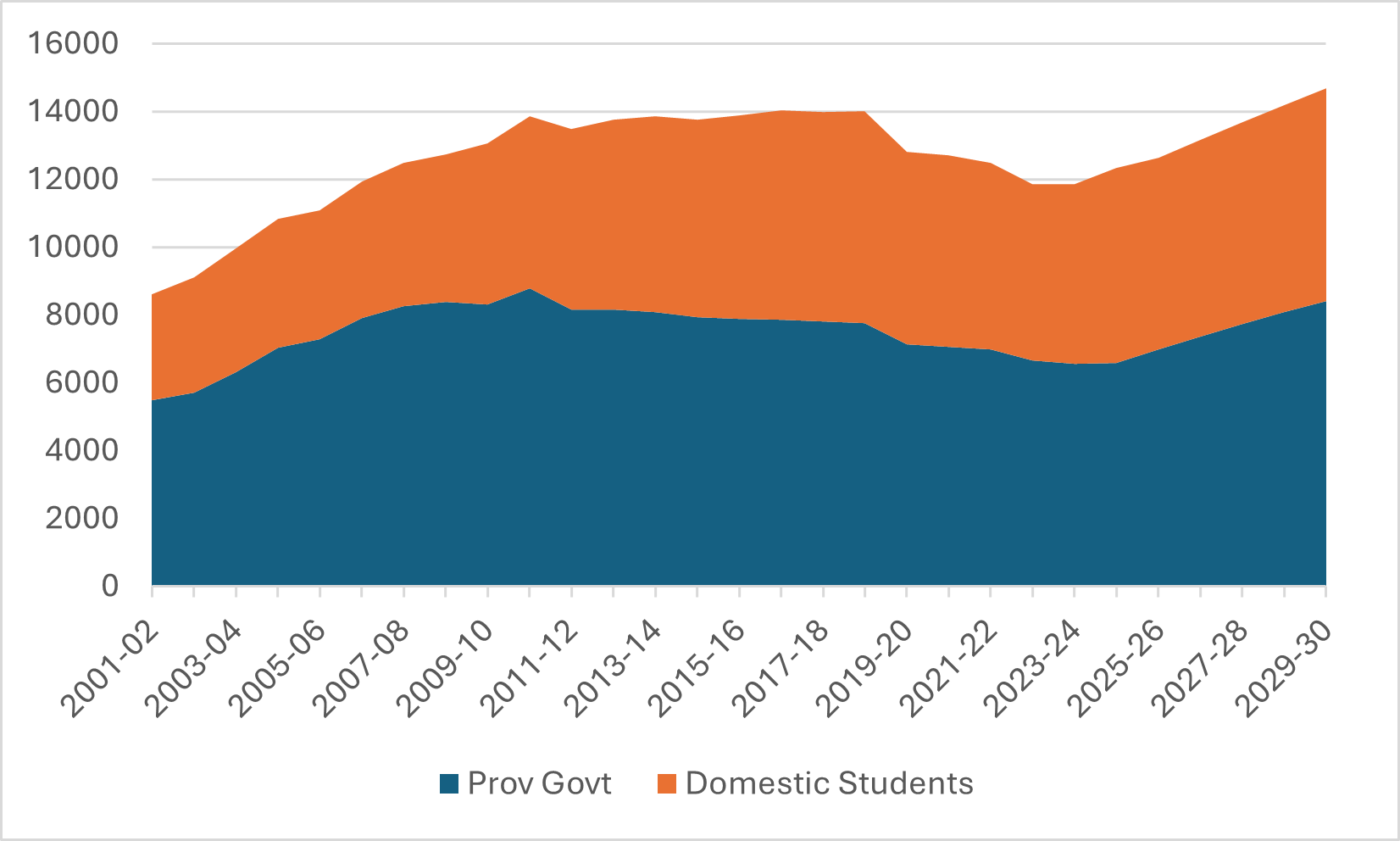
Now let’s layer on the effect of changes to domestic fees, which were, of course, affected by a 10% reduction in tuition in 2019 plus a freeze thereafter. Total income from this source dropped by about 16% in real terms between 2018-19 and 2022-23, but it has since recovered a bit thanks to higher enrolments and students switching into more expensive programs. Assuming both of those trends continue in the future, then total domestic fee revenue – and thus total operating income from domestic sources – are still on pace to hit an all-time high in 2029-30. (Note: I am making what I think are some reasonable assumptions about student numbers for the last two years and the next four, but they are still assumptions…caveat emptor, etc.).
Figure 2: Domestic Revenues of Post-Secondary Institutions, 2001-2002 to 2029-30 (projected), in Millions of $2025
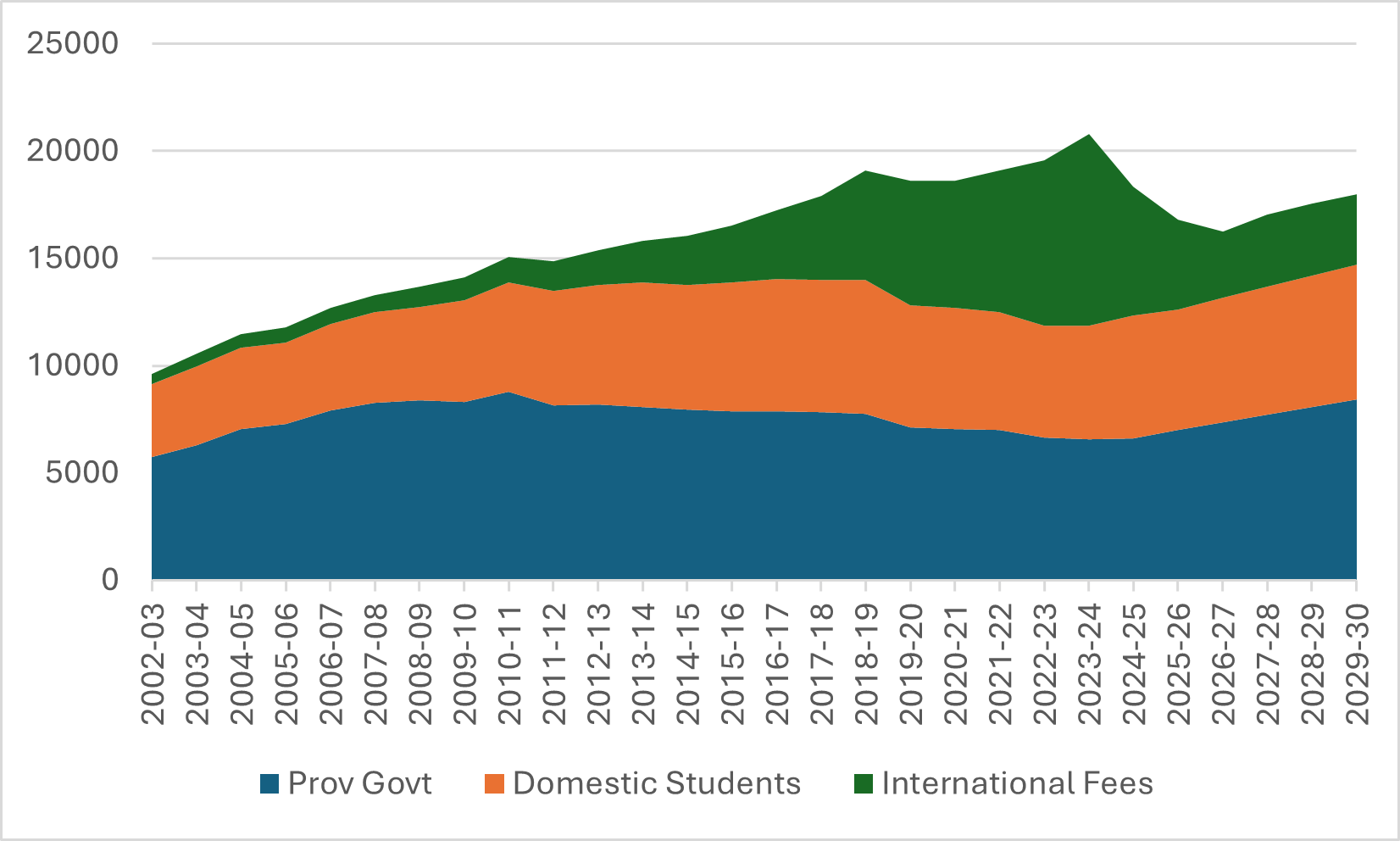
Of course, the big story for institutions over the last couple of years is that they have lost so much international funding. As figure 3 shows, this new package does not make institutions whole for that loss by any means: the system will still be $2.7 billion poorer without those students in 2029-30 than it was back in 2023-24 (though again, assumptions made, caveat emptor, etc.).
Figure 3: Total Operating Revenues for Post-Secondary Institutions, 2001-20 to 2029-30 (projected), in Millions of $2025
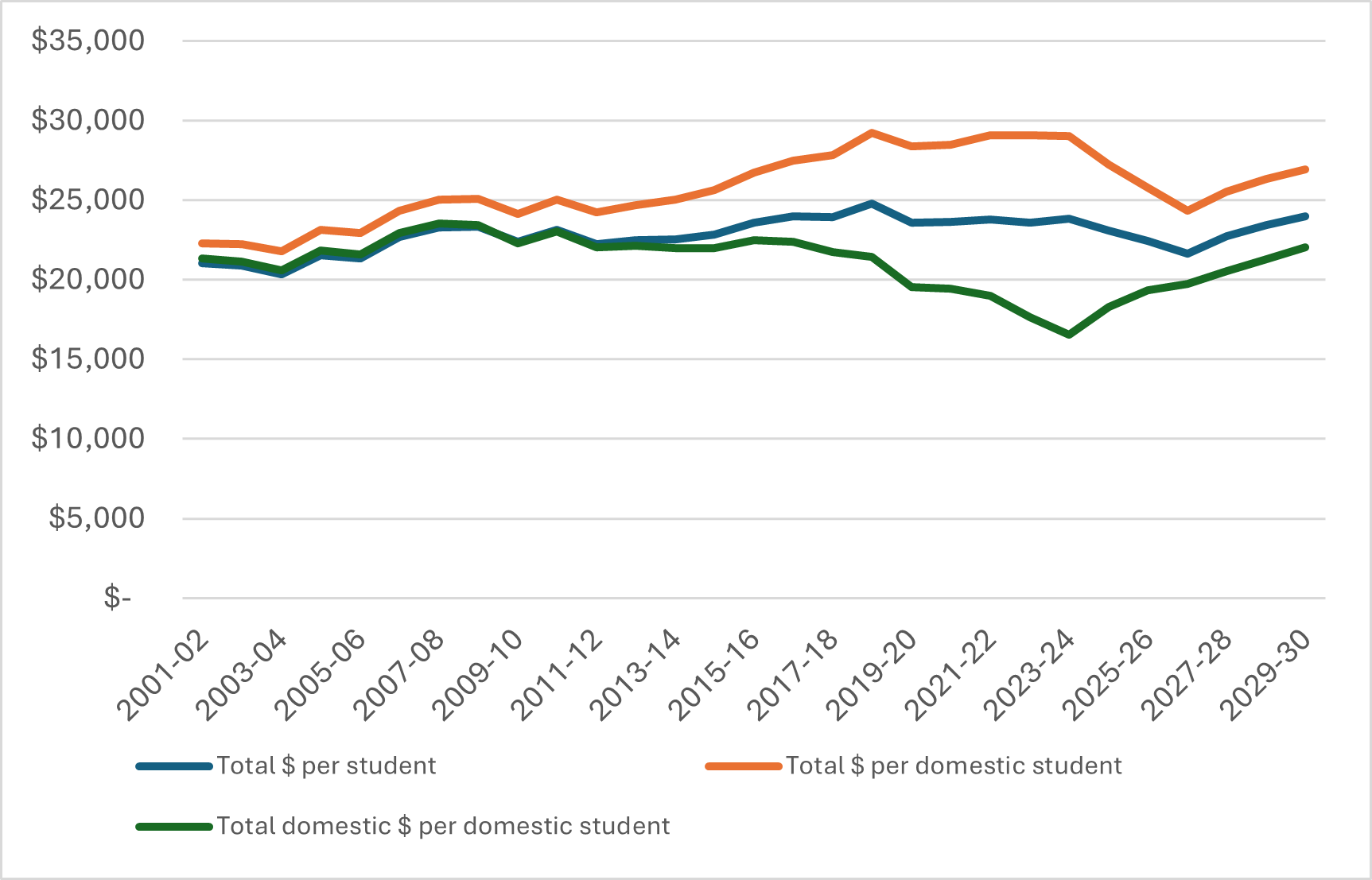
With changes both to income and student numbers, though, are things overall getting better or worse? Well, it depends a bit on what you put in the numerator and the denominator. Are we talking about government expenditure or total income? Over all students, or just domestic ones? Well, it’s complicated and the answer varies a bit by the measure chosen. But as figure 4 shows, no matter which measure you use, this announcement gets us back by 2029-30 to about where we were in 2015-16 or so (same caveat applies, and remember this is both colleges and universities combined that is being measured here).
Figure 4: Funding per FTE student, Various Measures, 2001-20 to 2029-30 (projected), in Millions of $2025
So that’s the spending side of things. Now I want to get to the other side of the story, which is “where is this $5.3 billion coming from”? Some of this is new money, but a substantial percentage of it – at least 52% by my count – is coming out of students via cuts to the Ontario Student Assistance Program (OSAP). It was not framed as such in the announcement, of course, but it’s pretty clear that this is what is happening.
Here’s the math on this: in the final year for which we have data (2023-24), the province distributed $1.3 billion in grants and $260 million in loans. Because student loans cost about 25 cents for every dollar lent due to the in-school interest subsidy plus the cost of defaults, that means about 95-6% of all expenditures stemmed from the number of grants issued. Figure 5 shows Ontario student aid by issuance and by estimated cost for 2023-24.
Figure 5: OSAP Aid Issuance and Estimated Cost by Type of Aid, 2023-24
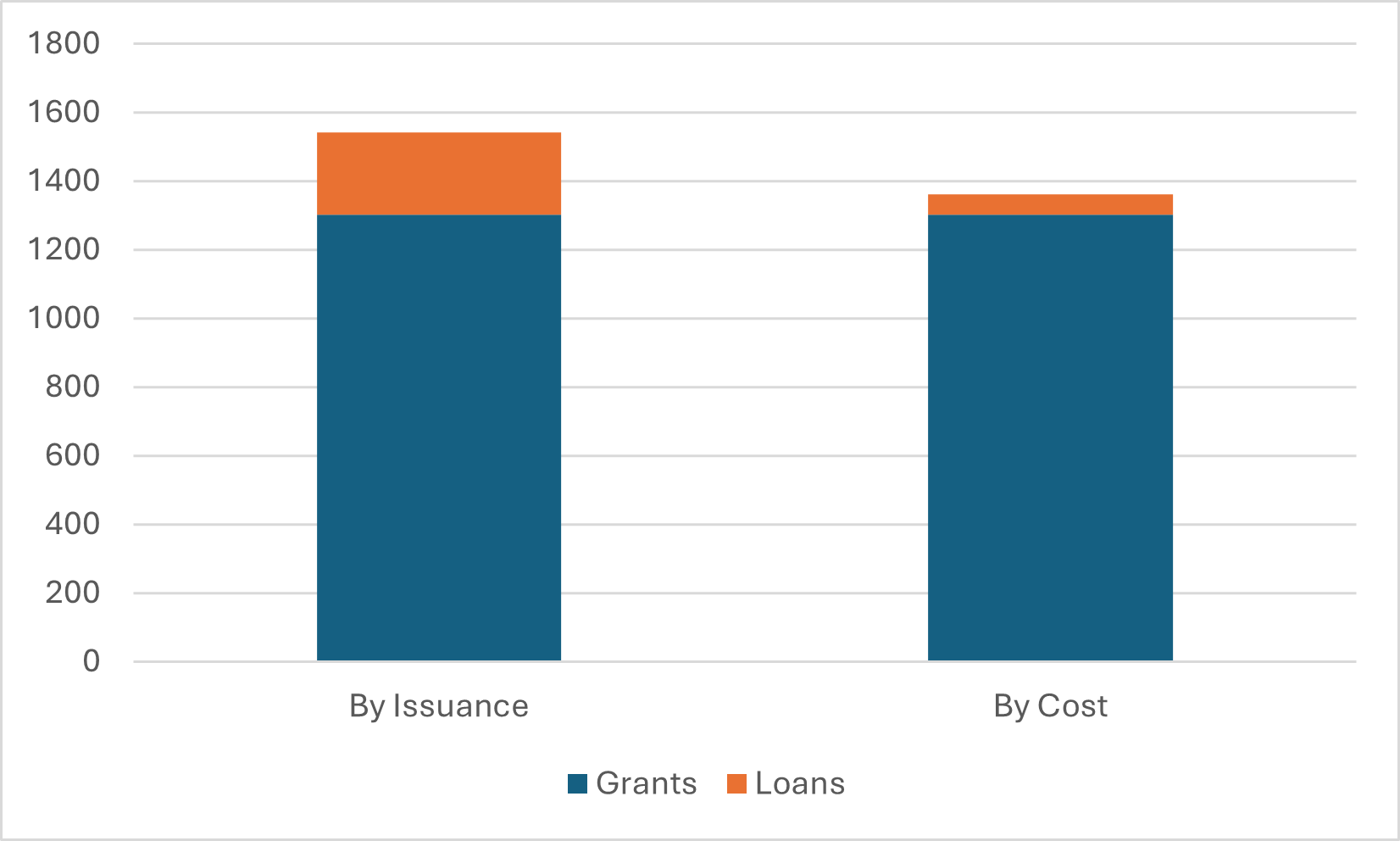
However, as this Toronto Star summary of the government’s announcement shows, the government is moving to go from an 85-15 grant/loan ratio to a 25-75 grant/loan ratio. Students’ total aid packages won’t decrease, but the loan proportion will be much higher and the grant proportion much lower. Assuming total aid stays at the same level as in 2023-24 (it may not), then as of next year, the distribution of aid will look more like it does in figure 6. Even though students’ aid packages won’t change in size, the total cost of providing that aid will drop by about $690 million. Multiply that by four, and what you get is $2.76 billion in government savings. That comes out to 52% of the total new expenditures of $5.3 billion.
Figure 6: OSAP Aid Issuance and Estimated Cost by Type of Aid, 2026-27 Onwards
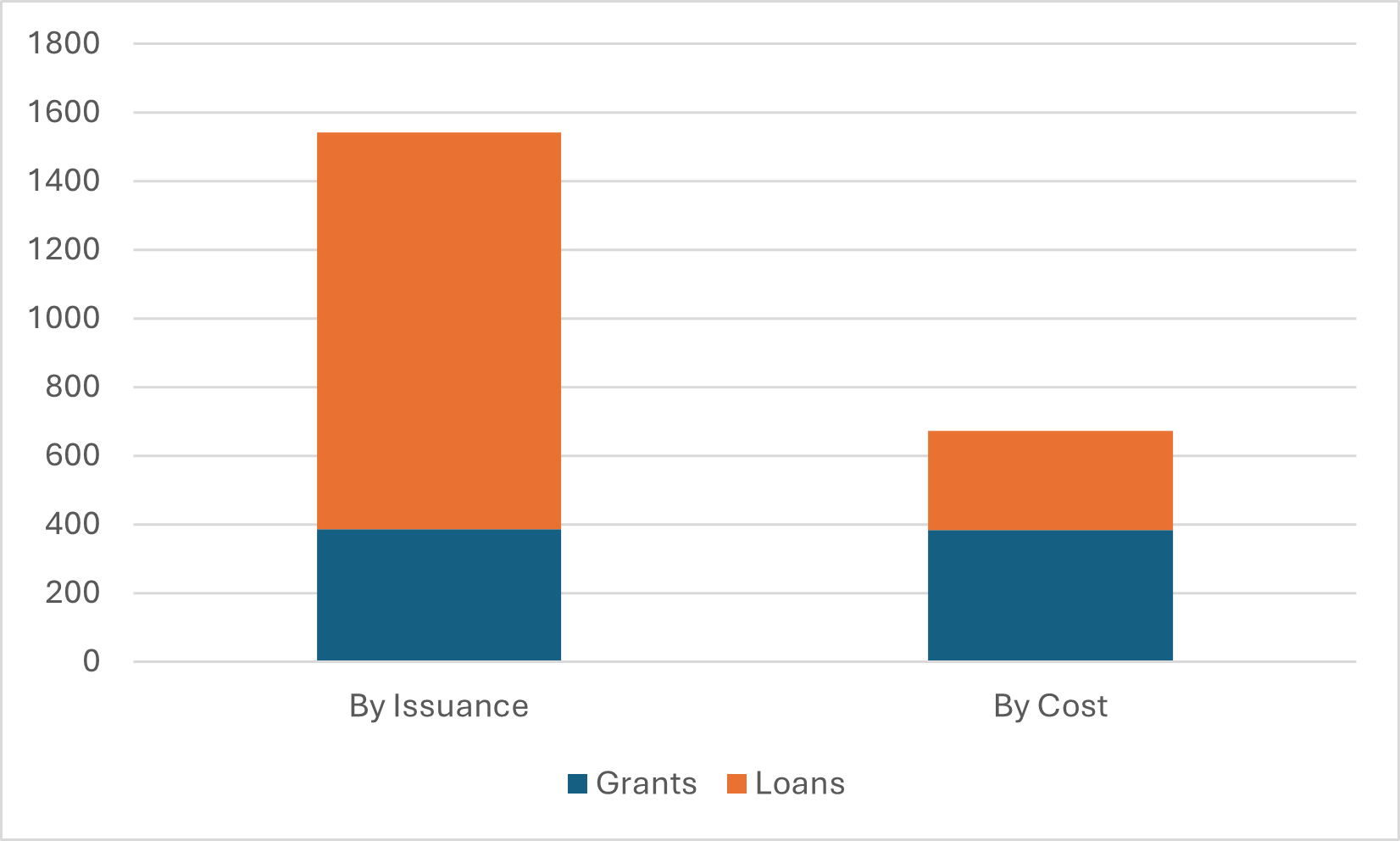
(Actually, it will probably be more than that since the government also announced that it would eliminate grant aid to private career colleges. That will nudge the cost savings upwards, too, closer to $3 billion.)
This is undeniably going to be hard on students. Going from 85-15 to 25-75 will, for students at the maximum aid point, will means switching about $3500 from grants to loans next year. Add to that the federal government’s apparent decision to reduce federal grants from $4200 to $3000 per year, my take is that low-income students in Ontario are going to see their loan balances increase by an extra $4700 in 2026-27. Or, to put it another way: richer students, those who don’t need student aid, are looking at tuition increases on the order of $160 next year. Poorer students, the ones who receive grants, are going to see an increase in net tuition about thirty times larger. This will be, by far, the biggest “net” fee increase ever imposed in Canada, and it will take place almost entirely on the backs of low-income students.
(Was there a less regressive way of doing this? Of course! The government could have held student aid in place and raised tuition fees instead: restoring tuition to 2018 levels would more or less have done the trick. Such a move would have ensured that the new income being given to universities would have been paid by wealthier Ontarians rather than poorer ones. The government knows this. There is frankly no excuse for what it is doing.)
That said, as rough as this deal may seem, it’s worth remembering that provincial loan-grant ratios are even higher than 3:1 in places like BC and Alberta. And now that Ontario tuition is – after years of fee reductions and freezes – middle-of-the pack nationally rather than the country’s highest as it was in 2018, the Ontario student experience is going to be almost indistinguishable from that in the rest of the country. Count on the provincial government pushing this point when students, understandably, complain about the whole thing.
When all is said and done, this announcement basically brings the province back to mid-2010s levels of public spending on universities and colleges in Ontario. It also cuts student assistance spending to mid-2000s levels, while keeping tuition at early-2010s levels. The Wynne government chose to spend money on students not institutions. The early Ford government chose to spend money on neither. And now, the later Ford government is moving the pendulum back more or less to where it was in the McGuinty era. It’s as if the last ten or fifteen years were just one big fever dream.
Briefly then, the institutional funding part of this announcement is very good, but the tuition/student aid part of it is grotesquely regressive.