





Over the last few weeks – while I have been busy obsessing about Year in Review 2025 – a couple of big Statscan releases came out. One was about students in 2023/2024 and one was about academic staff in 2024/25. Time to catch up.
The student data is the slightly more interesting of the two, because it (finally) shows the system essentially at the height of the international student boom in the late fall of 2023 (Statscan student data is based on an October/November snapshot and therefore does not quite capture the full craziness of what went on in Ontario colleges, where most all international students were on an 8-month schedule with starts happening every four months and so therefore did not necessarily show up on Statscan scans).
Unsurprisingly, total enrolments in Canadian postsecondary went up. A lot. 140,000 or so, which in absolute terms is the biggest single-year increase in post-secondary enrolments in Canadian history. But as figure 1 shows, that increase was a) highly concentrated in the college sector and b) largely due to international students.
Figure 1: Increase in Post-Secondary Enrolments by Sector and Source, Canada, 2023-24

Figure 2 breaks down the college increase by field of study. Again, not a huge surprise: the biggest source of increase was business programs (cheap to deliver, required level of English not all that high); if anything, though I am surprised that so many programs saw an increase in enrolments: this result is actually substantially less business-centric than I would have expected.
Figure 2: Increase in College Enrolments by Field of Study, 2023-24

Over to the stuff new material on academic staff. I won’t bore you with the stuff about salaries, but it’s pretty clear from eyeballing the list of institutions and salaries over the past couple of years that at most institutions, average salaries are increasing faster than inflation (which I suspect means that retirements are going down, but it’s hard to tell for sure). I will note, however, that average salaries at the top few institutions in the country are getting stupidly high (see table 1 – keep in mind an average salary in Canada is around $70,000). UBC took over the top spot for average salary for permanent academic staff, at $206,125, largely due to the fact that the provincial government basically insists that all its new money goes to salaries rather than other operations. Hilariously, this data came out on the same day that the provincial government called a provincial review into efficiencies at universities and colleges and completely failed to include provincial funding rules and practices in the Terms of Reference.
Table 1: Canadian Universities with Highest Average Professorial Salaries, 2024/25
| Institution | Average Salary |
| UBC | $ 206,125 |
| Queens | $ 198,975 |
| Toronto | $ 196,500 |
| York | $ 192,800 |
| McMaster | $ 188,675 |
| Waterloo | $ 188,450 |
| TMU | $ 184,875 |
| SFU | $ 182,975 |
| Saskatchewan | $ 180,525 |
| Western | $ 178,525 |
(ahoy stats nerds: yes, I could have used median instead of average, and it would change the order of these ten a bit, but not much. The difference between the two measures is very slight at most institutions.)
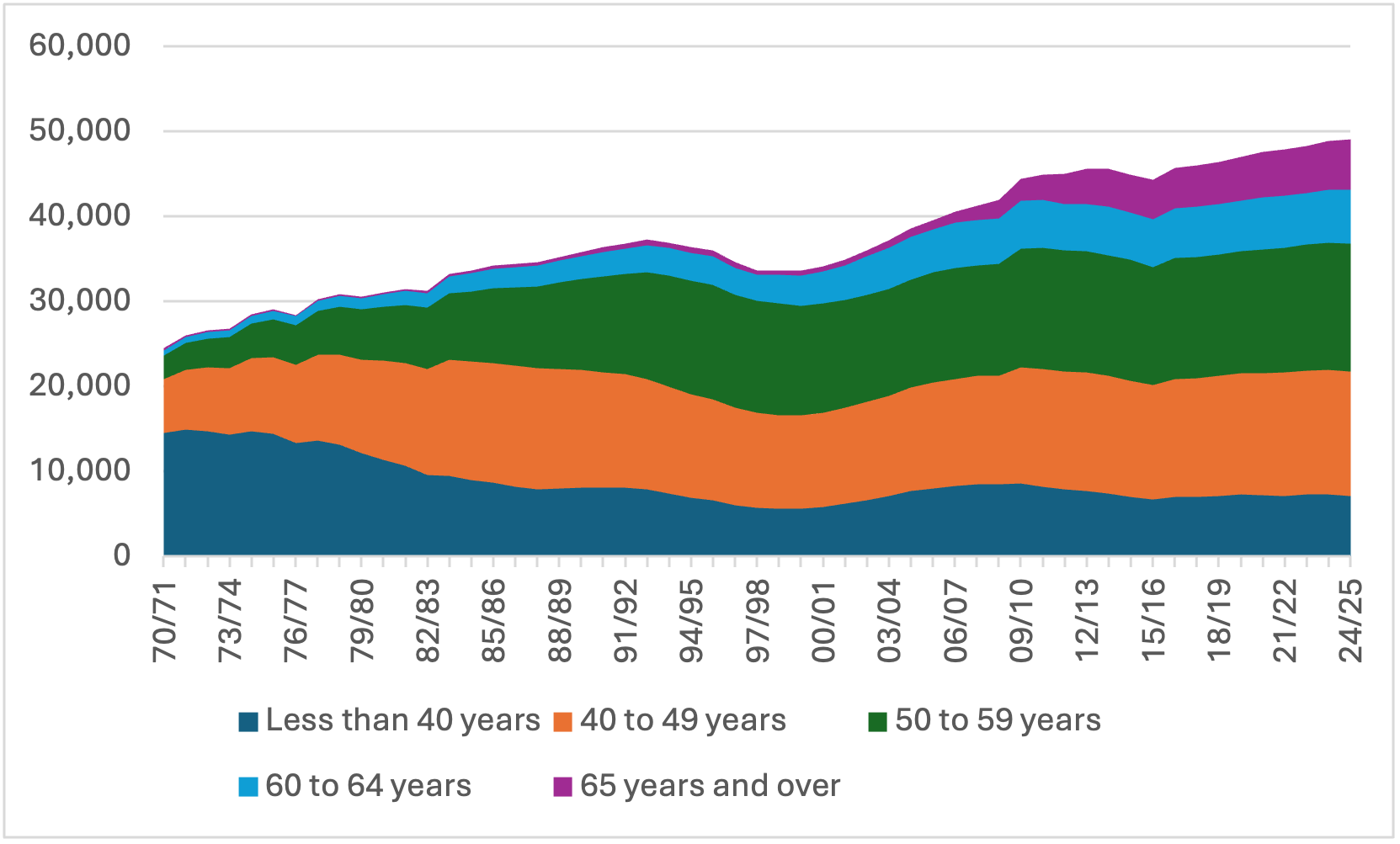
On to other fun stuff: Statscan has released some older data, allowing us to take a look at some longer-term faculty trends among faculty. I particularly like the data in figure 3, which shows the size and age composition of Canadian University faculty for the past 55 years. Amazing as it seems now to contemplate, in 1970, only 15% of the professoriate was over the age of 50 and only 3% were over 60. Today, it is 56% and 25% respectively.
Figure 3: Ranked Academic Staff by Age, Canadian Universities, 1970-71 to 2024-25
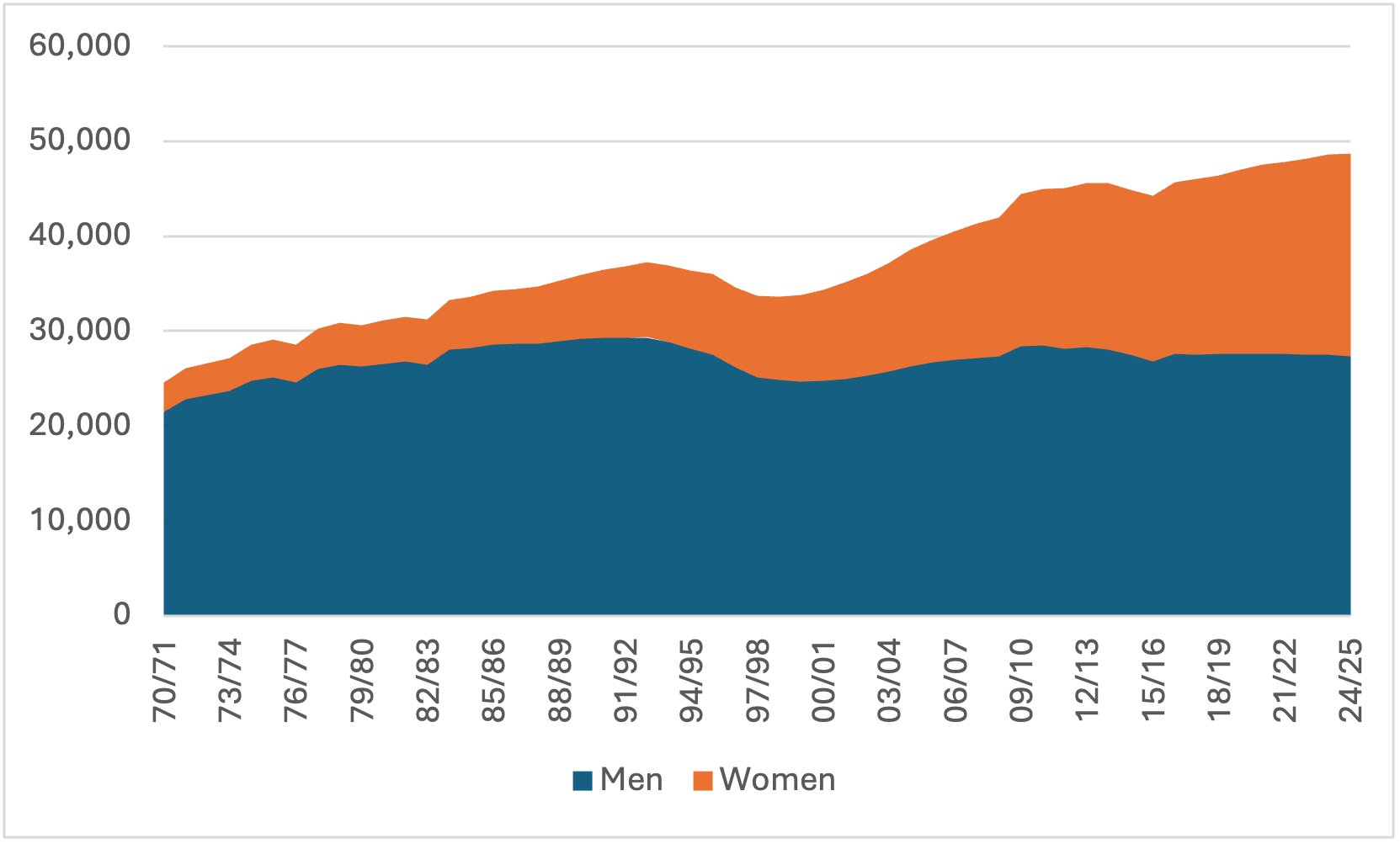
And finally, there is academic staff by gender. What’s striking to me here is that there was basically no change in the proportion of faculty who were female here until about 1987 – which, if memory serves, is right about when the Federal Contractors’ Program kicked in, which required universities (among others) to start producing equity plans. Since then, the percentage of faculty who are women has risen by about two points every three years almost like clockwork. We are now at 44% of academic staff being women, and at current rates of change, we are looking at reaching 50% somewhere in the mid-2030s.
Figure 4: Ranked Academic Staff by Gender, Canadian Universities, 1970-71 to 2024-25
And that’s all for now.



One Response
I wonder how much higher average salaries are a function of universities either having larger classes, or getting precarians (whose low salaries aren’t included in the figure) to teach more.