

Hi everyone,
Tiffany here.
A quick reminder that Focus Friday is happening today (November 7) from 12:30-1:30pm Eastern, and we’re taking on the biggest conversation of the week: the 2025 Federal Budget.
I’ll be joined by three people who know the file inside and out: James Hammond (Director of Public Affairs, U15 Canada), Michael McDonald (Vice President, External and Member Relations, Colleges and Institutes Canada), and Michelle Coates-Mather (Vice President, Public Affairs, Universities Canada).
Together, we’ll look at what this year’s budget means for postsecondary education — from funding and research to workforce development and international enrolment — and where institutions go from here.
If you haven’t registered yet, it’s not too late! You can still join us here.
The format is simple: we’ll start with a few questions to our guests, then open the floor for a real, coffee-chat style discussion. Bring your thoughts, stay curious, and join the conversation.
Looking Back
Two weeks ago, we turned our attention to one of the biggest stories shaping Canadian campuses: the future of international student enrolment.
Joining me were Victor Tomiczek, Director of International Recruitment and Global Partnerships at Cape Breton University, and Eric Simard, Director of Fanshawe International and former Director of International Recruitment and Market Development at Fanshawe College. Together, they offered a grounded look at how institutions are navigating a period of rapid change, from record growth to sharp policy caps and from optimism to uncertainty.
The mood, they said, is mixed. Recruiters are anxious in the short term, watching numbers fall and budgets tighten. But institutional leaders are starting to think longer-term: about sustainability, integrity, and the kind of international education Canada actually wants to build. “We have to be optimistic when we look at longer timelines,” Eric said. “That’s the right approach for where we need to be as a sector.”
Victor reflected on Cape Breton University’s journey: from one of the country’s fastest-growing international enrolments to a planned, intentional slowdown. Growth, he said, brought opportunity but also lessons: “It taught us that recruitment, retention, education, and care are all part of the same student experience.” The university’s international program didn’t just transform the campus; it reshaped the island’s population, economy, and culture. And as numbers now decline, those ripple effects are being felt just as quickly – on public buses, in schools, and in small businesses across the region.
For Ontario’s colleges, Eric described a different challenge: adapting to constant policy shifts while maintaining diversity and fairness. Fanshawe has long capped any single source country at 25% of its international population, an ethical recruitment approach that’s helped it weather this period of instability. “We’ve built our recruitment on balance,” he said, “and that’s what’s keeping us resilient.”
Both guests emphasized that international education isn’t a separate line of business—it’s part of the broader mission of post-secondary institutions to serve and strengthen their communities. Across the country, institutions are rethinking what that means in practice: investing in student supports and wellness, building stronger ties between campuses and local services, and designing programs that align with labour market and community needs.
They also spoke about the opportunity this moment creates – to rebuild international education on more sustainable and ethical foundations. That means diversifying source countries, improving transparency in recruitment, strengthening pre-departure and arrival supports, and focusing on students’ long-term success, not just their arrival.
Looking ahead, both Victor and Eric called for a renewed sense of trust and coordination between institutions, governments, and communities – one that recognizes international students as contributors to Canada’s social and economic future, not just as a temporary population. The next chapter of international education, they suggested, will be defined less by growth and more by balance, integrity, and belonging.
You can catch the conversation here.
Looking Ahead
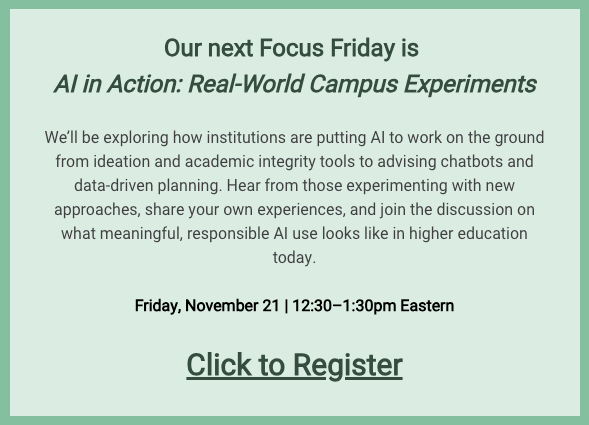
Next up, we’re bringing AI-Cademy to Focus Friday. On November 21, from 12:30–1:30 p.m. Eastern, we’ll be turning our attention to what’s actually happening on campuses when it comes to AI implementation and experimentation.
From pilots in classrooms and student services to institution-wide strategy and policy design, we’ll look at how colleges and universities are moving from conversation to action. It’s a session for anyone curious about what’s working, what’s being tested, and what lessons are emerging from the early adopters. Register below using the big green box.
As always, you can keep sharing ideas for future topics in the registration form or reach out anytime at tmaclennan@higheredstrategy.com.
I’m looking forward to seeing many of you this afternoon—and again in two weeks.
Cheers,
Tiff