

Hi everyone,
Tiffany here.
A quick reminder that Focus Friday is happening today (November 21) from 12:30-1:30pm Eastern, and we’re taking on one of your most requested topics: AI readiness.
I’ll be joined by Stephanie Enders, Chief Delivery Officer at Alberta Machine Intelligence Institute (Amii), who has been leading national conversations on applied AI, workforce development, and what it really takes for institutions and communities to adopt AI responsibly and effectively.
Together, we’ll look at how AI is being implemented on the ground: what’s working, what isn’t, where institutions are getting stuck, and how campuses can prepare their people, systems, and culture for the next wave of change. We’ll also touch on broader societal readiness and what this moment means for learners, educators, and the labour market.
If you haven’t registered yet, it’s not too late. You can still join us here:
https://us02web.zoom.us/meeting/register/GQaJdx1FRYqLFMPTw-syLw
The format of Focus Friday is simple: we’ll start with a few questions to Stephanie, then open the floor to you for a real, coffee-chat style discussion. Bring your questions, your curiosity, and your experiences. We’d love to hear what AI looks like on your campus.
Looking Back
Two weeks ago, we turned our attention to another major story shaping campuses across the country: the federal budget. Joining me were James Hammond (U15), Michael McDonald (Colleges and Institutes Canada), and Michelle Coates Mather (Universities Canada). Three people who work daily at the intersection of federal policy and postsecondary realities. Together, they offered a grounded and unusually candid look at what this budget signals for the sector, what’s missing, and what comes next.
James began with what he saw as the clearest through-line: this budget places research at the centre of Canada’s economic ambitions. “Research really runs through this entire budget,” he said. “The government is clearly signaling that research and innovation are foundational to Canada’s economic future.”
The protection of Tri-Council funding from government-wide cuts was, in his view, a meaningful sign of confidence: one that positions research universities as strategic assets in a moment defined by productivity, sovereignty, and global competition for talent.
Michael approached the budget from a different angle: what happens when the federal focus on building (housing, infrastructure, economic capacity) isn’t matched with investments in the people needed to deliver it. “The budget talks a lot about building — homes, infrastructure, economic capacity,” he noted. “But it doesn’t address how we’re going to build these things or who is going to build them. The workforce gap is real.”
For colleges, this gap is not theoretical. Institutions are confronting deep shortages in the skilled trades and technical fields, alongside cuts to applied research that directly supports local industry. The result, he said, is a widening disconnect between national priorities and the training systems meant to sustain them.
Michelle highlighted another dimension: partnership. She emphasized that many of the budget’s most ambitious goals like AI capacity, quantum, national security, climate, and community infrastructure depend on a coordinated talent strategy.
That means industry, governments, and institutions working together, not in separate silos. And while the budget doesn’t solve every challenge, it does open one significant door: universities and colleges are now eligible for core federal infrastructure funding for the first time in a decade. “Infrastructure funding matters because campus infrastructure is community infrastructure,” Michelle said. “This is an opportunity to shape a program that can deliver real, tangible outcomes for students and communities.”
All three speakers also reflected on the international student levels plan, released in parallel with the budget: a plan that effectively formalizes the steep declines institutions have already experienced this year. The message was consistent: predictability, processing consistency, and clearer coordination between federal and provincial governments will determine how institutions navigate the next three years. On the flip side, the removal of graduate students from the study-permit cap, they agreed, was an important corrective step.
Looking ahead, the panel pointed to several questions that will define the year to come:
- Will Canada’s immigration system be able to support the talent attraction initiatives announced in the budget?
- How will Ottawa structure the new infrastructure program and how accessible will it be to institutions on the ground?
- And perhaps most importantly, the continued question of how will universities and colleges sustain institutional finances in a period of declining international enrolment and flat provincial funding?
Despite the challenges, the conversation ended on a note of cautious ambition. For all three organizations, the budget represents both a recognition of the sector’s importance and a reminder of how much coordination across governments, systems, and communities, will be needed to translate policy commitments into real outcomes. You can catch the full conversation here: https://www.youtube.com/watch?v=k05xfrUB8jU
Looking Ahead
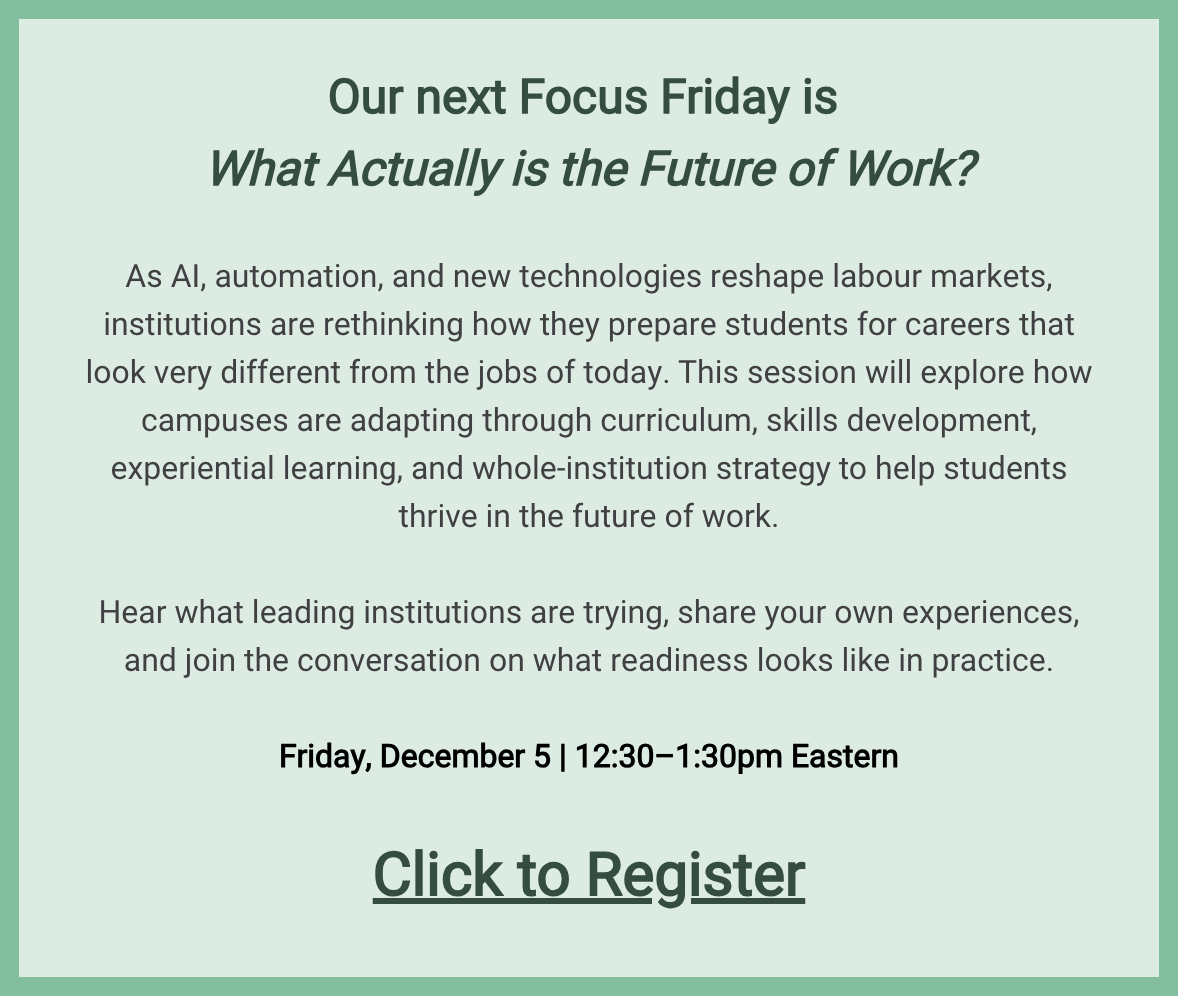
Next up, we’re turning our attention to the future of work. On December 5, from 12:30-1:30 p.m. Eastern, we’ll be looking at what the future of work actually is and how colleges and universities are adapting their programs, teaching, and supports to prepare students for it.
From AI-driven job transformation to shifting employer expectations, we’ll explore how institutions are helping students build the skills, mindsets, and adaptability needed to thrive in a rapidly changing labour market. It’s a session for anyone curious about how campuses are moving from prediction to preparation, and what early efforts on the ground are revealing.
Registration link will be shared below in the big green box.
As always, you can keep sharing ideas for future topics in the registration form or reach out anytime at tmaclennan@higheredstrategy.com.
I’m looking forward to seeing many of you this afternoon, and again in two weeks.
Cheers,
Tiff