


The above is a banger of a title but, unfortunately, I am not weaving those three topics into a single master narrative. Rather, today I’d like to catch everyone up on some Statistics Canada releases from the last couple of weeks which I think deserve wider attention.
Canadian First-Generation Students Fare Pretty Well. First up is a paper by Landry Kuate, Amélie Lafrance-Cooke, and Jenny Watt entitled The educational pathways of first-generation students. “First generation” students – that is, students who are the first in their families to attend post-secondary – attract a lot of policy attention because, in the United States at least, they are a lot less likely to complete university than so-called “continuing generation” students. Of those who attend a four-year institution in the US, they are 17-18 percentage points less likely to complete a degree within either four or six years. This concept of paying attention to “first-generation” students entered into Canada when Mary-Anne Chambers was Minister of Colleges and Universities in Ontario and began requiring institutions to monitor access to studies by, among other things, “first-generation status”.
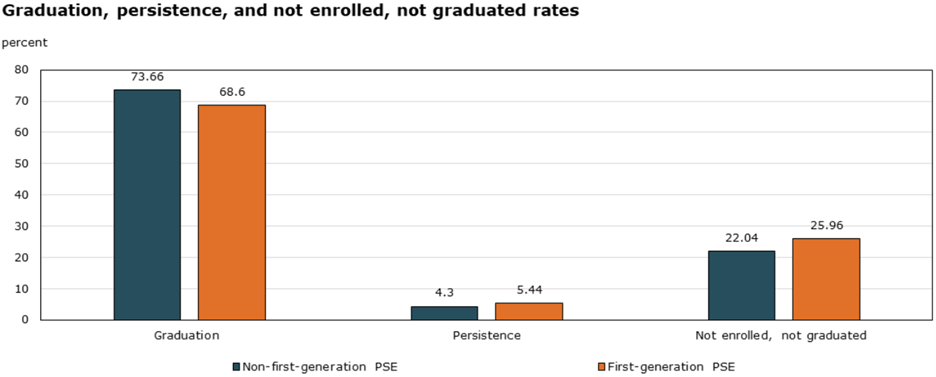
The thing is, though, Canadian “first-generation” students look a lot different than American ones, in terms of ethnicity, income and immigration status. And, as it turns out, they also have different outcomes, at least among those who make it to post-secondary education. As this Statscan paper suggests, the difference in six-year graduation rates are only about five percentage points, and that this gap is about the same both at the college and university level. That is, the gap in Canada is about a third of what it is in the United States.
Figure 1: Outcomes of First-Generation and Non-First-Generation Graduates in Post-Secondary Education, Entering Class of 2010
Graduate Migration
The second Statscan paper of interest is National and provincial retention of graduates from health degree programs in Canada by Youjin Choi and Feng Hou, which uses tax data to track the post-graduation mobility of graduates of health programs. There is a lot of interesting data in here, although, as is frequently the case with Statscan publications, the way that data is portrayed and visualized is sometimes a bit baffling. As a result, I am going to show the data in slightly different ways than the authors do.
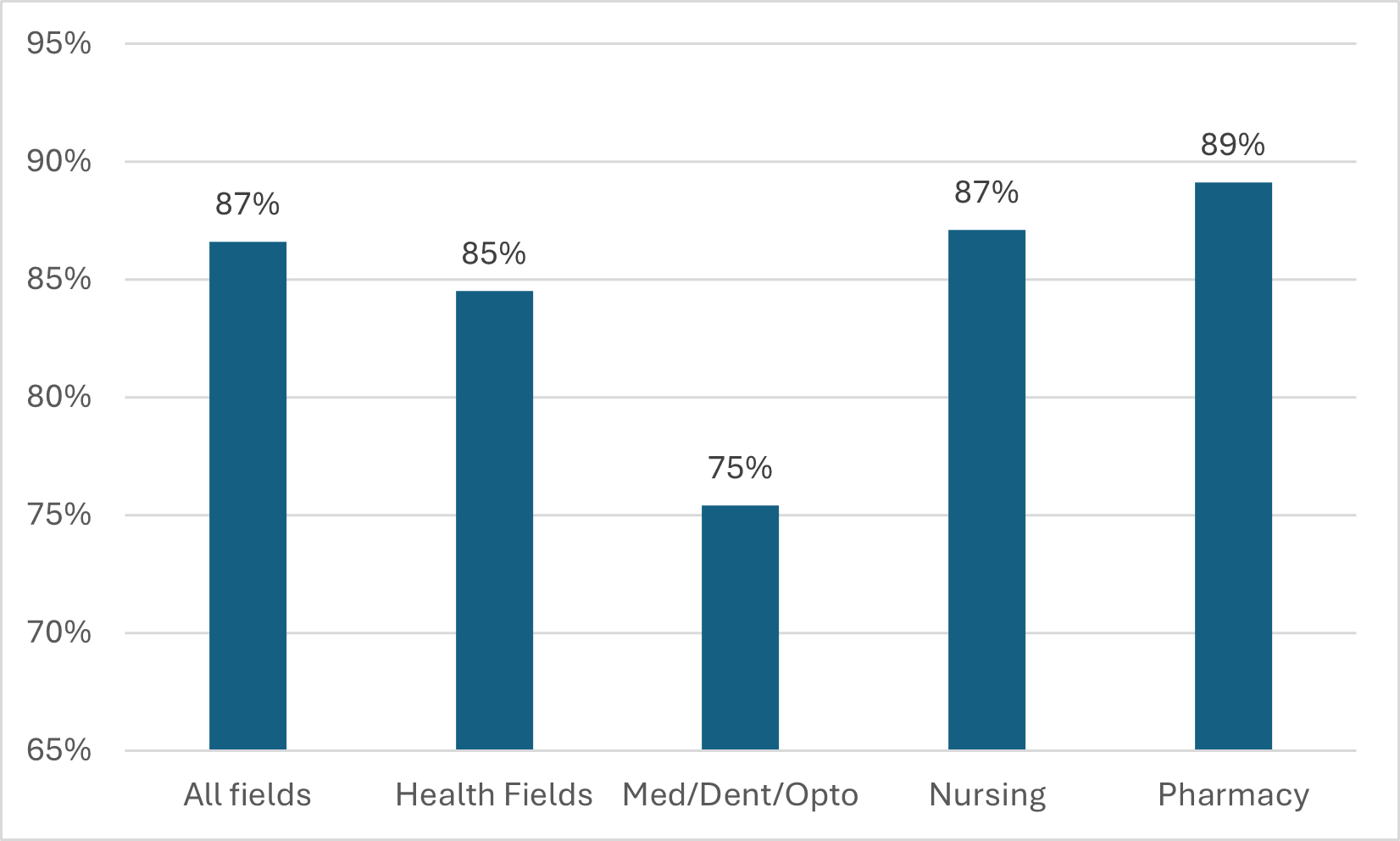
In figure 2, what we see is that roughly 7 out of 8 of all graduates stay in their home province after graduation. The rates for graduate of Nursing and Pharmacy are actually slightly higher than the average, but the rates for graduates in Medicine, Dentistry, and Optometry are significantly lower (have MD, will travel, essentially).
Figure 2: Rate of In-Province Retention of Graduates (Classes of 2015-21), Three Years After Graduation, by Program Type
But of course, the rate out of outbound and inbound mobility varies quite a bit by province, as figure 3 shows. Note that the graph shows New Brunswick and PEI with zero loss of Medicine/Dentistry/Optometry graduates because at the time neither had their own med school. Also, the keen-eyed will note that there seem to be a lot more losses than gains in this graph, and that’s true because some graduates leave the country (Canada of course attracts lots of foreign graduates in these fields, but these are not included in this report’s data).
Figure 3: Net Loss/Gain of Health Degree Graduates (2010 to 2019), Three Years After Graduation, by Program Type
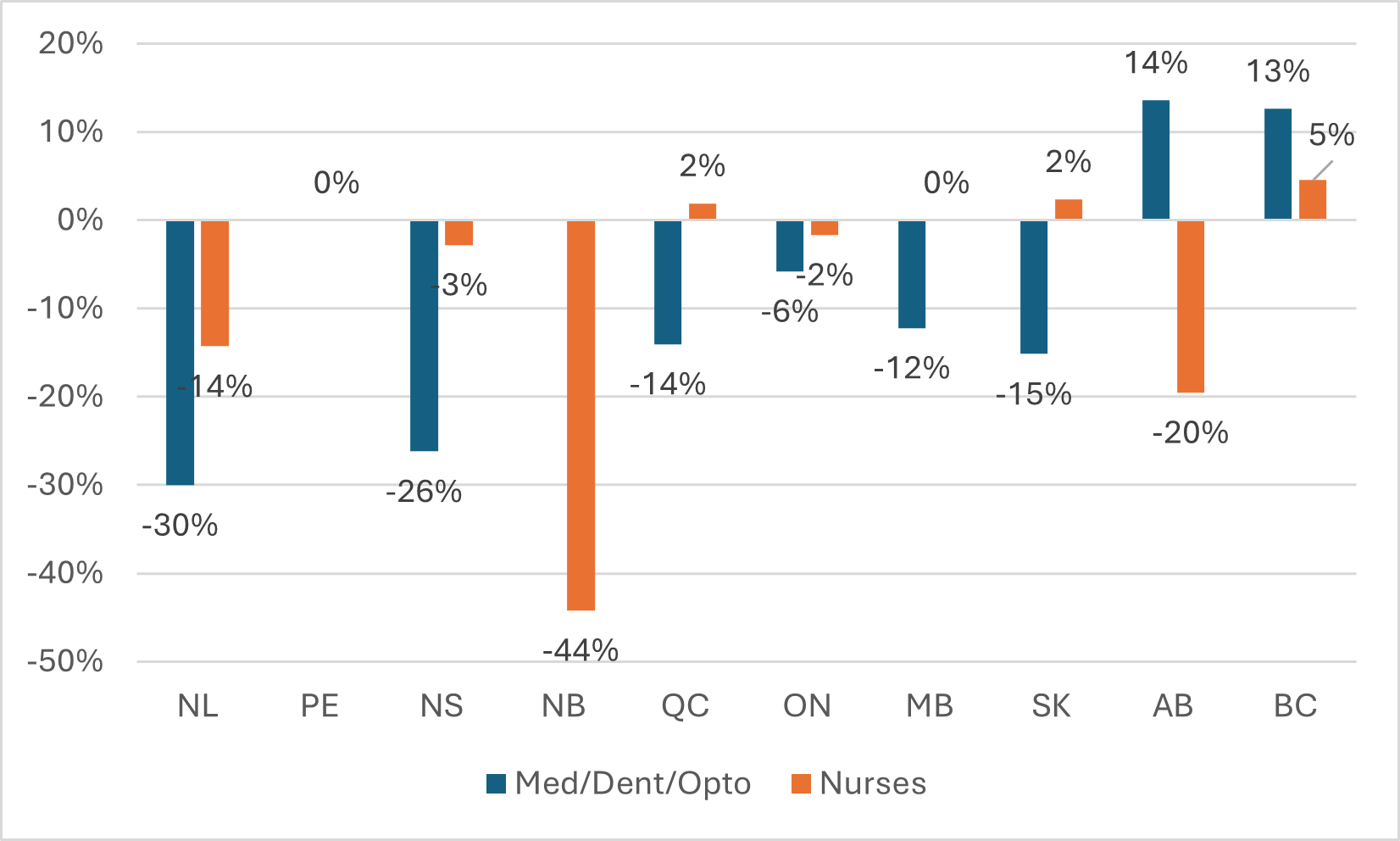
So, the quick takeaways here are i) that British Columbia and Alberta have managed to import medicine/ graduates from elsewhere in the country, ii) there are a couple of provinces where the loss of health graduates is bananas…Newfoundland loses 30% of its Medicine graduates? New Brunswick loses 44% of its Nursing graduates? Alberta – Alberta! – loses 20% of its Nursing grads? All pretty wild. And goes to show how difficult it is to plan medical human resources in this country.
AI and the Labour Market
The last report I want to highlight isCanadian employment trends in the era of generative artificial intelligence: Early evidence by Tahsin Medhi and GOAT Statscan analyst Marc Frenette. There has been a lot of noise over the past few months about how i) Gen AI is growing in importance and ii) unemployment is rising in Canada, with quite a number of people suggesting that the two are causally related. This paper uses something called the “complementarity-adjusted AI occupational exposure (C-AIOE)” index (the terminally-nerdy, can read details on the index here) to look at whether or not job losses since November 2022 (i.e. since Chat GPT 3.0 was released) are disproportionately occurring in industries that are exposed to artificial intelligence. Without getting too far in the weeds, the findings are:
- Since November 2022, employment has grown at a similar pace in both AI-exposed and non-AI exposed occupations and industries.
- Since November 2022, employment growth was weak for younger and less educated workers in both AI-exposed and non-AI exposed occupations.
- Since November 2022, job vacancies have decreased at a similar pace in both AI-exposed and non-AI exposed occupations.
- Since November 2022, the change in occupational mix is not different than it has been in previous waves of technological change.
The first three basically say that fears about mass unemployment due to technological change are largely unfounded so far (in Canada at least, some data form the US is different), but the implications of that fourth one are very important. No one would ever say that the internet hasn’t changed the nature of work. Of course it did! It just didn’t change the occupational mix very much over the short term. Artificial intelligence just looks like it might be the same kind of deal.
And with that: have a good week, everyone.