


I have spent a few days recently reviewing new strategic plans at global top 200 universities (partly because of some talks I am giving in China and India this month, and partly because, as I mentioned yesterday, there’s a section on “what’s new in strategic plans” in our new World of Higher Education – Year in Review, out December 4th!). As a result of all this pondering, I think I have come up with a typology of sorts, which I thought I would share with y’all. Buckle up.
The format of strategic plans can, basically, be divided into three types.
Single-Level Basic. These are the simplest strategies, where the activities are grouped under three or perhaps four themes (though perhaps “buckets” is a better term). The first two are usually “Education” and “Research”, while the third is some variation on what Europeans call the “third mission”, such as “community engagement” (typical among American land-grant universities) or “innovation”, or perhaps “entrepreneurship” or even “impact”. The second and third buckets can be somewhat interchangeable – for instance, innovation and entrepreneurship are sometimes crammed in with research as a second priority, with community relationships or social responsibility then taking up the third bucket. There is also usually a fourth theme, which broadly speaking contains “enablers” of the other three – investing in people, technology, and infrastructure. While this kind of plan is very common among non-elite universities, it is relatively rare among top 200 institutions. That said, among plans released this year, the University of Arizona, Carnegie Mellon University, and Erasmus University Rotterdam are all examples of this kind of plan at the “world-class” university level.
Generally speaking, these kinds of strategic plans are the easiest both to draft and to read. Teaching/Research/Third Mission is the most common way universities describe their activities, and also the way most faculty understand it as well. If one is not looking to change too much, then there is a good case for lumping together a task list of things one wants to do into these three buckets and calling it a strategy. But it’s probably not the way to go if one is actually trying to be transformative.
Single-Level Thematic.These plans are slightly more complicated than the “basic”, both in the sense that the plan’s themes are usually more abstract than just teaching/research/third mission, but also in the sense that they usually contain more than four themes. But, within this grouping, plans can vary both in the number of themes and the degree to which they depart from the simple teaching/research/third mission headings.
At the simpler end of the spectrum, there is Hong Kong Polytechnic, which has the usual four buckets plus one for internationalization, or Hebrew University of Jerusalem, which has Research, Teaching, Internationalization, “Diversity, Gender and Inclusion”, and “Community”. Université Paris Sorbonne’s Strategic Plan (technically a “feuille de route” or roadmap), is a 100+ page prose brick, which commits the institution to moving forward on ten big files simultaneously (e.g. interdisciplinarity, student life, doctoral training, etc.).
At the more complicated end of the spectrum, universities group at least some of their themes under more abstract, less prosaic titles. The University of Manchester based its plan in five themes: i) “Flexible, personalised and digitally enabled learning”, ii) “Research excellence to impact”, iii) “A powerhouse of innovation”, iv) “The university to partner with” (i.e. collaboration), and v) “Digital inside and out”. Aarhus University’s six themes are i) “Research of the highest international caliber”, ii) “Popular degree programs with high academic standards”, iii) “Coherent, Vibrant Campuses”, iv) “Research-based innovation and entrepreneurship”, v) “Digital frontrunner”, and vi) “Spearheading sustainable development.”
One of the more interesting university plans of this year is Wageningen University in the Netherlands, which simply describes itself as having three sets of “ambitions”, one set of which are “Global” (under which teaching and research are subsumed), another “Organizational” and a third “Individual”. The last two are what in other situations might be called “enablers” in the sense that they involve institutional investments in people and structures.
As can be seen from the above, this type of plan covers a lot of different structures. What they mostly have in common though is that the themes, rather than being buckets, actually describe institutional ambitions or, occasionally, values/identity. The actual actions being undertaken might not appear to differ all that much from institutions with basic strategic plans, but by being grouped thematically ambition they are, in theory at least, being managed with a sense of purpose in the direction of the desired change.
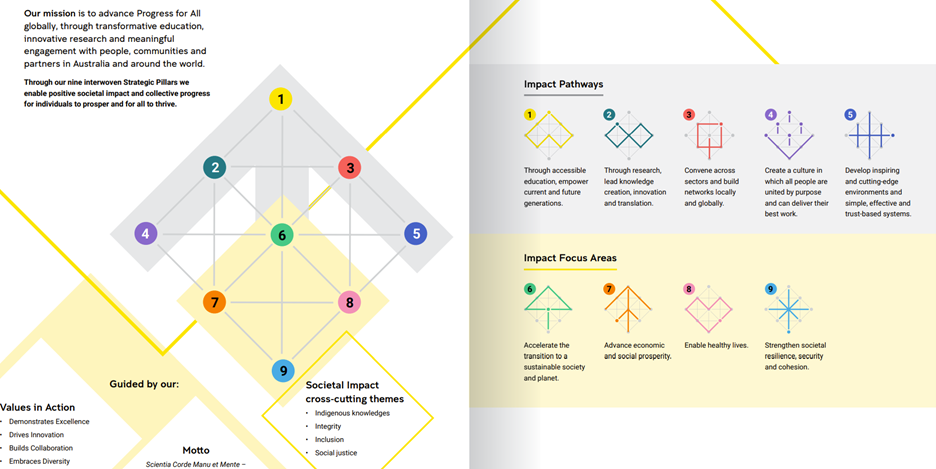
Multi-Level Thematic. A number of institutions have much more complicated strategies, which involve interactions between multiple sets of themes. For instance, the University of California San Diego’s plan has seven goals and fourteen (!) strategies, University of Utah has six “values” (which are not in fact values but objectives) and three “pillars”, the University of Milan has seven objectives and four strategies, and EPFL Lausanne has three “Objectives” and nine “Transversal Areas”. Meanwhile, the University of New South Wales has four “Strategic Principles” but also nine “Strategic Pillars”, five of which are “Impact Pathways” and four of which are “Impact Focus Areas” (yes, really).
It is not immediately obvious that having a multi-level plan implies an institution is pursuing a more sophisticated strategies than an institution with a single-level one. The relationship between the two levels is not always clear, despite the sometimes terrifying attempts of graphic designers to try to make the links clear (See UNSW’s attempt to graphically explain its plan below).
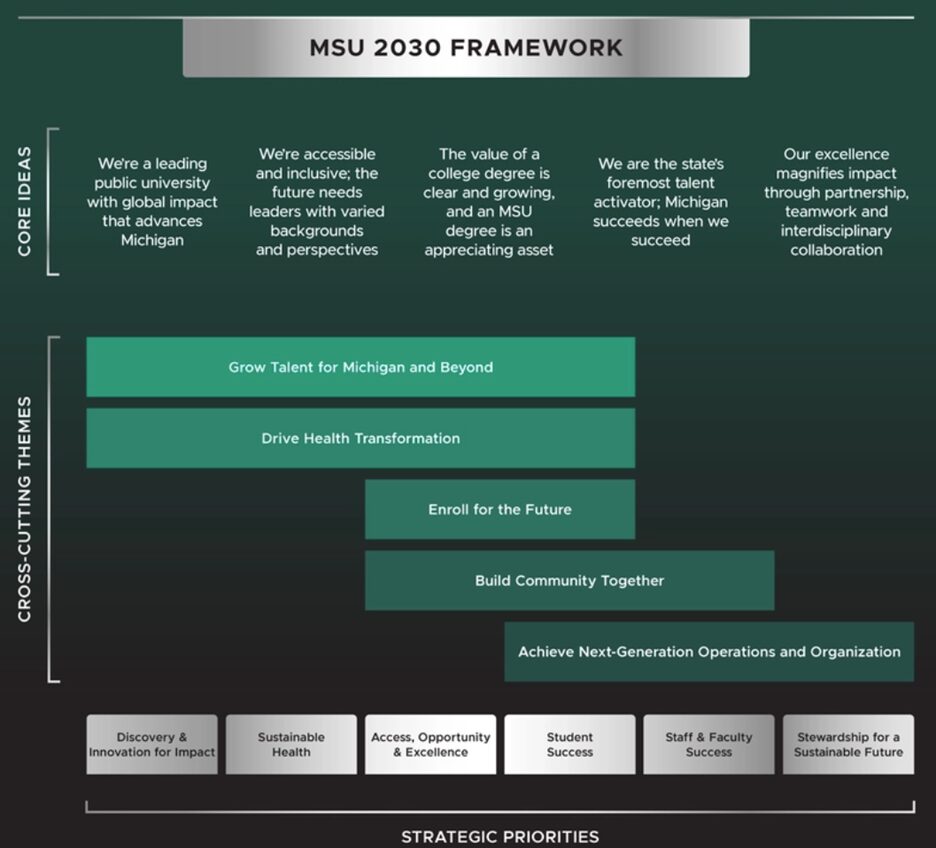
In theory, all the multi-level plans are trying to make some kind of distinction between an institution’s ambitions or what it wishes to achieve, and the activities it is pursuing to further those objectives. In very few cases do the plan’s authors clarify the relationship between objectives and strategies. Michigan State’s Plan is a positive example, where a simple graphic makes the overlap between themes and priorities a bit more comprehensible.
Indeed, the feeling one is often left when reading multi-level plans is that the planners are using the extra layer of themes to make sure that no internal agenda is left unaddressed and/or no internal constituency feels unheard. In this sense, the second level of themes can reinforce the impression that an institution simply wishes to be all things to all people. In that sense, they feel like the opposite of strategy, instead representing an overly complicated task-list without much in the way of a unifying theme (I find the University of Milan plan to be extremely scattered in this sense, and I don’t think it’s just because my Italian isn’t great).
Finally, in some cases, institutions with either Single-Level Thematic or Multi-Level Thematic plans also include a list of research themes where the university will have the most impact. These are not, for the most part, references to specific disciplines, but rather interdisciplinary concepts to which scholars from many disciplinary backgrounds can contribute. At Utrecht University, those themes are “Dynamics of Youth”, “Institutions for Open Societies”, “Life Sciences”, and “Pathways to Sustainability”. At UCSD, the six themes are “advancing fundamental knowledge”, “understanding cultures and addressing disparities”, “shaping and engaging with technology”, “conserving the planet and exploring the universe”, “studying human knowledge and creativity”, and “breakthroughs in human health”. Wageningen also has six themes, albeit all more tightly related to life sciences and the environment, in keeping with that institution’s profile. Other institutions may also have such research themes but not include them in their strategic plans, leaving them to be enunciated in a separate Research Plan.
That’s enough for now: more on December 4. And tune in tomorrow for full coverage of the federal budget.