





Most years, I do a quick overview of the major international rankings and how Canadian institutions have fared in them. Today is the day I do that for the 2026 rankings from the Times Higher and QS, as well as the 2025 Shanghai Ranking (Shanghai is dated the year they come out, Times Higher and QS are numbered like automobiles, one year ahead of the release date). In a bit of a departure from past practice, I am going to show not just how results have changed over the past year, but the past decade as well.
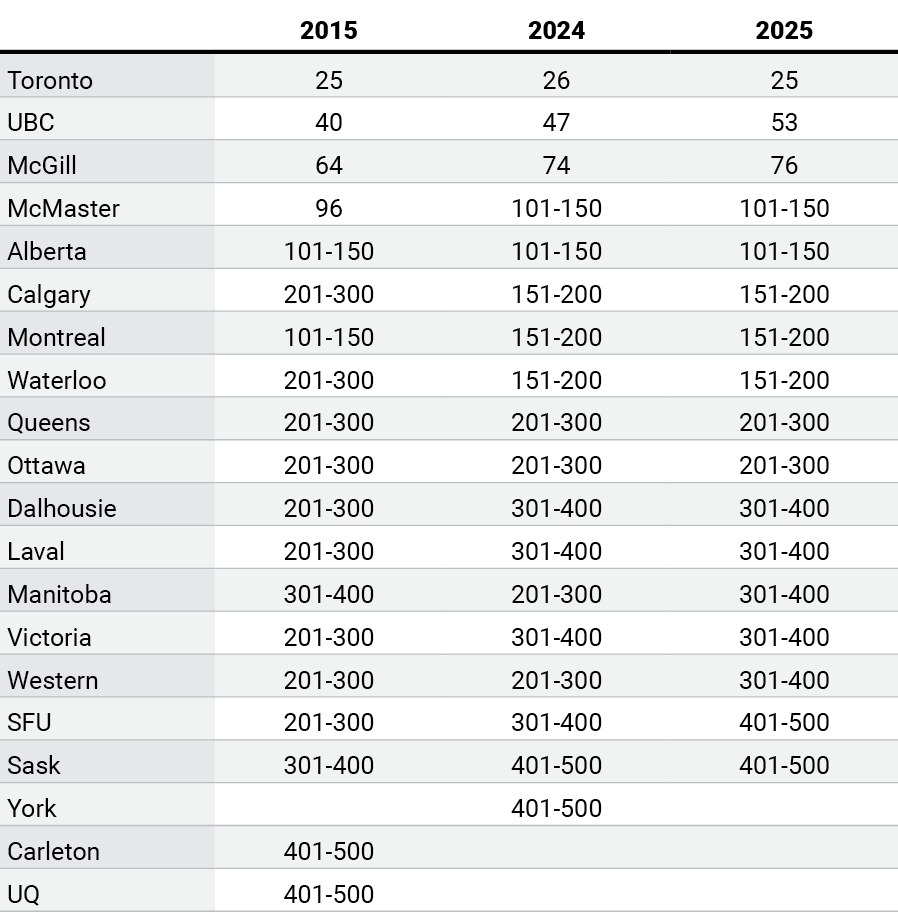
Let’s start with the Shanghai Ranking, which are the most stable of the bunch by some distance. Compared to last year, not much has changed. We still have 3 universities in the top 100 (with Toronto leading by a mile), five in the top 150, and eight in the top 200. Not so shabby, though we have one institution fewer (17) in the top 500 than we did a year ago. Even over ten years, we don’t see a lot of change. McMaster used to be in the top 100 and has now slipped out of it, but Calgary and Waterloo have clawed their way into the top 200. The bigger issue is at the bottom of the list: we used to have 19 in the top 500 and 15 in the top 300 whereas now the figures are 17 and 10, respectively.
Figure 1: Canadian universities in the top 500 globally, per Academic Ranking of World Universities (Shanghai Ranking), 2015, 2024 and 2025
(I know what you’re thinking: the strong institutions are staying strong and the somewhat less strong are getting weaker. But that’s not quite what’s happening. I’ll explain at the end.)
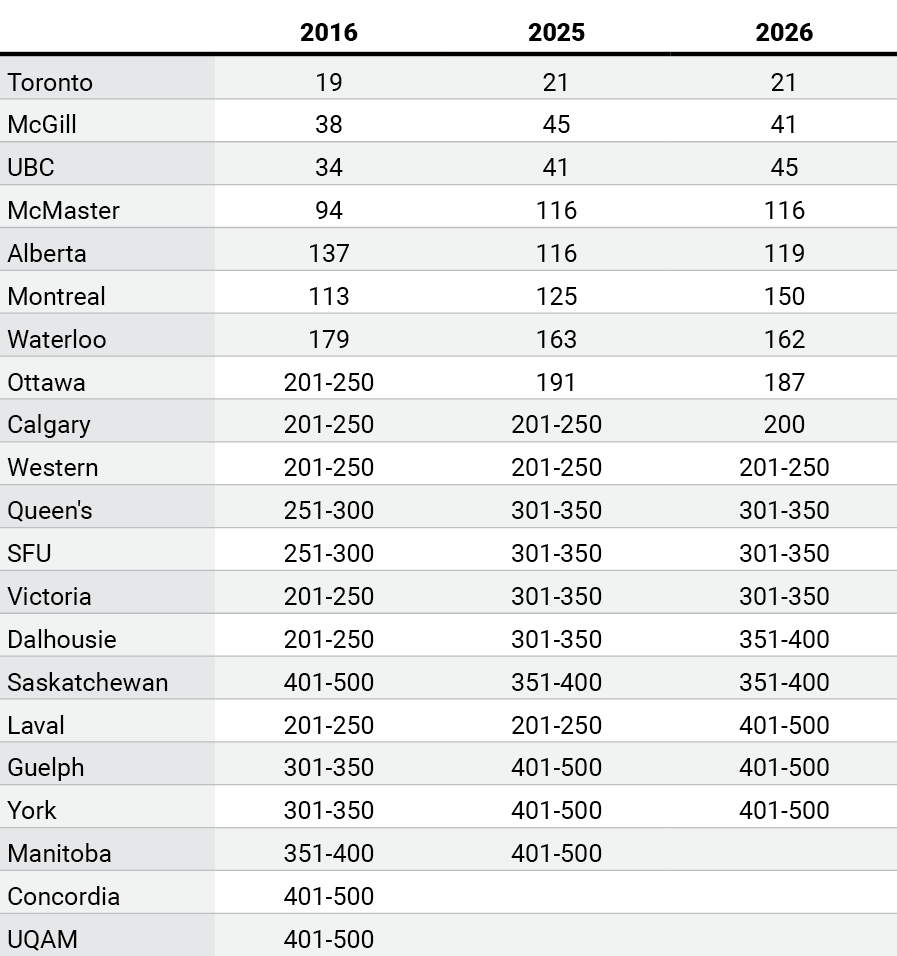
Now let’s shift over to the Times Higher Education World University Rankings. The story here is pretty much the same with respect to where the universities are placed. The top eight or so are basically the same with only minor changes in ordinal placement. As with the Shanghai Rankings, we have one fewer institution in the top 500 than last year (though in this case it’s Manitoba rather than York getting the boot). And over the longer term, we see the same pattern of both more universities in the top 200 but fewer institutions in the top 500. The one result to really note here is Laval, which fell somewhere on the order of 200 places. That’s not unprecedented globally, but it’s very, very rare.
Figure 2: Canadian universities in the top 500 globally, per THE World University Rankings, 2016, 2025 and 2026
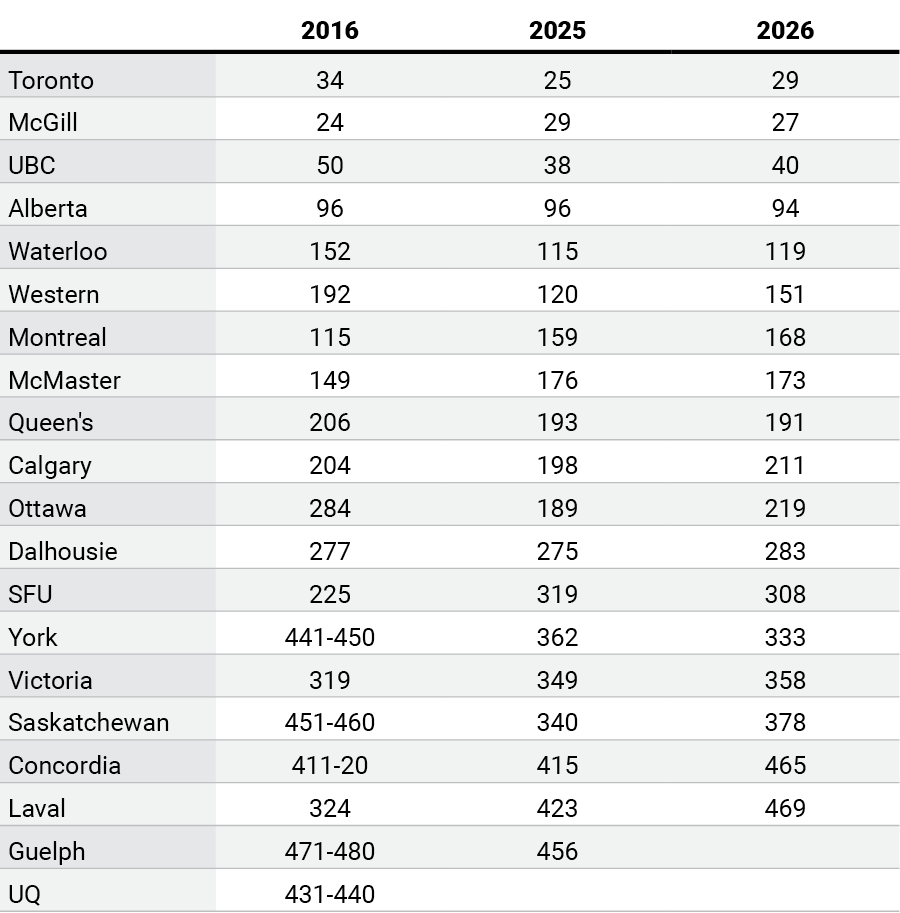
And finally, let’s look at the QS rankings, the most volatile of the three (in part because it eschews ranking bands in favour of the spurious precision of individual ordinal ranks to a far greater degree than the others. QS ranks Canadian institutions somewhat more generously than the other two, and places some institutions like McGill and York much higher than the other two rankings while other institutions such as Laval and Manitoba come off much worse (though in the latter case, at least, it is because Manitoba chooses not to submit data to QS, which means missing data and a ranking of 100-200 places lower than it probably should be). But again, broadly, the picture over a decade looks pretty similar: stability for the top three, more institutions in the top 200 and fewer institutions in the top 500.
Figure 3: Canadian universities in the top 500 globally, per QS World University Rankings, 2016, 2025 and 2026
Now to round this off, I will look at the ten-year trends for all of the 18 universities which made the top 500 in at least two of the big three rankings. In figure 4, a green box indicates that the institution has made a significant jump up the rankings over the past decade, a yellow box means their rankings have remained roughly similar and a red box means the ranking has fallen significantly. The one Canadian institution which is unequivocally rising over the long-term is Waterloo, though Ottawa and to a lesser extent Saskatchewan are also rising more than they are falling. Toronto has stayed roughly steady over the past decade, which is still incredibly impressive considering how high up the rankings it sits.
Figure 4: Change in rankings, Canadian universities, 2015-2025
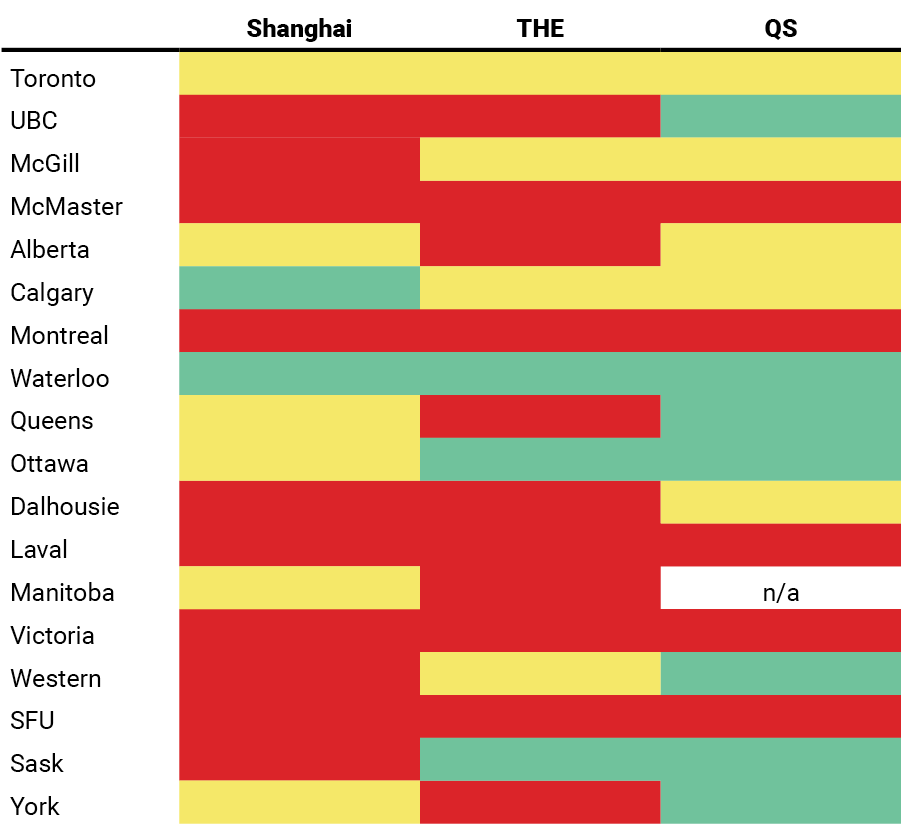
But for the other Canadian institutions, it’s not a pretty picture. Four institutions – Laval, Montreal, SFU, and Victoria – have seen their rankings fall in all three sets of rankings over the past decade (interestingly, Quebec and BC were the two provinces where public funding increased the most from the mid-10s to the mid-20s, which suggests that base funding might not be quite as big an independent variable in these exercises as one might think). Manitoba, Dalhousie and Alberta all have somewhat disappointing showings. Elsewhere, the picture is less clear and more uneven.
Now to explain all of what’s going on here I probably need to show you part 2 of this series, which will focus on changes in rankings globally. But the main thing is to remember that rankings are a zero-sum game. An institution can do better from one year to the next and still fall in the rankings because someone else is improving faster. And over the last decade? A *lot* of institutions have been doing better, in particular Chinese ones. Over the most recent four-year period for which we have data, 8 of the top 10 institutions in the world for scientific publications and 28 of the top 50 are Chinese. Ten years ago, it was just 2 of the top 10 and 5 of the top 50.
So, the best description of what is happening in Canada is as follows. At the very top of the scale, Toronto is holding its ground against some incredible competition. Waterloo, Calgary, and Ottawa are all to some degree making progress against that same competition, while the other institutions in the top 8 are losing ground but only gradually. The institutions which are having trouble against (mainly Asian) competition are the ones further down the list: it’s not so much that they are getting wors, but that they seem to be having greater difficulty keeping up with stiffer international competition.
More tomorrow.



5 Responses
Petite coquille: La figure 3 est le QS rankings.
Merci !
Apparently, the images of rankings are presented in the incorrect order. Univ. of Toronto is #29 in the QS rankings, #21 in the THE rankings, and #25 in the ARWU rankings in the most recent year.
– suspicious prestige-obsessed Anon
Some of theses rankings are incorrect and should corrected. For example Toronto is 25 in the Latest Shanghai and uOttawa is 187 in THE 2026.
The ARWU rankings I see on their own website seem to agree with your Fig 3, which you claim is QS. I think you have the tables scrambled (indeed, latest ARWU is called 2025, not 2026). Fig 3 is clearly ARWU, Fig 2 looks like QS (you call it THE), because in Fig 4 you claim that Manitoba is “n/a” for QS, and that matches your Fig 2.
You got the dates wrong for Figure 3 – McGill was first in the QS ranking for the year 2026